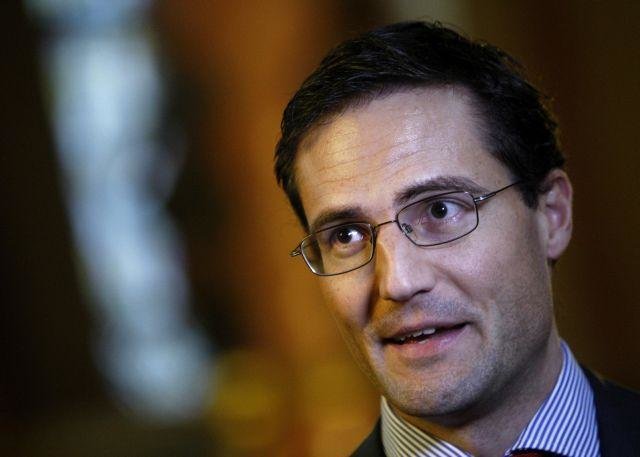
目前犹太国家是唯一对对叙利亚发动战争感兴趣的实体乔比克议会小组副组长、匈牙利议会外交委员会副主席兼各国议会联盟(议会联盟)匈牙利国家小组成员马尔顿·京杰西说。
Q:看来美国几乎肯定会对叙利亚发动军事攻击,军事打击可能带来什么后果,它将如何重新安排中东的力量平衡?
A: The war propaganda conducted by the West, and especially the USA, which always precedes a military strike, does not give too much hope for peace, indeed. In spite of the loud sabre-rattling however, we saw a somewhat unexpected event which gives us a glimmer of hope: several of the most loyal allies of the United States withdrew their support for Washington this time. Great Britain and Poland who had been the first to join the Iraqi and Afghan wars which were preceded by a similar kind of sickening propaganda and smear campaign as the current one, said a definite “no” this time. Considering the firm stance of Russia and China, the two large UN Security Council members, and the palpably anti-war sentiment of the majority of people in all Western countries including the United States, we should not give up the hope that the US president will eventually come to his senses. I might be too optimistic, but I think the fact that Obama was considering to put the issue up for vote in Congress on September 9, is a positive sign. The reason why it matters so much is that the US President has the mandate to decide in the question of war and peace without the approval of the legislation. I hope that Obama, whose presidential campaign focussed on finishing the failed and irresponsible wars launched by the Republicans, is transferring the responsibility to Congress in order to use them as an escape route from the grasp of the Zionist pro-Israel lobby that puts pressure on all US presidents and governs US foreign policy from the background. Currently the Jewish state is the only entity interested in a war launched against Syria. Similarly, the provocation of the previous wars was serving Zionist interests as well. Now when lobbyists are working hard day and night to sway Congress representatives, the question is whether or not common sense and the interest of the American people will overcome the Zionist interests. However, everybody feels that a war launched without a UN Security Council mandate, in other words, ignoring international law, would create a dangerous precedent and could lead to the destabilization of Syria as well as the entire Middle East. That would amount to a premonition of world war-like conflict.
问:如果可能发生军事干预,我们可以期待莫斯科、伊朗、以色列或土耳其做出什么样的反应?
A: At present, Moscow is the only player conducting a responsible and sober foreign policy in the Syrian conflict by promoting a peaceful solution in compliance with international law. On the other hand, they also expressed very clearly what they would do and where they would stand in case of an armed conflict. So the current situation is that the US would consider having to face Russia if an armed conflict broke out. As far is Iran is concerned, the reserved reaction of newly-elected President Rohani is somewhat surprising, but it is beyond doubt that Iran, aspiring to the role of a regional leading power, is fundamentally interested in and willing to make sacrifices for the survival of the Alawite-Shia Assad regime which had been a stable rock in the Sunni sea for half a century. There is no question that Israel, which governs US foreign policy from the background, would also mobilize to side with the US. It is no surprise that the Jewish state is fundamentally interested in a conflict because, ever since its establishment, it has always provoked wars against its neighbours to stabilize its own position in the region. In order to reinstate Zionist colonizing policy, the developments of the Arab Spring render military intervention necessary again, thus destabilizing Israel’s strong and stable neighbours. The real enigma is the role of Turkey. Logically, the Islamist Erdoğan government, relying on its unparalleled economic success, is aspiring to the regional leader’s role in a period when the status quo (the existing state of affairs) has somewhat been upset by the Arab Spring, and enters the decades-old Sunni-Shia duel fought by Saudi Arabia and Iran as the third contestant in order to become the dominant power in the region whose participation is essential for the resolution of the Syrian issue. Turkey is obviously not interested in the survival of the Assad regime, which enjoys the support of Shia Iran as well as Russia, Turkey’s other great historical rival. In my opinion, this aspect is dwarfed by the danger that Assad’s removal may very well destabilize Syria, which would open the way for Saudi Arabia, Qatar, and the Salafi and Wahhabi, the Islamist extremist movements that openly cooperate with Al-Qaeda and other terrorist organisations and enjoy the highly controversial support of the West as well. If you have to choose between a stable semi-dictatorship or an unstable terrorist state, no question that the former serves the interests of all closer and farther countries.
问:您如何解释为什么美国的战略没有在伊拉克、阿富汗、巴基斯坦和利比亚取得预期成果?
A:事实上一点也不奇怪,衰落的帝国都走着同样的路线,美国没有什么不同:只有通过发动一场又一场的战争获取越来越多的资源,才能掩盖和资助自己巨大的内部经济和社会紧张局势,与苏联帝国类似,美国试图在全世界扩张,依靠其充满争议的虚假意识形态,美国区别于前辈并允许其扩张的是它对外强制力量的热情弥赛亚主义,它以极端的无知和原始主义来看待它,美国从中东战争的角度考虑了三个方面:以色列的安全,美国的经济和地缘战略利益,从“客户”的角度来看,这些战役在短期内都取得了成功,问题是这些战争对该地区的稳定和繁荣产生了什么长期影响。

Q:乔比克唿吁召见匈牙利议会外委会,为什么对你很重要?
A:我们假设,如果出现像叙利亚方面目前正在展开的那场极其危险的冲突,那么在匈牙利议会讨论反映并代表匈牙利民族意志的问题也不会有那么糟糕的想法,在我们动议的方式上存在技术障碍,我们需要五分之一的委员会的签名,由于委员会有二十名成员,而且其中只有三名是乔比克代表,我们需要多一票,尽管我们齐心协力,但我们无法收集到第四个,我们既无法动摇任何青民盟的代表,他们自动拒绝任何乔比克倡议,也无法动摇LMP的和平主义代表,他们持反战立场的卡塔林 · 埃特西,更不用说基督教民主党的代表了,他们至少应该对我们西方盟友支持的叛乱分子在叙利亚杀害基督教神父和修女这一事实感到愤慨,可惜现在的情况是这样,我们在匈牙利议会的外国委员会中有如此勇敢和有原则的代表。
Q: 您对匈牙利外交部有什么期望?
A:该部对犹太复国主义-大西洋主义利益的从属程度清楚地表明,匈牙利外交政策领导层是唯一发布其典型的、顺从的新闻稿,呼应了大马士革涉嫌化学罢工后美国外交部的荒谬宣传和指控。这只外交部豹子永远不会改变它的位置,它只能按照其性质所决定的行事:习惯性地向目前最强大力量的立场磕头,这种态度继承了苏联时代。它没有促进匈牙利事业,而是为外国利益服务,没有意识到它不再与令人印象深刻的高贵掠食者相摩擦,而是一种粗支鬣狗。
Q:关于阿萨德政权,反叛分子,或者正如叙利亚政府所说的恐怖分子,我们需要了解什么?我们能否说,这场内战实际上是一场宗教战争,或者更确切地说是一场宗派战争?你认为阿萨德政权属于可预见的未来吗?如果是,接下来会发生什么?到目前为止,向民主过渡的想法在中东还没有真正成功。
A: The Assad system has been functioning for nearly half a century, and we can state as a fact that the Assads were the only ones who could stabilize Syria in terms of economy, society, culture and religion, ever since the country broke free from France. Considering how many ethnic and religious groups live in Syria, this is quite an achievement. In such a heterogeneous country, especially if it lies in the conflict-ridden Middle East, peace and security is a rare treasure. This is what the Syrian people may have realized because the majority of the society still supports Assad, although it is not advertised in the Western media. It was the ethnic and religious diversity that was abused by the West and its regional allies, Israel and Saudi Arabia. Since Assad based his power on the rule of the minority Alawite-Shia clan, the Sunni thought it was time to take over with the support of Western and Gulf countries. In that regard, the conflict has indeed expanded into a Shia-Sunni sectarian war, where the silhouettes of Shia Iran and Sunni Saudi Arabia or Turkey are discernible in the background. In addition to a religious war however, Turkey, Saudi Arabia and Iran are competing for regional leadership in Syria. On top of that, there is a geostrategic war going on as well. On the one side, there is the Zionist-driven US interest which focusses on the security aspects of Israel and the American encirclement of Eurasia, while on the other side there is the great economic power China, which is interested in stability, and Russia, which is trying to stop the US’ encircling operation. The survival of the Assad regime is highly important for Russia. Assad means the guarantee for Russia to maintain its large fleet stationed in Syria, which is the only such fleet in the Mediterranean. On the other hand, Russia considers the Middle East as some sort of buffer zone in the way of the Northern expansion of extremist Islamic movements. Moscow is already struggling with the rapid expansion of the Salafi movements in the Caucasus, and Russia tries to fight this war in theatres that are as far as possible from its borders. I think I can go as far as to say that all sane and peace-loving people, and especially Europe are interested in a stable Syria, which could not be ensured at all if Assad was removed by force and the Jihadists were raised to power. It would entail unpredictable consequences.