Subscribe to our social channels to get the latest news about Hungary!


Stühmer’s Százszorszép (English: Daisy flower) exemplifies in a certain sense when the packaging transcends the product’s internal contents and achieves an everlasting status. The legend of the Százszorszép, created during the Monarchy, lives on to this day: the production of the paper box, once designed by an industrial artist, is now overseen by of Stühmer’s creative manufacturing partner, Sz. Variáns, who handles the packaging design and execution. The company produces tens of thousands of the classic and iconic 250-gram box annually.
The retro renaissance continues to pervade our everyday lives – beyond the various fashion trends, objects and memories, let us take a closer look a cult item that carried a great meaning for generations, the candy box of Százszorszép. Many of us may might have a childhood memory from the 70s and 80s of our grandmother’s shelf displaying a distinctive, octagonal, flower-patterned box, which quite often contained sewing kits or other personal valuables.
To this day you can bid on these objects at online marketplaces, and it even inspired a long-established porcelain manufacturing company to create a bonbonier with the identical shape and pattern, featuring the Stühmer logo. “The success and uniqueness of Százszorszép can be attributed to the fact that it has represented the same quality for more than a century. The box also plays a big role in this, which actually can be thought of as a work of art: its assembly cannot be mechanized. We cover the material of printed gray plates with art printing paper, all by hand, which highlights the added value” says János Szakál, the managing owner of Sz. Variáns.
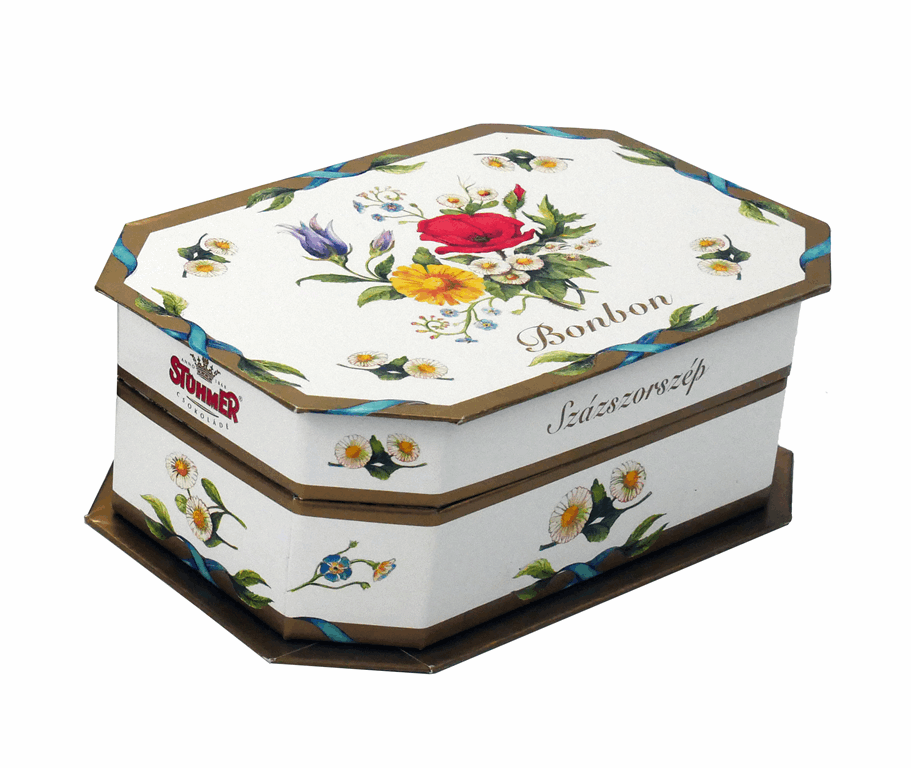
The history and evolution of the Daisy box spans across centuries and generations. It acted as a fixture in the repertoire of the former bourgeois culture, since in this period the aesthetic packaging functioned as a decor for everyday life. Due to its beautiful cover it was used in the fields of medical and cosmetic appliances, however it gained the greatest cult following from the confectionery industry. By the end of the 19th century, Stühmer had made Hungary a chocolate superpower. Franz Joseph honored the activities of the chocolatier Frigyes Stühmer with the Hungarian Cross of Merit, and the chocolate specialties, whose appearance – especially later, from the 1920s – served as a symbol of high quality, was also admired by the emperor’s wife, Sissi.
This is when important craftsmen such as Ernő Jeges, Ili Szirmai, Gitta Mallász and Kató Lukáts emerged as designers of Stühmer packaging, and the Stühmer Chocolate Factory established itself at the forefront of Hungarian packaging. The exquisite national craftsmanship of Százszorszép – along its delightful contents – remained available on the market during the Kádár era, even after socialization. Due to technological constraints, the shape of the exterior box design had to remain intact – it was made on the same production line later on, however the physical appearance resembling the daisy pattern took a detour for a few decades. The flower symbolized the tears of the Virgin Mary, therefore the logo of the “treat basket” designed by Pál Gábor in 1952 was placed on the box in the end.
Millions of Stühmer of the legendary candy box packages produced by Sz. Variáns, the eight-time Hungaropack award-winning business are sold in the domestic and international markets. The fruitful collaboration between the two family businesses, Stühmer and Sz. Variáns, started in 2007. “There cooperation between us is seamless. From day one, we carried out product development together, in fact the process of developing a new product line starts with a recommendation by Sz. Variáns”, says Péter Csóll, the visionary and current owner of Stühmer.
As in the case of other products of the traditional brand, an important aspect in the renewal of the Százszorszép candy packaging design was that the core values were prohibited to be damaged. In this case, the change meant the restoration of an old value: on the occasion of the brand’s 150th anniversary, the daisy motif – after several decades passed by – was returned to the box adhering to the designs of Zoltán Peternák, Stühmer’s graphic designer.
The Százszorszép candy is still one of the most popular Stühmer products. In addition to the classic version, it can be found with three different packaging designs on the shelves of gift shops, specialty shops, and airport duty-free shops. It appeares that the nostalgic magic represented by the exterior and interior content of the Százszorszép is enticing to domestic customers and tourists alike.
The managing owner Sz. Variáns, who is carries out the production of the Százszorszép box, also has decades-old memories of Stühmer’s iconic packaging. “One of the distinctive pieces of my childhood is the Százszorszép box. Even though the candy was long gone, no one discarded it, in fact, it was typically used to store small valuables – it was considered as a work of art. Typically, an object that has a soul accompanies us through our past and present. It fills me with great pride that we can be part of this story” says János Szakál.


