Subscribe to our social channels to get the latest news about Hungary!


Today we will travel in time a little bit and will introduce you to 3 of the smartest Hungarian scientists. Our candidates for today’s article are the most well-known Hungarian scientists abroad. It will probably fill all the Hungarian hearts with pride. We chose to highlight three characters today as they seem to be contributing the most to technologies we utilise today and would easily take as granted.
If you are interested and would like to read the previous articles of the ‘myth, literature, history’ series, you can read Part 1 and Part 2 by clicking on the links.
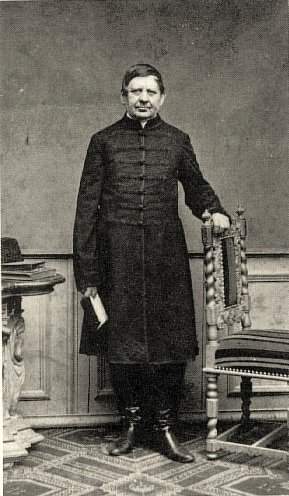
Ányos Jedlik was born in Szímő on the 11th January in 1800, and he died in Győr, 13th December 1895. He was a Hungarian natural scientist, inventor, Benedictine monk and an outstanding instructor. His birth name was Istán Jedlik, Ányos was the name given to him when he entered the Benedictine order.
Many inventions are connected to his name, for example, the creation of the electric motor, the discovery of the self-excitation, writing down the dynamo principle, the manufacturing of the carbonated water and the recognition of voltage multiplication.
When working on the electric motor, Jedlik immediately came up with three different methods to utilise Faraday’s findings:
Jedlik’s the third iteration, the only electromagnetic rotation is only seen six years later the motor of the German Moritz Hermann Jacobi, which he demonstrated at the Academy of Paris. This electric motor built according to Jedlik’s third solutions was able to be used to propel a boat with 12 passengers in 1838 on the Neva river near Saint Petersburg.
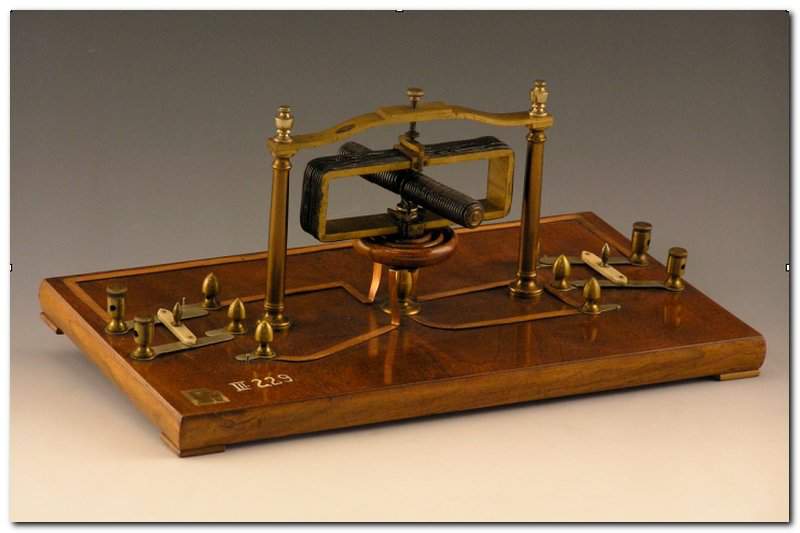
Jedlik said the following about the date of his original discovery of the engine and the recognised version of Moritz’s machine:
“I created the device based on the rotating motion of electromagnets in around 1827-28. At that time, I was unable to find any data concerning experiments of the same device in journals or books. I had the judgement that although I discovered the mentioned device for myself, others have probably discovered it before me. In my career as an instructor, I had been familiar with cases that when I discovered something, it was already written down by someone else before, but I was unable to find that publication due to lack of time. I had the same judgement concerning my iteration of the electric motor (…). It would be troublesome to argue with anyone about the priority of the invention of the device.”
Jedlik studied the best batteries of the time, the Bunsen-batteries. He realised that by lowering the inner resistance of the batteries, he can make one that is of higher performance. Instead of the one-liquid cell, he created his with two different liquids divided with impregnated paper. He sent his iteration of the cells to the 1855 Paris World Expo, but because of poor delivery, only a few of them arrived in working condition.
Nonetheless, this was enough to gain him the bronze medal, and they opened a factory in Pest to manufacture the new batteries. Jedlik’scellss became famous and sought-after. They even delivered them to Paris and Constantinople. He demonstrated his cells and lighting in 1856 in Pannonhalma. According to the saying, the light got so bright that locals thought that the building in which the demonstration was held caught on fire.
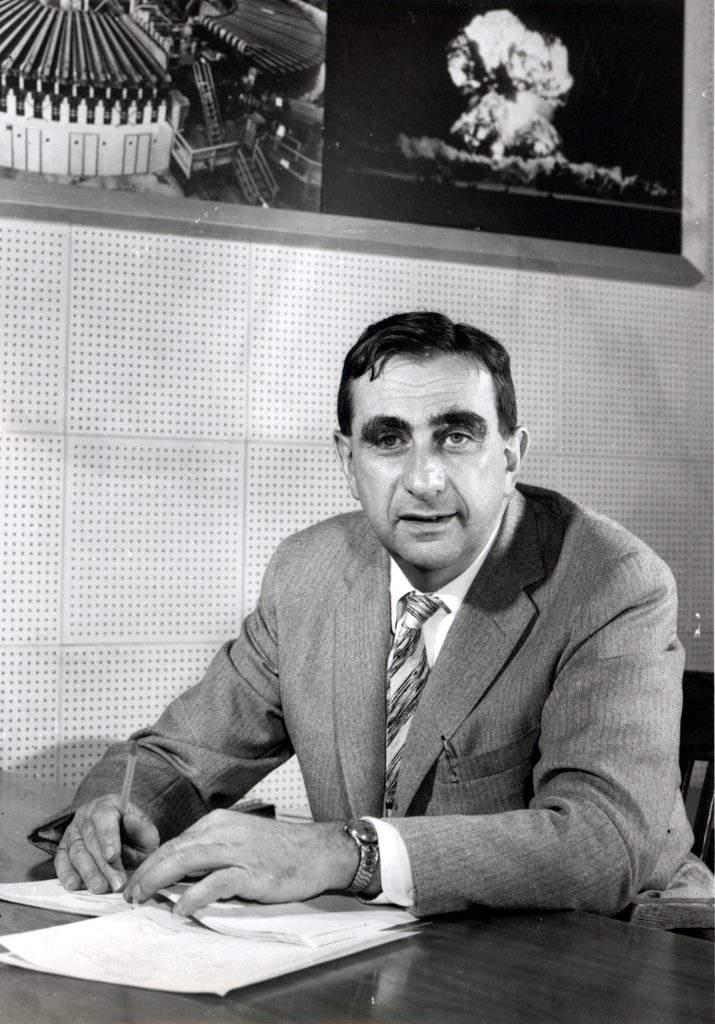
Edward Teller was born in Budapest, 15th January 1908 and died in Stanford, California, 9th September 2003. He was a Hungarian atom physicist, who spent most of his life in the US and achieved most of his successes there as well. His most well-known work is probably his contribution to the research of the hydrogen bomb, he is often called the father of the hydrogen bomb for this reason. When he received permission, he left Hungary.
Later in his life Teller said that he owes his scientific successes to the fact that his mothertounge is Hungarian, otherwise he would have only been a high school teacher. Our language often proves to be a logic developer tool. Nándor Balázs another physicist also has similar views.
After the successful launch of the nuclear reactor in Chicago in 1942, Teller was invited to work on the Manhattan project.
In 1945 he became member and later, in 1947 he became the president of the Reactor Safety Commission. Tellerrecognisedd the dangers of the uranium-graphite-water type reactors and was able to convince to suspend the operation of power plants of this type in the US. The nuclear plant in Chernobyl was the type as mentioned above. He also took his part in the development of the TRIGA (fool proof) reactors. To Teller’s initiative, in 1952 they established the Lawrence Livermore National Laboratory of which he became the director for a period. In the same year they were able to execute the first successful hydrogen bomb-experiment. This is interesting, because while the atomic bomb utilizes fission, the hydrogen bomb is using nuclear fusion, which could provide far more energy than fission.
In 1962 President John Fitzgerald Kennedy gave Teller the Enrico Fermi Award for his successes in the fields of chemistry and physics, for his leading role in thermonuclear research and for strengthening national security.
Since 1936 Teller only revisited Hungary in 1990, but he travelled to his homeland every year from then on. He was the ambassador of the peaceful utilisation of nuclear energy and he even visited Hungary’s nuclear power plant in Paks, where in the auditorium of the Energetics Academy he played Mozart works on the piano as part of the presentation.
On the 23rd April in 1994, Göncz Árpád president gave him the Decoration of the Hungarian Republic. Later in 1997, he was among the first to receive the Reputation for Hungary Award.
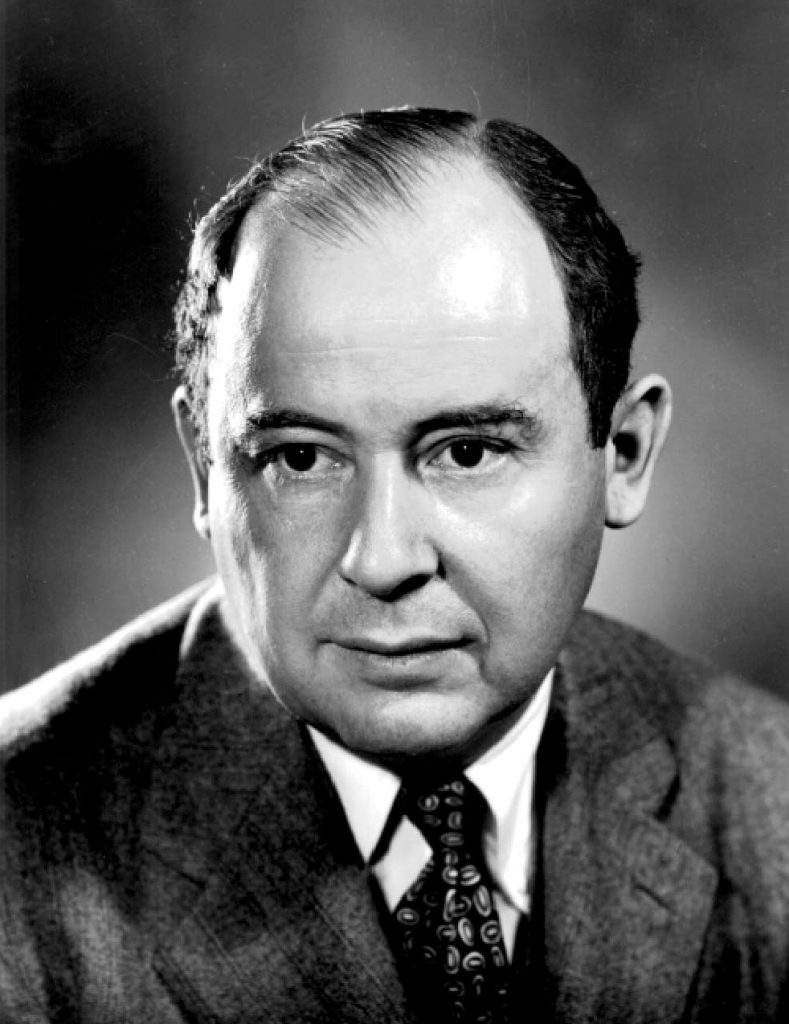
John von Neumann was born in Budapest, 28th December 1903 and died in Washington, 8th February in 1957. He was a Hungarian mathematician. Beside his research concerning quantum-mechanics, he became famous because he laid down the theoretical foundation of the computer.
„The lion’s share of the work needs to be done when the machine is finished and will be usable. Then the computer itself needs to be used as an experimental device.” – John Von Neumann
He had achieved significant merits in the logical designing of the electronic computers. He laid down the fundamental ideas of the computer such as the utilisation of the binary system, the memory, storing software and the command system. These are collectively called the Neumann-principle. He was a consultant of the engineering process of EDVAC, the first computer that had the software installed in its own memory, which was eventually put into service in 1952. During the engineering of this computer he developed the Von Neumann Architecture, the inner organisation system of computers, which is still the basis of designing computers after so many years.
He also worked together with other Hungarian immigrant scientists who also helped to shape today’s computer technology. I will list a few here as honourable mentions.
Source: Daily News Hungary


