Subscribe to our social channels to get the latest news about Hungary!


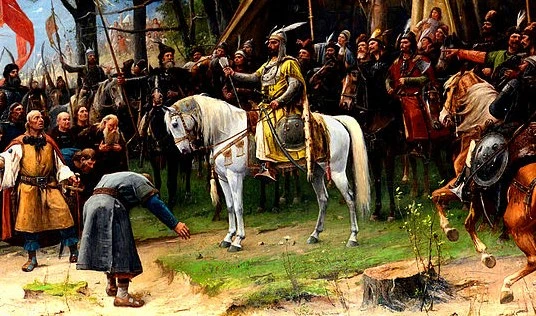
We do not know much about the life of Árpád, the Conqueror. He conquered the Carpathian Basin between 895 and 907 as the leader of the seven Hungarian tribes and other nomadic peoples who joined them. But, apart from legends, we know little about when and how he died or where he was buried. His grave may be discovered with the help of a newly discovered map made in the 18th century.
Historians agree on little about Árpád, the Conqueror. We presume he was the leader of the strongest tribe of the seven, so he became ruler of the Hungarian tribal alliance before the Conquest of the Carpathian Basin. Based on the latest research, it might happen that his family was not even Hungarian but a former leading family or even monarch of an Asian empire, nomadic tribe or people because they knew a lot about how to reign well and make good decisions.
The Árpád family managed to unite the Hungarian (and other) tribes in Etelköz (Northeast of the Carpathian Mountains), conquered the Carpathian Basin and defended it from the franc invasion. Later, they successfully conducted a religious change, founded the Christian Hungarian state and ruled it for more than 300 years. That is a success story very uncommon among the peoples of the Eastern steppe, which mostly perished only decades after they arrived in Europe. One good example is the fearful Huns, later the Avars or the Pechenegs.

Despite that fact, we know almost nothing about the genesis, the history of the family or Árpád. For sure, he led the Hungarian tribes, defeated the francs in Pannonia (Transdanubia), secured the Western borders of Hungary and settled somewhere in the Buda, Esztergom, Székesfehérvár triangle. Later, that region became the centre of the Christian Hungarian Kingdom in the Middle Ages.
According to our chronicles, he died after the Battle of Pozsony/Bratislava (July 907), where the Hungarian tribes defeated the francs and protected their land, hindering further German attacks for the next century. Árpád was buried in Fehéregyháza (Alba Ecclesia), and a monastery was built near his tomb in the 11th century. However, the buildings were destroyed under the Ottoman rule of the region between 1540 and 1686.
Hungarian archaeologists found the medieval monastery in Óbuda in the 19th century, but the work did not continue then. One of Lajos the Great’s (1342-1382) charters issued in 1355 gave details about the village, the monastery and the lost Fehéregyháza (Alba Ecclesia). It says that the monastery’s main door looks at Alba Ecclesia, origo.hu said.

Now, an 18th-century map may help the project. It was found in the Hungarian National Archives in 2011 and shows the agricultural holdings in Óbuda and Hidegkút back in 1778. A section talks about “the ruins of Alba Ecclesia”, since the map was made to help the monarch decide a lawsuit. Thus, clerks verified it multiple times and made it as accurate as possible.
If the researchers start their work by following the map, they may find the tomb of Árpád the Conqueror soon. Archaeological success stories are not unknown to Hungarians. Historians found Ottoman Sultan Suleiman’s tomb in 2014 in Szigetvár.
Source: origo.hu, Válasz Online


