Subscribe to our social channels to get the latest news about Hungary!


By Gopalan Rajamani, guest author
On April 15, 2025, the Liszt Institute – Hungarian Cultural Centre, Delhi, in collaboration with Csoma Room Foundation, Hungary, organised a discussion and exhibition on the life of Alexander Csoma de Kőrös (1784-1842).
Csoma set off on a long and tough journey from Transylvania to Asia in 1819 in search of the origins of the Hungarians. He was commissioned to compile the first Tibetan-English dictionary. He went to the remote village of Zangla to seek help from Sanghe Puntsog Lama, and worked there in the ancient royal palace. Csoma’s pioneering work opened Tibet to Europe.
Balázs Irimiás, a Hungarian architect along with his partner went to Zangla in Ladakh, India in 2007 on bicycle. Ladakh is called the roof of the world. They found the palace in which Csoma had worked was in disrepair. Balázs Irimiás and his partners established Csoma’s Room Foundation, a non-profit organisation. He along with volunteers repaired and saved the Zangla palace by using eco-friendly and sustainable materials.
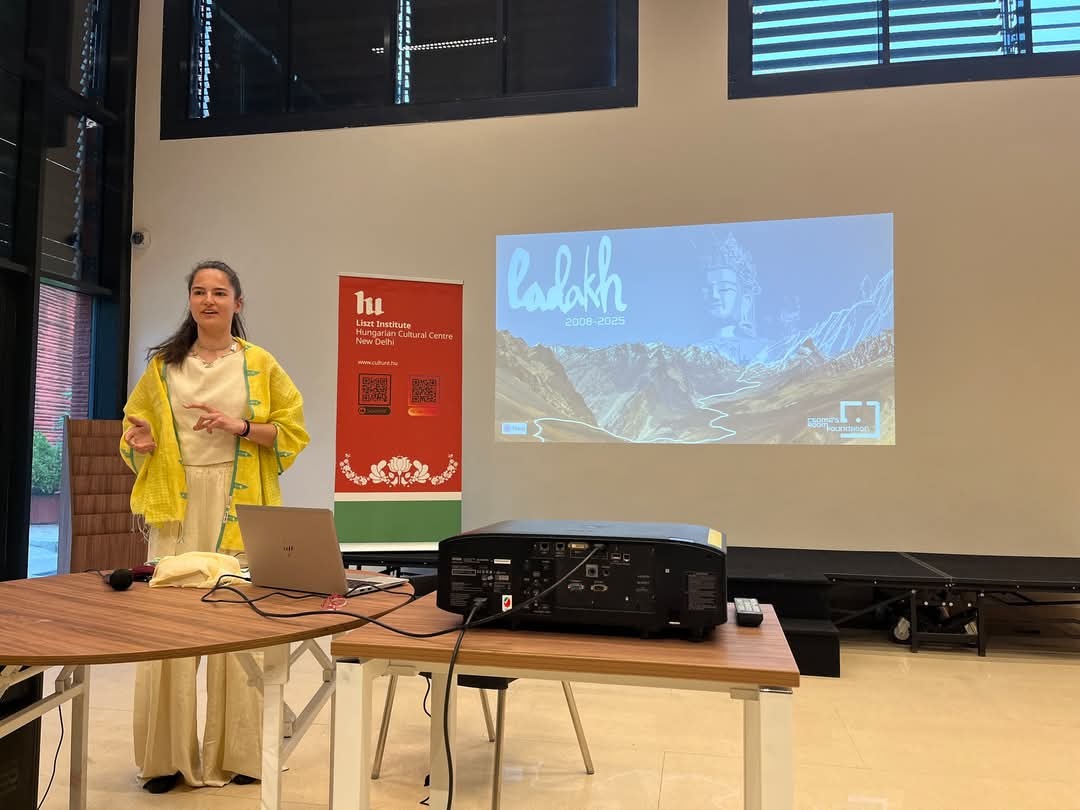
A lecture cum presentation was made by Ms. Anna Ditta Feher. She started volunteering with Csoma’s Room Foundation in 2005 as a student of architecture. She said that she has been to Zangla regularly in the last ten years. She has been working for the foundation in the capacity of curator for the last few years. She explained the difficulties faced and surmounted in the project. After the restoration of Zangla palace, the Foundation went ahead to restore several Stupa in the region. A Stupa means a dome-shaped building erected as a Buddhist shrine.
Thereafter, in order to help the local community the Foundation has constructed three solar powered school buildings which function during day time in winter months. These efforts by the Foundation have led to Hungarian and international awards. Foundation’s volunteers also conducted educational activities in the schools.
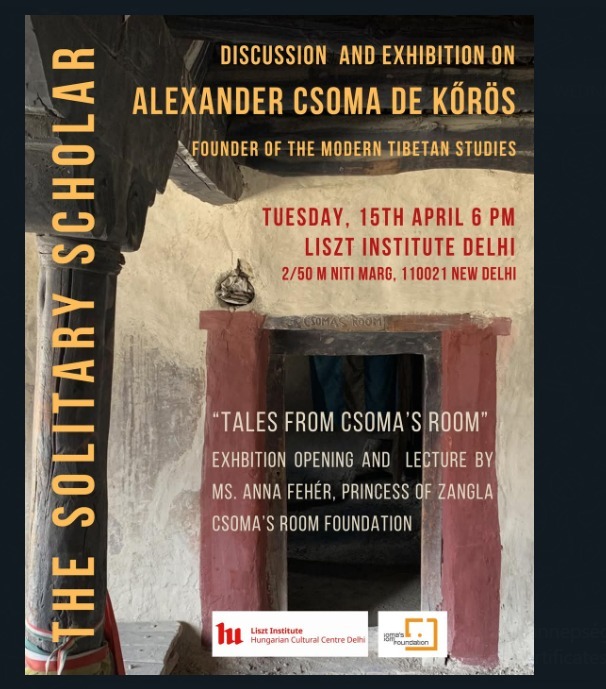
Anna Ditta Feher stated that she has an Indian husband, who is from Zangla and she is called the Princess of Zangla because her husband is from the royal family.
After the lecture she answered questions from the audience.
Margit Koves, Visiting Assistant Professor of Hungarian Language in Delhi University had this to say on Csoma:
“Csoma’s life and work are the first strong cultural link between India and Hungary. Csoma is presented to young people as a model of perseverance and
sacrifice in the interest of learning new languages, widening one’s horizons and merging oneself more deeply in history, relating it to the past of other peoples.”
Read also:


