Subscribe to our social channels to get the latest news about Hungary!


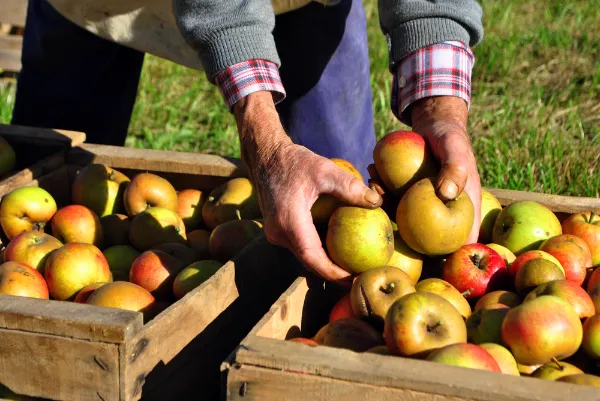
The spring frosts, a chilly May, drought, and a summer marked by extreme temperature fluctuations have led apple growers to harvest the weakest crop yields ever recorded — according to a joint review by the National Chamber of Agriculture (NAK) and the Hungarian Fruit and Vegetable Interbranch Organisation (FruitVeB).
Their Tuesday statement to MTI notes that final figures are not yet available, but their estimate for the 2025 season is barely 160,000 tonnes of apples produced across the country. This amount is only half of last year’s already very low harvest.
Of the total harvested volume, approximately 60,000 to 80,000 tonnes are table apples, while 80,000 to 100,000 tonnes are industrial quality fruit. This means the table apple yield represents just 55-60% of a typical good year’s output, while industrial apples amount to only about 20-25% of an average year’s harvest.
They pointed out that the scale of the yield loss is significant in both segments, even compared to market demand: domestic consumption of table apples is around 110,000 to 120,000 tonnes, and processing industry capacity sits between 350,000 and 400,000 tonnes. Ideally, both sectors should source at least 90% from local production.
Several factors contributed to this poor harvest, the organisations stated. The nearly three-month-long extreme drought and heat stress last summer and early autumn, despite autumn rains, likely hampered the development of flower buds.
The worst damage came from frosts in early April and on 10 May. Then, in June, recurring heatwaves hit, combined with the prolonged drought since early spring and intense UV radiation. This mainly caused further quantity and quality losses on non-irrigated orchards and sandy soils.
They emphasised that apple production in Hungary currently covers around 20,000 hectares — only half the area of 20 years ago. Despite the steep decline in planting, the production potential in a good year would be around 500,000 tonnes: approximately 120,000-130,000 tonnes of table apples and 370,000-380,000 tonnes of industrial apples. Even in 2024, the domestic apple harvest fell well short of average at just 342,000 tonnes.
According to the statement, the Idared variety remains the dominant type in Hungary. It is considered the best suited for the country’s climate in terms of cultivation and crop reliability. Alongside Jonagold and Idared, Gala, Golden Delicious, and the Red Delicious group are also very popular, with the range of alternative varieties steadily expanding.
However, growing new varieties requires new technologies and additional land. They also warned against undertaking large-scale plantings of unfamiliar varieties not tested under local conditions, as there is still no concrete data on their performance.
Read also:
Click for more articles concerning Hungary’s agriculture.

 ZH
ZH IT
IT DE
DE HR
HR NL
NL FR
FR JA
JA RO
RO RU
RU ES
ES TR
TR

