Subscribe to our social channels to get the latest news about Hungary!


The Ministerial Commissioner for Space Research has shared details of the rigorous training undergone by Hungarian astronaut candidates, outlining a series of challenging tasks they needed to complete to be selected. She also discussed Hungary’s future in the space industry and her expectations for the Hungarian EU presidency regarding European space policy.
In an interview with Index, Orsolya Ferencz, a space researcher, Ministerial Commissioner for Space Research, and head of Hungary’s European Space Agency (ESA) delegation, spoke about space research in Hungary and the tests Hungarian astronaut candidates underwent during training.
Since 2018, the Hungarian Ministry of Foreign Affairs and Trade has overseen the Hungarian space programme. In its 2021 Space Strategy, the Ministry stated that the country should open up to space technology development. While Hungary is not a major power in space exploration, neither is the European Union, Ferencz noted. “It is very difficult to get into this club [of space powers],” she admitted.
Indeed, Hungary cannot enter the sector on its own, making bilateral and multilateral agreements essential to realise the significant benefits of space exploration, according to Ferencz. Professional knowledge and research facilitation are also crucial.
“I am very happy that more and more people are now ambitious about the Hungarian space industry, which shows the success of the work carried out by the Ministry of Foreign Affairs and Trade in recent years,”
Ferencz said. She added, “It is no secret that Hungary would like to have, if not a say, at least a look into the big boys’ game. Our realistic aim should be to get many more than the current two or three Hungarian SMEs to become suppliers to the big companies.”
For Hungary to establish its role as a supplier in the market, it must produce equipment for the European Space Agency’s scientific missions. It is also encouraging that companies, universities, and research institutes are increasingly able to apply for and participate in European space missions and research.
However, participation in space exploration requires financial backing: in 2018, the budget for space research totalled EUR 5.1 million. By comparison, in 2024, the budget for ESA programmes alone will be EUR 32 million.
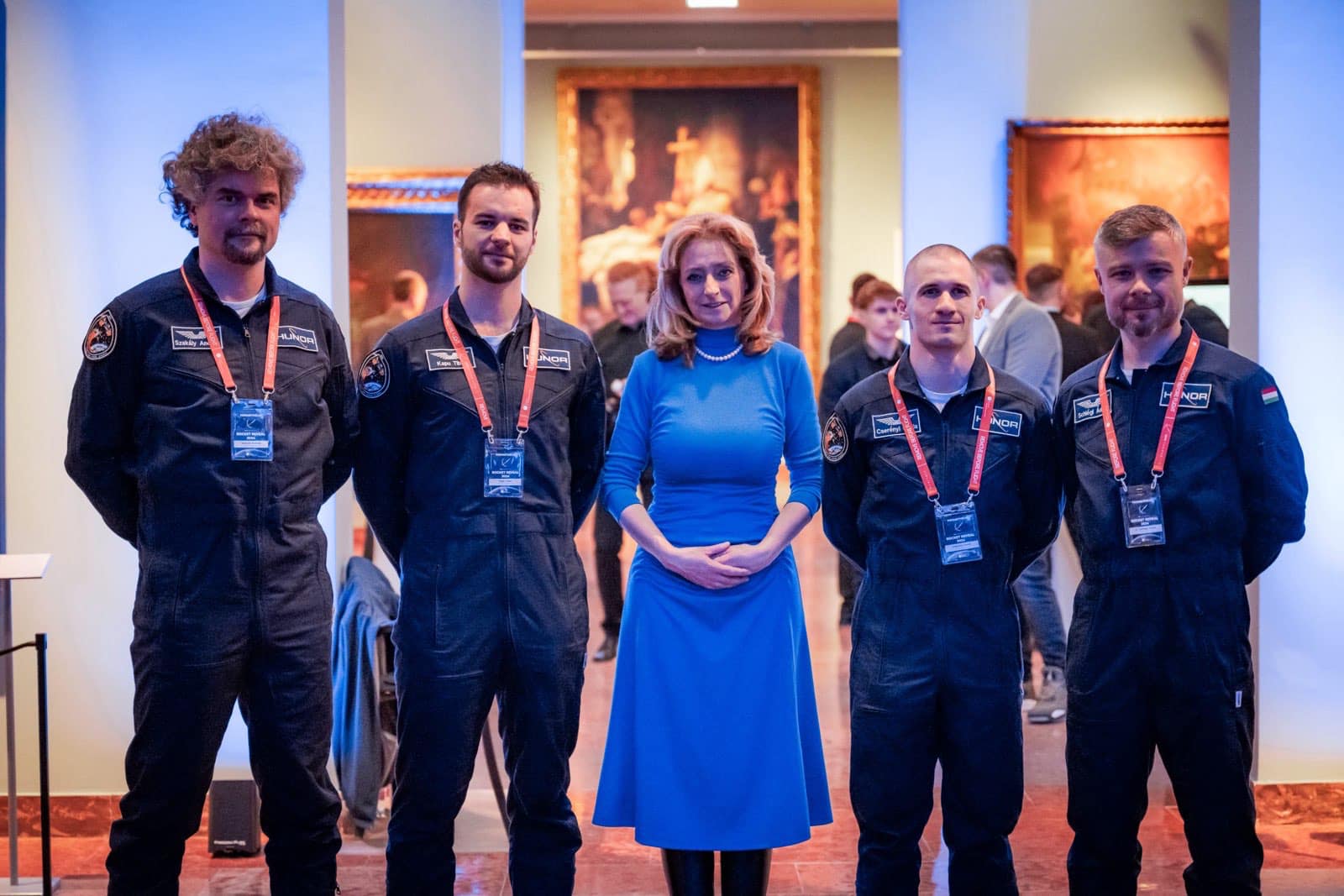
Hungarian astronauts could be on board the International Space Station as soon as late 2024 or 2025, reports Index. The candidates have undergone more than a year of training, including a six-day test jointly developed by Semmelweis University and the Counter-Terrorism Centre. Ferencz explained that the test assessed both the physical and mental stamina of the candidates, who had to spend 144 hours locked in a 48-square-metre container under constant professional observation.
“During this time, they could only crawl from one room to another through small holes. The four Hungarian astronaut candidates had an extremely hectic schedule: for example, alerts at night, or running practices, after which they immediately had to solve maths problems.”
The practice aimed to simulate everyday life on the International Space Station. As Ferencz explained, the 144 hours spent in this stressful environment was a good way to assess the candidates’ mental performance and their ability to adapt to life in space. “On the International Space Station, you cannot pick and choose your travelling companions and you often have to act quickly in stressful situations.”
One of the Hungarian astronauts, Tibor Kapu, recalled, “We had a very serious agenda and timetable to follow. After a day or two, we were introduced to both food shortages and sleep deprivation. This was to bring out the stress factors that we could then measure, to make sure that our trainers saw that we could function well in such a situation.”
Ferencz also discussed her hopes to start addressing the EU space regulation dossier during the Hungarian EU presidency, highlighting the growing need for European-level regulation and cooperation in space exploration.
“Hungary’s position is that the EU member states should jointly develop their space capabilities because Europe is only one player in this global field,” she said.
Comparing the current state of the space industry to the air traffic revolution of the 20th century, Ferencz said space could provide career opportunities for future generations as more industries and research focus on space.
In Hungary, the HUNOR Programme provides opportunities for the selection and training of future astronauts. HUNOR collaborates with the European Space Agency, NASA, Axiom Space, Semmelweis University, the Hungarian Defence Forces, the Air Force, and the Counter-Terrorism Centre.
Read also:
Source: Index


