


The incredible story of the Hungarian National Anthem

Hungary officially adopted its current national anthem in 1989, though several patriotic works had vied for the honour long before. In the 19th century, alongside the Himnusz, works like the Szózat, the Rákóczi March, and others sought to give voice to national unity.
The birth of the Hungarian National Anthem
In the early 19th century, Hungary lacked an official national anthem. Multiple patriotic poems and musical compositions were contenders for the role as the nation’s emblematic song. Although Ferenc Kölcsey penned his poem Himnusz in 1823, it wasn’t printed until years later and only gained widespread recognition after Ferenc Erkel set it to music in 1844.
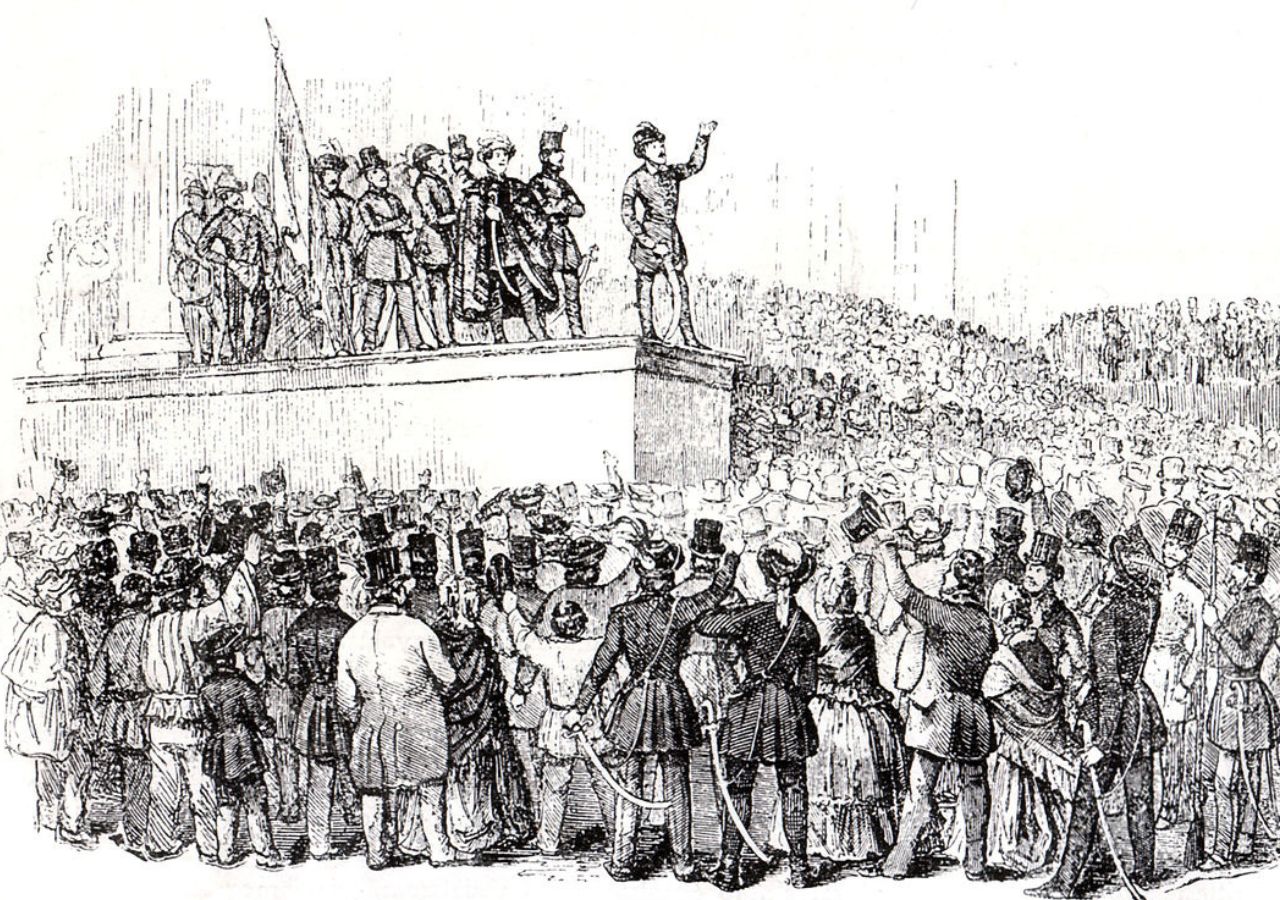
Around the same time, Sándor Petőfi’s revolutionary National Song also captured the public imagination, becoming one of the symbols of the 1848 revolution. However, it never achieved official anthem status. In that era, Mihály Vörösmarty’s Szózat and the Rákóczi March were also popular national tunes. Several poems and musical works thus competed to serve as a unifying national song.
The unofficial “first” anthem: The Szózat
Before Kölcsey’s work became official, Mihály Vörösmarty’s Szózat was among the most cherished national songs in Hungary. As early as the 1840s, many Hungarians viewed it as a spiritual guide. With its unifying message addressed to the nation and its memorable melody, the piece gained widespread popularity and, for a long time, rivalled the Himnusz as a national symbol.
“No one can take away or dismember the homeland glorified in the Szózat. It irrevocably belongs to us. We carry it within us just as it carries us; (…) The Szózat is an ‘integral part’ of this homeland: without it, our intellectual country would be incomplete, and we could no longer call ourselves Hungarian.” – Mihály Babits on the Szózat, written in 1936 for the poem’s centennial.
By the 1840s, the Szózat was sung at public celebrations, and Lajos Kossuth even declared, “Vörösmarty’s Szózat has already become our national anthem.” In 1843, a competition was held to set the poem to music, which Béni Egressy won. Once paired with music, the piece became even more popular. Although it was never officially codified by law, the Szózat served for years as a de facto national anthem.
A revolution’s heartbeat: The National Song
On March 15, 1848, Sándor Petőfi recited his National Song, instantly turning the poem into a revolutionary symbol. As both a literary and political work, its rousing lines—“Rise up, Magyar, the homeland calls!”—had an immediate and electrifying effect on the crowds. That same day, it was printed at the Landerer press without musical accompaniment. Over the following years, several musical adaptations circulated, but no official version was ever adopted. Despite its popularity, the National Song never became the national anthem, likely due to its close association with the revolution and calls for radical change.
Rivals and the triumph of the Himnusz
By the mid-19th century, alongside the Szózat, the Rákóczi March also ranked among Hungary’s most beloved national compositions. It was commonly performed at ceremonial events, military parades, and patriotic commemorations, seen by many as the musical embodiment of the Hungarian national spirit. However, its solemn and militant tone evoked glory and resistance rather than a national prayer, which may help explain why it never became the official anthem.
Other patriotic verses, now largely forgotten, also emerged from time to time. But none could so powerfully express Hungary’s historical sense of fate as Kölcsey’s Himnusz. Though it initially spread slowly, by the end of the reform era—and especially by the early 20th century—it had become indispensable. Its dignified tone, religious and historical motifs best captured the Hungarian national identity: reflecting on loss, hope, and survival, while honouring the past.
Related articles:
- 8 facts about the Hungarian National Anthem only a few Hungarians are aware of – continue reading HERE
- The fascinating details of the Hungarian national anthem
Click for more History-related articles.
To read or share this article in Hungarian, click here: Helló Magyar