Subscribe to our social channels to get the latest news about Hungary!


There are some Hungarians who achieved great successes, even international fame at times. However, there is one person who, despite her achievements like having her book become one of the 2000 fundamental pieces of literature in America or having a crater on Venus named after her, is shrouded in mystery for most Hungarians.
Emma Orczy has a fascinating story. However, as she spent most of her life abroad and wrote in English instead of Hungarian, perhaps it is no surprise that she is not so well-known among Hungarians – reports Divany.
Emma Orczy was born in 1865 in Tarnaörs (Hungary), into an influential family. Her mother was Countess Emma Wass, her father composer Félix Orczy, who knew people like Ferenc Liszt or Wagner, too. The family travelled a lot and eventually moved to London when Emma was 15 years old. It was there she started to learn English besides learning to paint and draw.
She turned to writing only after meeting her husband, Montague MacLean Barstow. They had a long and happy marriage; however, the beginnings were not easy since the man worked as an illustrator, and money was scarce. Orczy started to write stories to help increase their income a bit.
She was active when it came to social and political affairs as well. For instance, she founded the Women of England’s Active Service League to convince men how important it was to participate actively in the armed forces.
She is one of the few Hungarians who has a crater named after them on Venus. Other examples include Mari Jászai actress and Katalin Klafsky opera singer.
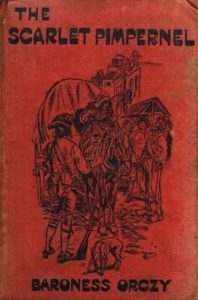
In her first book, she paid homage to her Hungarian origins, as she gave it the title of Old Hungarian Fairy Tales. Her second book was not very successful; however, in 1903, she published the book that soon brought her international fame and success – The Scarlet Pimpernel. Just two years after it came out, it was turned into a theatre production that became a massive hit – for four years, every production had a full house.
The book was translated into 14 languages – including Japanese -, it was turned into a musical as well as a movie, and it even served as inspiration for Johnston McCulley when creating his famous Zorro character.
She never forgot about her Hungarian origins and often visited the country with her husband. In 1934, when yet another Pimpernel movie was in the works, it was Orczy herself – together with Lajos Bíró – who prepared the script. The main role was given to Leslie Howards, who also had Hungarian origins, and his birth name was László Steiner.
Later on, Orczy continued the story of the Scarlet Pimpernel while also producing works in other genres.
For example, she was the first to create the character of the first independent female detective in the collection of lady Molly of Scotland Yard.
There are several reasons the book became such a hit. First of all, the main character was the first in literature to have a secret identity, with adventures full of romance, danger and fiction. Of course, these are still popular tropes in contemporary books and films. She got inspiration for this from her own life, as she travelled a lot when she was young.
The main character of The Scarlet Pimpernel is Sir Percey Blakeney. He is rich but a bit of a simpleton, a sort of laughing stock. However, it later turns out that he was just pretending, and in reality, he does many heroic acts. After each one, he leaves a scarlet-coloured flower called a pimpernel at the scene. He has influential accomplices and somehow manages to escape impossible situations, too, for example escaping from Robespierre or Madame Guillotine.
Orczy had a fascinating life full of adventures. She was a financially independent woman who managed to achieve international acclaim. It is time that we as Hungarians learn more about her story.
Featured image: hu.wikipedia.org
https://dailynewshungary.com/hungarian-director-created-disneys-brand-new-101-dalmatian-street-videos/
Source: divany.hu


