Subscribe to our social channels to get the latest news about Hungary!


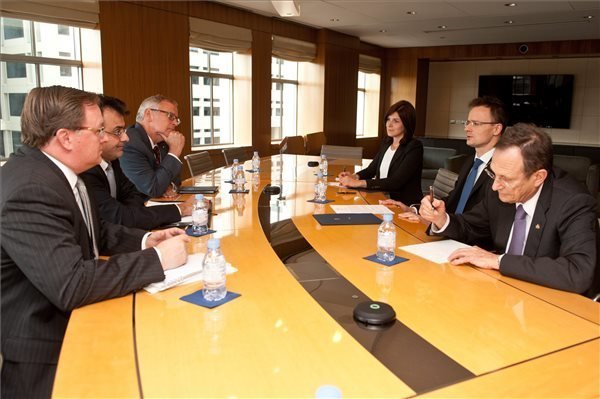
Washington, DC, October 22 (MTI) – Foreign Minister Péter Szijjártó said that he was in agreement with Victoria Nuland, the US Assistant Secretary of State for European and Eurasian Affairs, that bilateral economic and security policy relations were excellent. Political disputes were also discussed at their meeting on Tuesday, he added.
Szijjártó told MTI after talks in Washington that Nuland had expressed appreciation for Hungary’s involvement in Afghanistan, its contributions to NATO and its gas supplies to Ukraine.
In a press statement, deputy spokesperson Marie Harf said Nuland and Szijjártó had discussed a range of issues, “including cooperation in the fight against ISIL, our shared commitments to Afghanistan; support for Ukraine; TTIP and the U.S.- Hungarian economic relationship; and the U.S. government’s concerns regarding democratic developments and corruption in Hungary. Both sides agreed to work together to address concerns about democracy, corruption, and the investment climate.”
Regarding the entry bans on “certain current and former Hungarian officials,” the statement said the bans were “based on a range of authoritative information concerning corruption in the Hungarian government, readily available from numerous sources, such as watchdog NGOs, whistleblowers, and a range of civil society groups charged with upholding government transparency.”
In connection with Iraq, Szijjártó said that Hungary, belonging as it does to a Christian Europe, feels a special responsibility towards protecting Christian communities, and it is therefore a trailblazer for international cooperation whose goal is to bring the leaders of the Islamic State before the International Criminal Court.
On the topic of economic cooperation “I said that we are committed to the Transatlantic Trade and Investment Partnership (TTIP). Hungary’s calculation is that if a sufficiently ambitious TTIP agreement comes into being then Hungarian exports could grow by 15-20 percent, which would mean an extra 20,000-30,000 jobs in the country and an annual boost to GDP of 0.2-0.3 percent.”