Subscribe to our social channels to get the latest news about Hungary!


Pálinka is one of the most well-known Hungarian alcoholic drinks, and in recent years, its popularity has been growing both in Hungary and around the globe. Thanks to the government’s lenient rules on making pálinka, many people try to make their own at home, but it can have its risks, so if you want to taste the best pálinka and have a great experience, choose from the offer of one of the well-established distilleries such as 1 Csepp Pálinka, Rézangyal Pálinka, Agárdi, Panyolai etc.
Pálinka is a traditional Hungarian fruit distillate. “Its official description stipulates that pálinka must be fermented from fleshy pitted fruits, fruits without pits, or from berries (and from the pulp of these), distilled and bottled in Hungary. Mashing, fermenting, distilling, ageing, and bottling must all take place in Hungary,” according to the Collection of Hungarikums.
Grape marc is usually mentioned together with other pálinka, although it is legally different. “Grape marc pálinka is a pomace brandy made of grape pomace, produced and bottled in Hungary. It is made exclusively from grape pomace produced in Hungary, with fermentation, distillation, maturation, conditioning, and bottling all performed in Hungary,” says the Collection of Hungarikums. It is usually clear, but some varieties that use blue grape can have a slight colouration. Pálinka, grape marc pálinka, and certain local variants are under protected designation of origin in the European Union; the term “pálinka” can only be used by Hungary and four Austrian provinces. Pălincă is a legally protected Romanian fruit distillate that is legally independent of Hungarian pálinka.

According to Magyarországom, the most common fruit pálinka is distilled from plum, pear, apple, apricot, sour cherry, cherry, grape marc, or strawberries, but they can be made from any fruit grown in Hungary (only apricots in the Austrian provinces).
Prior to the 20th century, pálinka was predominantly made from plums.
The modern meaning of the term pálinka was consolidated in the 21st century, after its protected designation of origin status. At first, the Hungarian word pálinka simply meant spirits after its appearance in the 17th century, but in the 20th century, Hungarian pálinka was mostly made from fruit, pomace, wine, or wine lees. However, the historical Hungarian pálinka included distillates made from rye, wheat, corn, buckwheat, potatoes, and less often even beets, sweet roots, or peas. The term was used collectively until the introduction of the fine spirit industry in the first half of the 20th century.
In order to make a good pálinka, a good quality ingredient, in this case, fruit, is needed. It has to be ripened in order for the process to work properly. For one, ripened fruits have a higher sugar content, which is important when fermenting, but two, ripened fruits have more aroma which would translate to the drink. The harvested fruits are washed, (peaches, plums, and cherries are pitted, apples are ground) then placed in barrels. The fructose or fruit sugar in the barrels is converted into alcohol. The fermented mash is then heated, and this would start the next step: distilling. As a result of the heat, steam rises from the mash, which condenses to become liquid again and is then collected. The so-called distillate formed has 8-15 degrees of alcohol. The distillate is then further processed and refined.
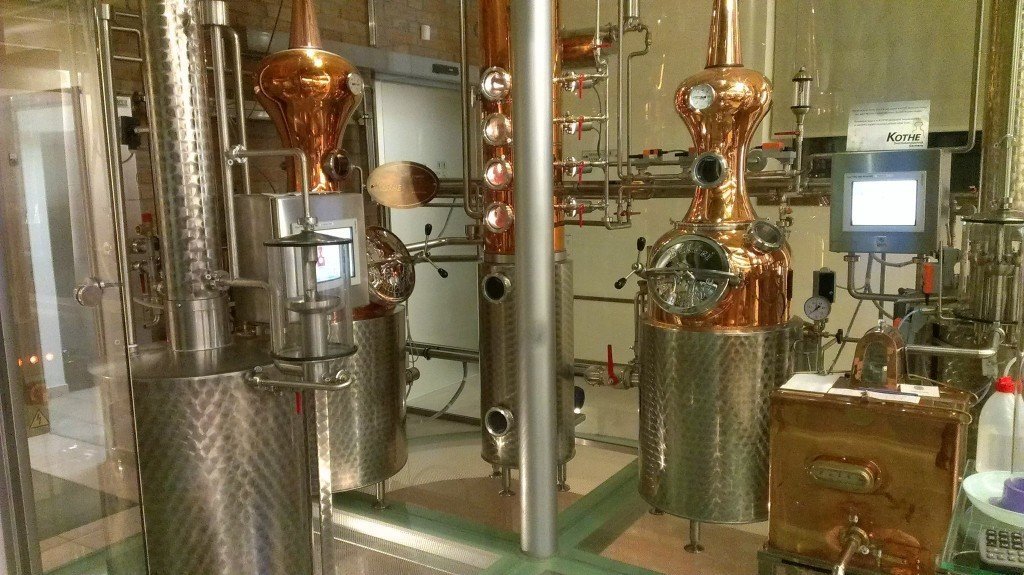
After the distilling is finished, you get pálinka, but it is not ready for consumption yet. Pálinka has to rest before it is fully ready.
Sometimes this is done in glass or metal containers, but some pálinkas are matured in wooden barrels (usually oak) for a few months. Also, in order to lower the alcohol degree of the product, some water is added to the mixture, but the ratio and method in which this is added are very important.
One of the more popular pálinkas of Kecskemét is its apricot pálinka. One of the reasons for its popularity is the good quality apricot it is made from; it is called Magyar kajszi (Hungarian apricot) or Magyar legjobb (Hungarian best). The other interesting fact about this pálinka is that they do not pit the apricots for this variety.
The cherry pálinka from Kecskemét (43%) is also quite a popular pálinka. Like with the apricot pálinka, cherry seeds are also used when making this drink. This cherry pálinka is then matured in ash barrels.
The distillery in Kecskemét is modernised and now computer-controlled, but it still uses traditional methods. Even though computers help to make the process the same every time, there is no substitute for the professionals whose task is to constantly monitor the pálinka in every step of the making. Similarly to wine production, the quality of the harvest varies every year, but
the vintage is not indicated on the bottles of pálinka, instead, distilleries strive to achieve the standard taste, colour, and aroma every year. The alcohol content is also constant.
Source: Magyarorszagom.hu


