Subscribe to our social channels to get the latest news about Hungary!


At the John Molson International MBA Case Competition in Canada, students from 30 universities around the world competed against each other, with the Corvinus beating the hosts in the semi-finals.
The Corvinus students competed against teams from Australia, the US, the UK, South Africa, the Dominican Republic, the Netherlands, Ireland, Canada, Colombia, Germany, Sweden, and Singapore in the John Molson MBA International Business School Case Competition at Concordia University in Montreal during the first week of January. The competition is the largest and toughest global competition in the world for the MBA students (Master of Business Administration, the world’s most popular business degree), and aims to bridge the gap between the corporate and academic worlds.
The case solving was conducted under strict rules, without the use of the internet, and based on personal experience and insights. Competitors typically had three hours to analyse and evaluate a complex business problem and present their solution. In addition to creativity, the teams were judged on their success in identifying the problem and the feasibility of the idea.
The Hungarian team of Adél Hadházy, Luca Horváth, Tamás Józsa and Gergely Keményfi competed in the final against students from Lund University in Sweden and the University of Münster in Germany, with the latter coming first. The Hungarian second place is the best result in the history of Corvinus in John Molson International MBA Case Competition competition.
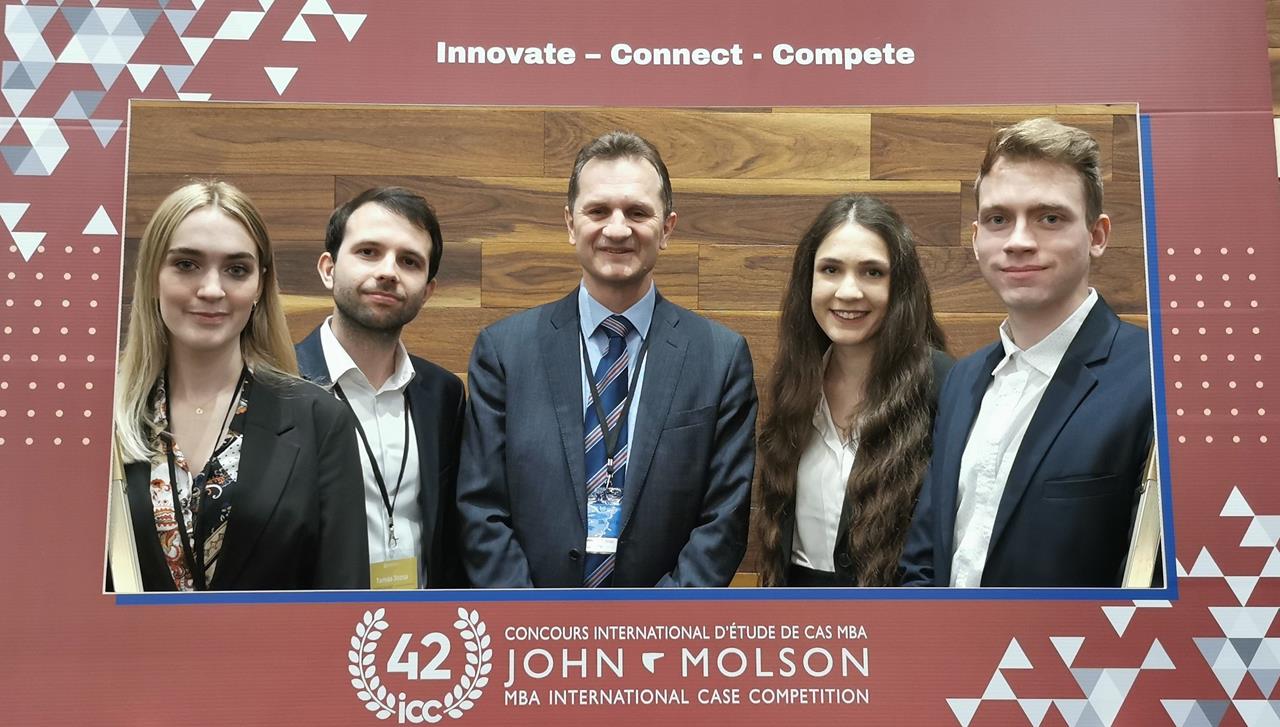
“The most difficult challenge for us was the so-called “live case” exercise, during which the company problem was presented live on the spot by the CEO of the company himself. The main challenge was to quickly find a rational and feasible solution to the company’s complex problem based on limited information. We thought we performed best in the semi-final, where we developed a long-term growth strategy to address the environmental challenges of a Swiss automotive company. Our insights proved to be both creative and rational, and the feedback from the judges showed that our strong team unity set us apart from the other two teams in the semi-final. With this result, we beat the previously unbeaten University of New South Wales and the host Concordia University team,” said Tamás Józsa, representing the student team of Corvinus.
“This competition is incredibly difficult and is considered the best of the MBA competitions. The team members have once again demonstrated their outstanding preparation, perseverance, and enthusiasm. The result is also a great confirmation of the high quality of practice-oriented education at Corvinus. As a coach teacher, I am proud that we have reached the finals of this competition twice in the last three years, which is a testament to the excellence of our talent management programme and our students,” said Balázs Felsmann, the team’s mentor and associate professor at Corvinus.
The Corvinus team has already achieved great success in the past; last November they were the first European team to win the Cornell University Emerging Markets Institute International Case Competition, among 126 competing teams.
As we wrote earlier, Hungarian universities are to host the 2024 European Universities Games, details HERE.
Also we wrote before, most Hungarian universities excluded from the EU’s international research support program, details HERE.


