Subscribe to our social channels to get the latest news about Hungary!


Astronomers have reached a new milestone in the study of Betelgeuse, the well-known red supergiant in the Orion constellation. An international research team has announced the first direct observation of the long-suspected companion star, whose existence was initially proposed by Hungarian astronomer László Molnár and his colleagues.
The breakthrough came thanks to the North telescope of Hawaii’s Gemini Observatory and may settle a scientific debate that has lasted for decades: one of the universe’s most iconic stars isn’t alone after all.
The theory of Betelgeuse’s elusive companion was put forward last year by László Molnár of the HUN-REN CSFK Konkoly Thege Miklós Astronomical Institute, alongside Meridith Joyce and Jared Goldberg. They noted the star’s unusual luminosity fluctuations, which could best be explained by the presence of a companion roughly the size of the Sun. While they attempted confirmation using the Hubble Space Telescope and the Chandra X-ray Observatory, those initial efforts fell short of direct detection. However, they were able to rule out that the companion was a neutron star, according to Qubit.
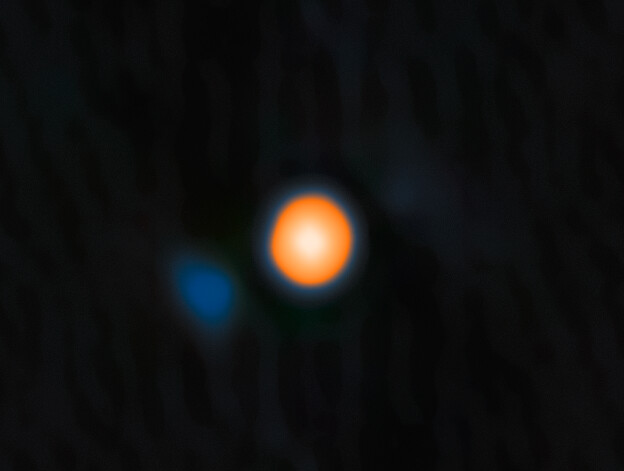
The major turning point came when the Gemini North telescope on Earth captured the faint companion using a technique called speckle interferometry, producing thousands of short-exposure images that were then combined. Remarkably, it appeared in the position and at the distance predicted by the Hungarian team. While the 1.5-sigma level of statistical significance is not considered a definitive detection, experts are hailing it as a major breakthrough—until now, it was believed Betelgeuse’s brilliance would forever obscure any companion.
According to the team’s measurements, the newly spotted companion—named “Siwarha”—has about 1.5 times the mass of the Sun and is classified as a very hot, bluish-white A- or B-type star. It orbits at a distance roughly four times greater than the Earth-Sun average—placing it within the outer edge of Betelgeuse’s extended atmosphere. The two stars likely formed around the same time, some ten million years ago, but their life paths diverge significantly: Betelgeuse is expected to explode as a supernova within the next few hundred thousand years.
A chance for a confirmed detection could arrive in 2027, when the companion reaches the farthest point in its orbit from Betelgeuse. Targeted observations in the meantime will aim to rule out that the current detection was caused by a random blotch, artefact, or interference. Hungarian astronomers are also planning studies of other red supergiants, like Antares, to determine whether such “hidden” companions are common across the universe.
The discovery of Betelgeuse’s hidden companion not only confirms Hungarian scientists’ predictions but also opens new avenues for studying supergiant stars. It highlights just how little we know about our own cosmic neighbourhood, and how even the most familiar stars can still deliver surprises.
Read more science-related news on Daily News Hungary!
Read also:
To read or share this article in Hungarian, click here: Helló Magyar


