Subscribe to our social channels to get the latest news about Hungary!


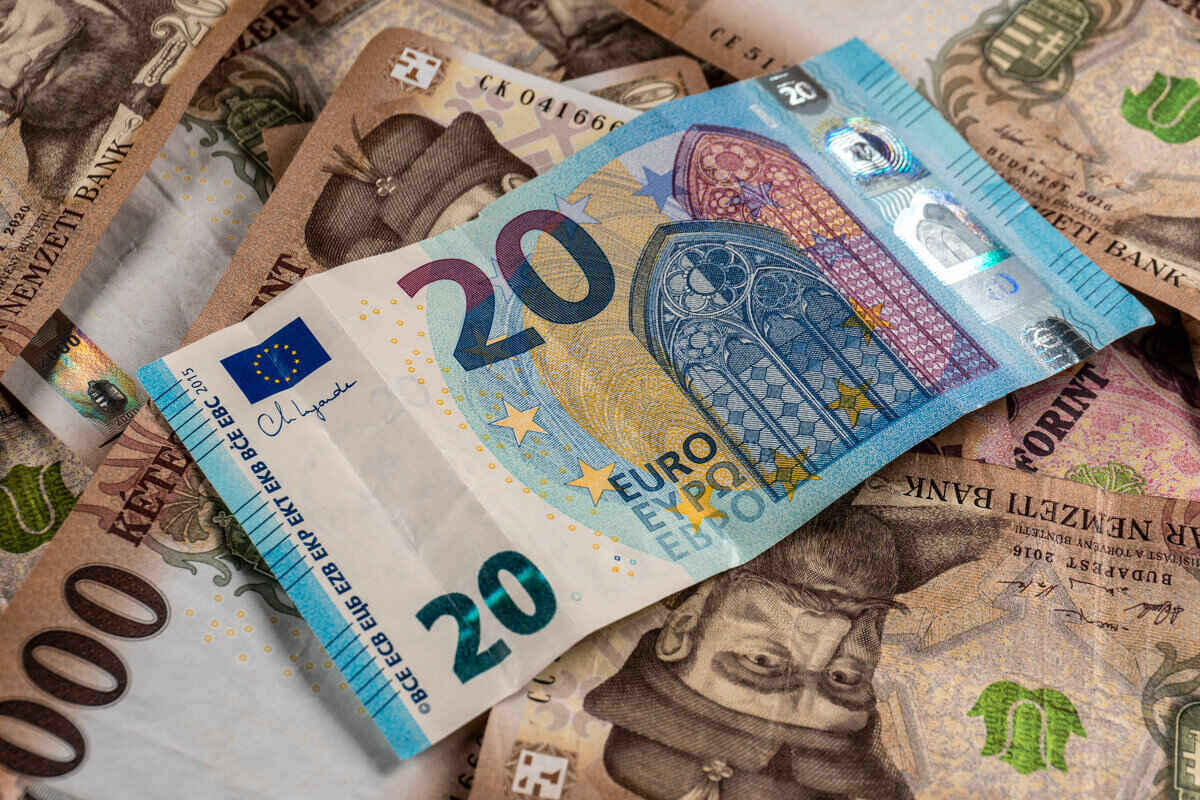
Despite committing to adopt the euro upon joining the EU, Hungary continues to struggle with meeting the eurozone’s stringent criteria. With challenges ranging from budget deficits and public debt to inflation and rising interest rates, the euro in Hungary remains a distant dream, overshadowed by the enduring forint.
As Pénzcentrum writes, Hungary committed to adopting the euro upon joining the European Union but has struggled to meet key eurozone entry criteria. The Institute of Economic Research recently assessed Hungary’s progress, highlighting mixed results. From 2004 to 2011, Hungary’s budget deficit consistently exceeded the 3% of GDP requirement, though fiscal discipline between 2012 and 2019 allowed compliance. However, the COVID-19 pandemic reversed this trend, with deficits exceeding the threshold until 2023, stabilising around 5% by 2024.
Public debt, another critical metric, remained far above the 60% of GDP guideline until 2012, despite a temporary improvement driven by pension fund nationalisation. While low interest rates aided a gradual decline in the debt ratio pre-pandemic, the crisis caused a sharp increase, leaving public debt levels stagnant since 2017. Meeting these benchmarks remains a significant challenge for the euro in Hungary.
Inflation has also posed challenges to Hungary’s adoption of the euro. Before 2012, domestic price growth consistently exceeded the eurozone’s price stability criterion. Between 2014 and 2016, Hungary managed to align with the standard, aided by artificially suppressed utility costs. However, after 2016, while inflation remained close to the Hungarian National Bank’s 3% target, low euro area price growth made meeting the criterion difficult. Following a period of record-high inflation in Europe, which began to ease in 2022-2023, Hungary’s inflation stabilised near the reference value by late 2024, marking progress towards meeting this key requirement for introducing the euro in Hungary.



Let’s hope it remains a dream because it actually happening would be a nightmare. Anyone who did even ECON 101 knows it makes no macroeconomic sense to do it, when weighed against the disadvantages. But the whole thing is yet another method of diluting, and ultimately abolishing, individual members’
sovereignty.
Just say NO!
Hi Mike boy… better a flaky crusted forint than a cherry pie. Our boy Steiner has his eye on the Orban prize.
Tell us Mr. ECON 101 Mike, in which of your 41 places of residence is the forint the currency of choice? And please explain how the drop in value of the forint is helping the average Hungarian? Perhaps you’d prefer…
Good job Viktor Steiner. I’m convinced!
Ehhh. We invoice in Euros. A lot if not most of our Hungarian suppliers invoice in Euros, or somehow “peg” values to the Euro. And there are very, very good reasons to do so.
I do agree with @michaelsteiner´s assertion that Euro adoption is to bind Member States closer together (that´s what you were trying to say, right?). The obligation for EU member states to adopt the euro was first outlined by article 109.1j of the Maastricht Treaty of 1992, which became binding on all new member states by the terms of their treaties of accession.
https://en.wikipedia.org/wiki/Enlargement_of_the_eurozone
So uh. Hungary already relinquished it´s sovereignty in that respect? Wait! There is more!
https://eur-lex.europa.eu/EN/legal-content/glossary/international-agreements.html
Steiner Michael – LAUGHABLE.
What’s number 42 ?
We KNOW you are OVER-JOYED at the return of the COMMIES ???
The Political Party of your MEMBERSHIP, the adoration of its Leader by you and your Hungarian bor wife, and of Current Prime Minister of Hungary – Victor Orban, you truely are on a HIDING to NOTHING.
NOTHING – whilst the name Orban and Fidesz Political Party remain in decision making positions in Hungary, absolutely NOTHING is going to be reversed from the cataclysmic disaster that is Hungary at this point in time, but CONTINUE to WORSEN, plunging the “poisonous” dagger DEEPER into ALL Hungarians.
Orban, his Fidesz Government, the Fidesz Political Party – just GROWS being CONFIRMED, they are the “Judas” in there Political Practices, against DEMOCRACY.
WHAT a “Toxic Culture” just keeps OOZING out confirming there Political Ideas and Philosophy – there Dogma, that has in it, the DISTILLATION of any form of DEMOCRACY remaining being practiced in Hungary.