Subscribe to our social channels to get the latest news about Hungary!


“Martians – Hungarian Scientists and Nobel Laureates” is the title of a new interactive traveling exhibition celebrating the giants of Hungarian science, including the nation’s Nobel Prize winners, which opened Tuesday at Vörösmarty Square.
As noted during the opening ceremony, the exhibition’s name was inspired by physicist Leó Szilárd, who famously likened Hungarian scientists who emigrated to the United States to Martians, highlighting their genius and seemingly otherworldly intellect.
Miklós Szánthó, Director General of the Center for Fundamental Rights, emphasised in his remarks that the open-air exhibition, debuting in the lead-up to Hungary’s holiday celebrating its Christian statehood, connects “the greatness of Hungarian scientists with that of our founding king.” He added, “We owe not only the Hungarian state to them, but—as evidenced by the international careers of many Nobel laureates—also the success of a nation that knows no borders.”
Szánthó reflected on the fact that while many of Hungary’s national icons developed their careers at home, numerous scientists were driven into exile. “Typically, this happened when empires tried to absorb us—but, inversely proportional to the success of these empires, our scientists’ achievements have thankfully left a lasting mark,” he said.
“Imagine the scientific and political success we might have experienced if peace and security had dominated our history instead of suffering,” he continued. “It is precisely because of our past—marked by heroes and scientists fleeing war—that we can now appreciate the value of a life without conflict.”
“That a small nation speaking what sounds like a Martian language to foreign ears has produced so many Nobel laureates—this is nothing short of a miracle, yet it remains a fact,” Szánthó concluded.
Balázs Gulyás, the exhibition’s curator and president of the HUN-REN Hungarian Research Network, said the showcased Hungarian minds share the common trait of having significantly impacted their communities and the world at large. They created lasting value and contributed to humanity’s collective knowledge. “Even in their lifetimes, their work transcended the strict confines of science—and continues to influence many areas of life today,” he said.
“Our exhibition is an exciting journey through time, covering more than 200 years, spanning the hardships of the 19th and 20th centuries to the present day,” Gulyás explained. It revisits key—and sometimes amusing—moments in the lives of great scientists, offering a glimpse into the hidden workings of science.
Robert Palladino, Chargé d’Affaires at the U.S. Embassy in Budapest, said the exhibition is more than a tribute to Hungary’s past. “It shows how Hungarian genius and American opportunity together have changed the world,” he said. Hungarian scientists have had a global impact through collaboration with American institutions, laboratories, and innovations.
He also announced a new partnership between the Hungarian-American Fulbright Commission and the HUN-REN Research Network. As part of the initiative, Hungarian researchers will go to the U.S., while American scholars will be hosted in Hungary. The first U.S. Fulbright fellow is set to arrive in Budapest this autumn.
Designed to be both accessible and engaging, the exhibition pays tribute to Hungarian and Hungarian-born Nobel laureates as well as leading domestic scientists and their remarkable achievements. The more than fifty featured scientists span fields such as mathematics, physics, chemistry, biology, and economics—with prominent figures from the automotive industry and some of the most creative inventors included as well.
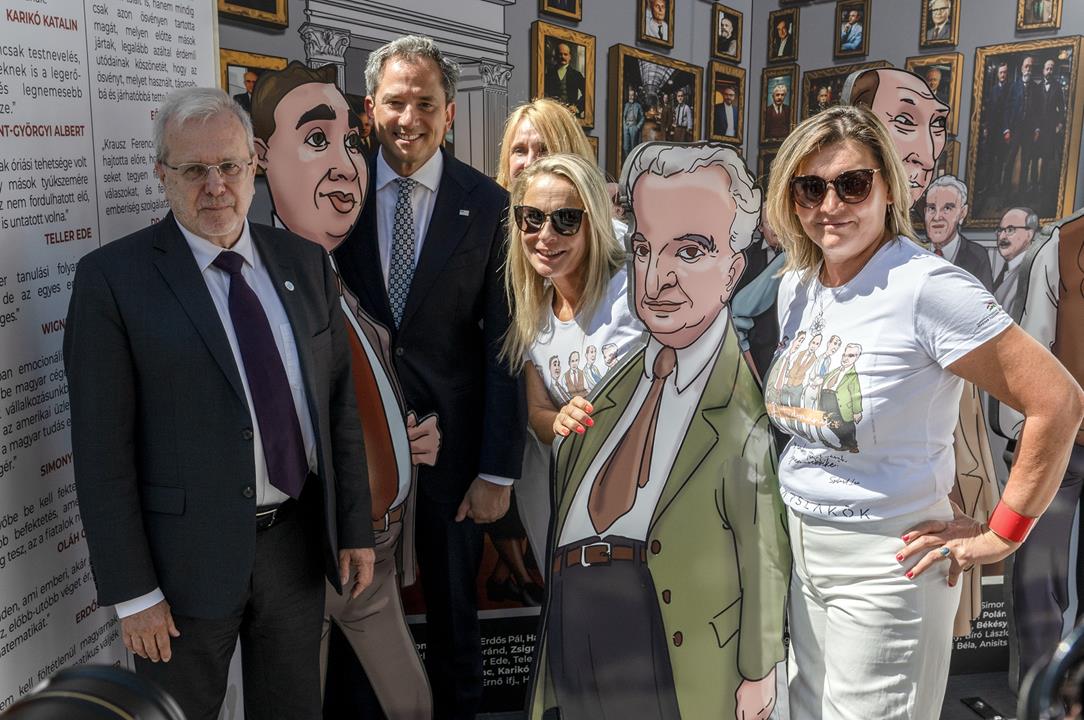
At the exhibition’s photo station, visitors can pose with life-sized caricatures of the scientists. Interactive touchscreens allow guests to explore the lives and work of Hungary’s great minds and offer a collection of fun facts and quotations. Content is available in both Hungarian and English.
The traveling exhibition will remain on display at Vörösmarty Square through 28 September, after which it will be shown at locations across Hungary, Europe, and the United States.
Read also:
Click for more news concerning science.
To read or share this article in Hungarian, click here: Helló Magyar


