


 ZH
ZH IT
IT DE
DE HR
HR NL
NL FR
FR JA
JA RO
RO RU
RU ES
ES TR
TR


Hungarian art students’ encounter with Japanese nihonga paintings

In November, renowned Japanese-style painter Ms. Mayumi Goto visited Hungary on the invitation of The Japan Foundation Budapest and held workshops for art students at the Painter Department of the Hungarian University of Fine Arts in Budapest and at the Faculty of Visual Arts and Music of Eszterházy Károly Catholic University in Eger.
Hungary marked the last stop of Ms. Goto’s professional tour around Europe. Prior to her arrival in Budapest, she held a lecture and workshop at the Bulgarian National Museum in Sofia, a workshop at the Prague National Gallery and at Masaryk University in Brno, Czech Republic, followed by another workshop in Bratislava, Slovakia. These programs were made possible by the support of the local Japanese Embassies.
Her workshop in Budapest was scheduled to be three hours, without a break, but even that considerable span of time left the participating students wanting more, and many stayed for an additional half an hour to ask Ms. Goto some questions. The workshop started with a brief lecture on the history and specifics of Japanese-style painting called nihonga.

What makes this technique special is the tools and materials it uses. The brushes and the way the artist holds them are what create the effortlessly beautiful lines we know from Japanese calligraphy. For the base, nihonga utilises washi paper of varying thickness, or silk in the case of traditional style roll paintings. However, the most exciting element is the paints themselves.
Japanese-style painting uses powder of colourful natural gemstones, which is then mixed with water and glue to stick to the base. In this day and age, when eco-friendly alternatives are becoming more and more popular with the younger generation, this natural aspect of nihonga caught many students’ attention.
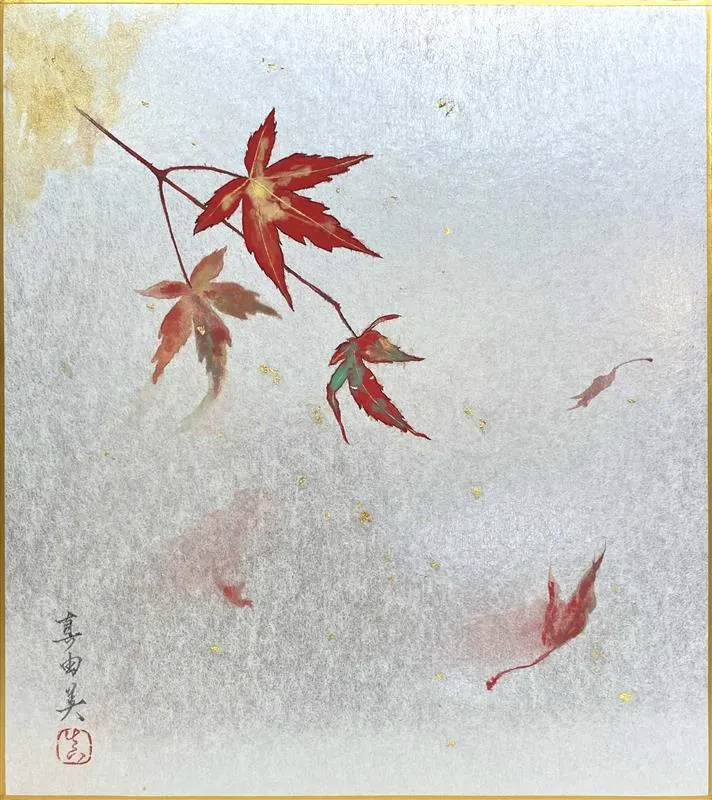
After learning the theory, the students got to try their hands at creating Japanese-style paintings themselves. Ms. Goto’s main theme in her own art is cherry blossoms; however, since these workshops took place in autumn, she selected themes more fitting for the season. Coincidentally, all venues selected Japanese autumn foliage momiji over other options, such as nashi pears.


