


Matthias Fountain: Why tourists throw coins at this 120-year-old Hungarian masterpiece

Change language:
One of the most striking and beloved landmarks in Budapest’s Castle District, the Matthias Fountain is often dubbed the “Trevi Fountain of Budapest,” a nod to its famous Roman counterpart. This monumental neo-Baroque fountain is located in the western forecourt of Buda Castle and depicts one of Hungary’s most iconic historical figures, King Matthias (Hunyadi Mátyás), on a hunting expedition.
Fit for a legendary king
The fountain was designed by sculptor Alajos Strobl, with the support of architect Alajos Hauszmann during the reconstruction of the Royal Palace. The design was approved by Emperor Franz Joseph I, and Strobl began work in 1899. His initial pieces earned a state gold medal as early as 1901, and the fountain was completed in 1904. King Matthias himself symbolically attended the unveiling—naturally in spirit only, as he lived in the 15th century, Promotions writes.
At the centre of the composition stands King Matthias, crossbow in hand, atop a rocky peak beside a majestic stag. Below him are a horn-blowing hunter and the leader of the hunting party, flanked by three hunting dogs. On the right side of the fountain stands the beautiful Ilonka, while the left side features Galeotto Marzio, an Italian chronicler often present at the royal court. Inspired by a ballad from poet Mihály Vörösmarty, the tragic romance between Ilonka and Matthias is woven into the group’s narrative.
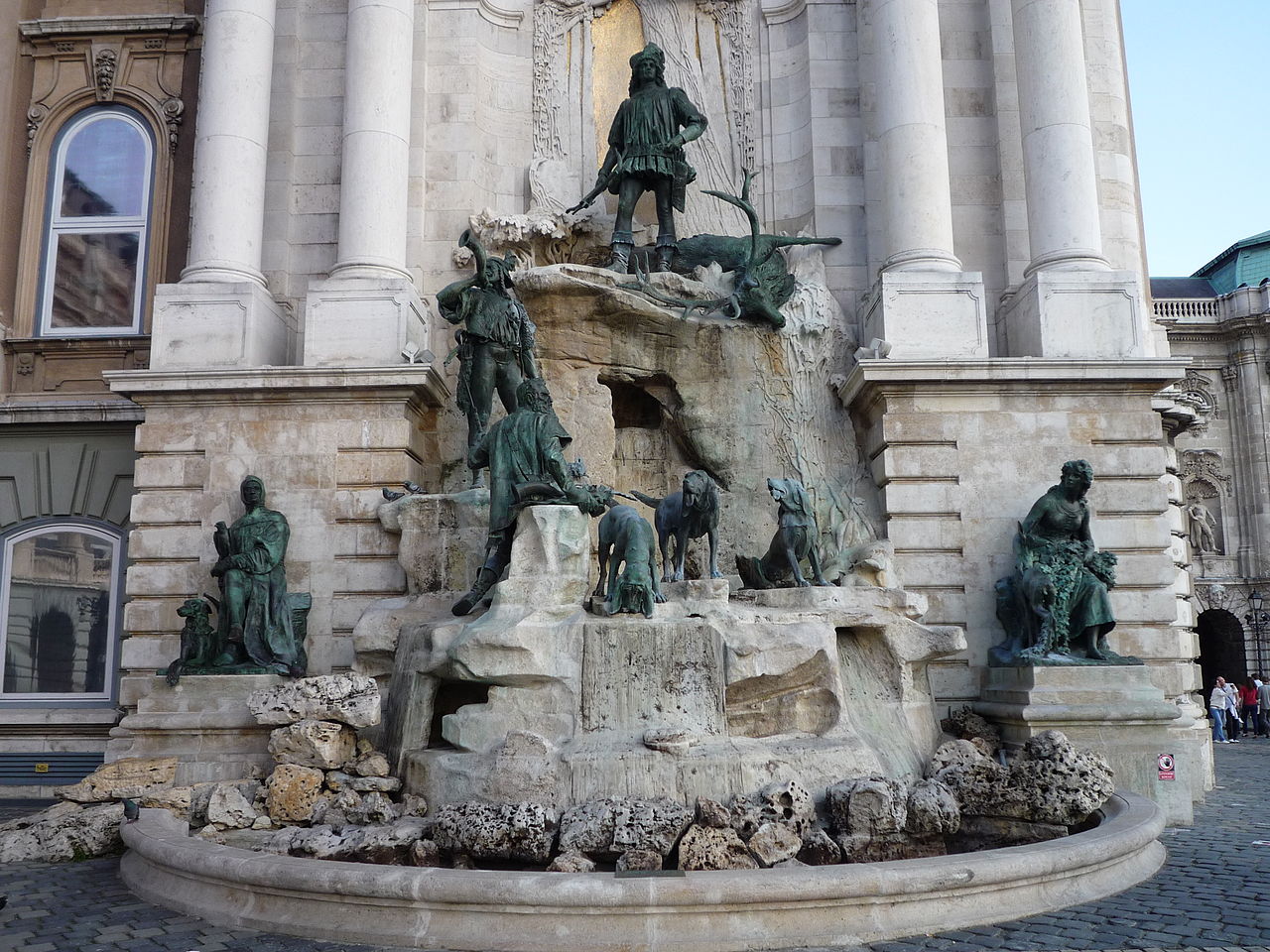
Behind the fountain, the façade is adorned with Corinthian columns and features the personal coat of arms of King Matthias in the central niche. The design showcases a distinctive fusion of artistic styles—traditional elements are combined with Art Nouveau details. The gentle flow of water through the rock crevices and the theatrical arrangement unmistakably echo the Roman Trevi Fountain, though the Budapest version is smaller in scale.
A curious legend is also tied to the fountain: according to some accounts, one of the hunting dog statues vanished because it caught the eye of Marshal Voroshilov. After World War II, a replica of the sculpture was returned to the composition. Another figure holding a falcon is believed to be Galeotto Marzio, known as the king’s court jester.