Subscribe to our social channels to get the latest news about Hungary!


The EU’s new potentially “veto-proof” proposal could allow up to €90 billion to be mobilized in support of Ukraine using frozen Russian state assets. Hungary’s position was clearly expressed by Foreign Minister Péter Szijjártó at the NATO Foreign Ministers’ meeting, emphasizing Budapest’s objections to the plan.
The fate of frozen Russian assets has been a topic of debate among EU member states for months. Legally, the money belongs to Russia, but the EU already uses part of its returns to support Ukraine. The Commission now aims for a much larger scale: mobilizing the full amount, complemented by a loan-like mechanism, which would constitute one of the largest financial packages for Ukraine since the start of the war.
“While we see Russia’s attacks intensifying, Ukraine’s financing needs are simultaneously increasing. According to IMF estimates, Ukraine will require around €135 billion over the next two years,” said Ursula von der Leyen, President of the European Commission.
Currently, a unanimous decision is required every six months to keep the Russian assets frozen. If a member state vetoed the proposal, the entire mechanism could be jeopardized, as the funds would theoretically have to be returned to Moscow.
According to Politico, the EU Treaty’s Article 122 could provide a legal workaround, allowing member states to make decisions by qualified majority in exceptional economic situations.
If the proposal is approved, the EU would effectively create a safeguard over the decision-making process, ensuring that frozen Russian assets can be mobilized for Ukraine’s support over the long term. Critics argue, however, that this solution could weaken member states’ veto rights and pose significant risks.
Hungary’s Foreign Minister Péter Szijjártó also reacted to the plan at the NATO Foreign Ministers’ meeting:
“No matter what Ursula von der Leyen proposes, even if she turns upside down or does whatever, the money of the Hungarian people will not go to Ukraine, not a single penny,” Szijjártó said.
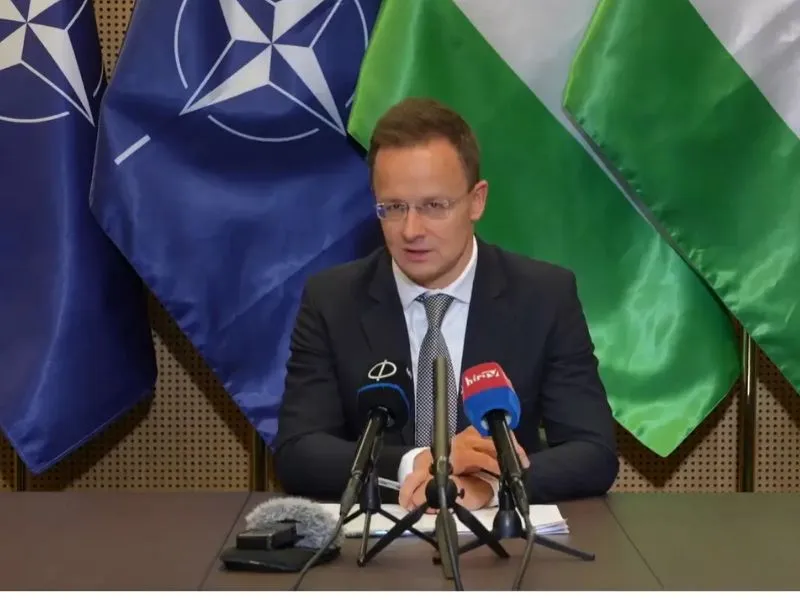
“Instead of sending more money to Ukraine, they should be made to account for how they spent the funds sent by European citizens, and how much of it their war-time mafia, organized at the highest levels of the state, has taken from what European taxpayers provided.” – added the Hungarian foreign minister.
Szijjártó referred to the recent Ukrainian corruption scandal, which led to the resignation of President Zelensky’s chief of staff at the end of November. It is, however, not proven that President Zelensky or Ukraine’s top-level leadership were personally involved.
Since Belgium’s banking system manages a significant portion of the frozen Russian assets, the country’s biggest concern is that a veto from any EU member state—such as Hungary or Slovakia—could prevent the extension of sanctions. In that case, the Belgian government would theoretically have to return the frozen billions to Russia.
The Belgian Prime Minister therefore considers the proposed “reparations loan” for Ukraine the worst possible instrument, as using the frozen assets carries too much risk: potential legal proceedings and claims from Russia could easily exceed the value of the assets, including interest and lost returns.
The final decision is expected on December 18 at the EU leaders’ summit, where member states will vote on the qualified majority solution. Hungary and other vetoing countries could influence the outcome, making their positions crucial for the future of the frozen Russian assets.
Cover photo: © European Union 2024 – EP

 ZH
ZH IT
IT DE
DE HR
HR NL
NL FR
FR JA
JA RO
RO RU
RU ES
ES TR
TR


A small country that receives more money from the EU than it pays in is trying to act like it’s protecting EU taxpayers. It uses its veto to block what most other members want, while its own budget depends on the EU’s support. It’s like biting the hand that feeds you and calling yourself a guard dog.
“A small country that receives more money from the EU than it pays in is trying to act like it’s protecting EU taxpayers…”
A large union trying, in plain sight, to loot billions of dollars that do not belong to them, for a war that they determined to start with Russia, as long ago as 1989.
Orban, Dear Rádzs, is not only protecting European taxpayers, he is protecting Europe from looking even worse than it already does.
Orban is standing up for both moral and legal behavior – his stance completely and unerringly in line with our Christian culture.
Once the world trust that The West was a good place to invest and build.
Now, after several years of the most glaring banditry of assets that are Russian, not to mention all of Hungarian money that has been unjustly held back from Hungarians, all to break the Hungarian economy – in order to regime change your leader, nobody in the world can trust anything to do with the EU.
Orban is certainly NOT biting that hand that feeds it, but taking a shovel to the head of a group of very venomous snakes.
God bless Orban for doing what any self-respecting European politician would have done, not so long ago.
Whatever Hungary’s inner faults are, it sets the very finest standard in the world – cooperation and diplomacy.
Happy Holidays!
A guardian of principles or a blocker of unity? The view depends entirely on one’s stance. While you see a moral stand for legal order, many see a veto used for political leverage within a system Hungary benefits from.
The core conflict isn’t about accounting, but about whether Europe’s response to aggression should be collective or subject to individual veto.
The summit will test if the union’s cohesion is stronger than any single dissent.
Happy holidays to you as well.
And indeed I dont agree that this belong to 1989 at all!!
“A guardian of principles or a blocker of unity? The view depends entirely on one’s stance…”
I love this statement of yours, Dear Rádzs.
How true it is!
Concerning the notion of collective EU cooperation, in the case of Aggression, I remind you that the EU has the rules of unanimity, therefore a veto is valid.
Moreover, I do not see Russian ‘aggression here’.
What I see is Anglo-American-EU aggression.
Our Secretary of State, James A. Baker, gave his promise to the Russians, in 1989, that NATO would not move one foot forward, if Russia allowed a German reunification.
Yet, where is the war?
1,000 miles to the East of the German eastern frontier.
Well, we put up our first Christmas tree tonight – a large tree in the foyer.
Next it is on to eating all the cakes and cookies my wife will bake.
I hope holiday preparations are going well where you are.
Victor Mihaly. Orban has personally, his Fidesz Government – SMASHED all trust and respect of the name Hungary in the European Union.
This will NOT be “reversed” the treatment through the name Orban – his “personal” crimes, his Fidesz Governments crimes committed against membership of the European Union.
Orbans “mouth”.
Orbans – BLAME games.
Orbans – fabrication of Truth, his “Judas” conduct against the European Union against DEMOCRACY.
Orban – his wanting slices from “both” sides – DEMOCRACY and his support of Putins Russia his “supposed” relationship, with the President of the United States of America, a Presidency under D. J. Trump that grows in being of CHAOS.
Orban, through failings of his personal political ideas and philosophies, his Dogma, his “idiotic” ideologies that ALL come back to either you are “on board” with DEMOCRACY or continue on, as FACTUALLY he is -taking Hungary deeper into a “new age” darkening Abyss, of No future reverting transferring Hungary back to a “full on” Dictatorship, a “blue print” replica – of the infamous years for Hungary 1945-1989.
Victor Mihaly. Orban – (16) sixteen years, his “second” coming as Prime Minister of Hungary, his “heinous” and “toxic” in culture – a Fidesz Government of Greed, of Selfishness, of total Exploitation to millions of Hungarians, that after (16) sixteen years have POSTIONED Hungary as a cataclysmic Economic & Financial being DEBT “riddled” country.
Victor Mihaly. Orban – through the “grease” on his palms, and on the palms the entire names of his Fidesz Government, the “inner sanctum” the Oligarchy – palms SATURATED through a “greasing” for US first not the People of Hungary – must be bought DOWN removed from Governance of Hungary come Spring of 2026.
Victor Mihaly. Orban – his Fidesz Government have HUMILIATED the name Hungary that trust and respect throughout Europe, the European Union and Globally countrys Governed by Democracy or who “embrace” Democracy – pay respect to the word DEMOCRACY.
Spring of 2026 the DOWNFALL one of personal humiliation on Victor Mihaly. Orban and on the name Fidesz and that they can NEVER be APPEASED.
I think you don’t quite understand the consequences for a small country like Belgium if this money were stolen, because that’s what VDL wants! Yesterday, the entire Belgian federal parliament voted against this decision and unanimously supported Belgian Prime Minister Bart De Wever!Valerie Urbain, the CEO of Euroclear, where the Russian assets are held, warns that if the money is seized—and this is the word she used—it will have unprecedented consequences! First and foremost, there are the legal consequences for Euroclear because Russia will legally challenge this decision!Euroclear will also initiate legal proceedings against the European Commission if it is forced to release the assets!Even if Euroclear were to remove the 180 billion euros from its balance sheets, this would be the death blow for them! It will also have an impact on the reliability of Europe as an international financial player! Other countries that also have deposits with Euroclear will reclaim them because they will be afraid that Europe thinks it can simply seize their money! Febelfin, the Belgian Banking Federation, also warns that this will cause problems for Belgium when it wants to borrow money on the international market! The interest that Belgium will have to pay on its debt papers will rise enormously! Will they demand that Belgium act as guarantor only if Russia reclaims its assets through international legal proceedings? The total amount of repayment will, by the way, far exceed 180 billion euros when interest and legal costs are included! The Prime Minister of Belgium rightly notes that this means the financial ruin of Belgium? Will Von der Leyen and countries like France, Germany, and Poland, which are very much in favor of this confiscation, demand that Belgian taxpayers put this money on the table? This whole insane idea is legally built on quicksand! Do you really think that all EU countries are happy with this idea of the unelected Von der Leyen and her gang of bureaucrats? Even if there are guarantees that the EU will provide some kind of solidarity mechanism, there will still be opposition, and not just from Hungary! Former Belgian prime ministers, such as the socialist Di Rupo, have expressed their support for current prime minister and political rival Bart De Wever!Public opinion is hostile to this plan and even calls it theft! Support for Von der Leyen in Belgium is very weak, especially since she is of German descent and Belgium has not had very good memories of Germans! This has to do with the two world wars in which the Germans did not show their best side! Deportations of Jews and non-Jews to concentration camps and the executions of civilians have not been forgotten by many families.Belgium provides Ukraine with more than a billion euros in aid every year, while in our own country there is a lot of discontent among the population due to budget cuts! The corruption scandals and mafia practices in Ukraine speak for themselves and are fed up with many Belgians! The attitude of the many Ukrainian refugees who enjoy abundant financial and material support as well as free access to medical care is causing much resentment! The latest and umpteenth corruption scandal in the EP has even led many Belgians to call for a Belgxit! Whatever the outcome, both internal Belgian and European politics will suffer heavy damage! Also, don’t forget that the only place citizens can get revenge is in the voting booth! The traditional parties in Belgium such as the Catholics, Socialists, Liberals, Greens, and Nationalists are very wary of this! Only the far-left and far-right parties are the winners! To be continued….
Europe is facing an existential crisis with Russian invasion and Hungary is doing everything it can to prevent Ukraine as part of Euroep from defending itself. Hungary is working for Putin, for Russia. Someone needs to neuter the Fidesz government because it will assist Putin to destroy us.
“They sometimes speak in soothing tones of brotherhood and peace, because, like other dictators before them, they’re always making “their final territorial demand,” some would have us accept them at their word and accommodate ourselves to their aggressive impulses. But if history teaches anything, it teaches that simpleminded appeasement or wishful thinking about our adversaries is folly.” (Ronald Reagan)
“Europe is facing an existential crisis with Russian invasion…’
It’s all a creation of the Western Elite, Dear Larry, and they need it for many corrupt reasons. – not least of which they tried, again, to regime change Putin; they need a reason to launder European taxpayer money, and an enemy greater, or at least for the time being, than the ones they are hurriedly importing.
Russia has less than zero interest in attacking Europe, unless Bruxelles insists.
If Russia were nearly so aggressive as you think, the war would currently be somewhere between Warsaw and Berlin.
I hope this remark finds you in good health and cheer!
I am sure you have the answer, @Mouton.
Russia bribery and influence operations have targeted European politicians across multiple countries, from what I can find online in Germany, Austria, Belgium, the United Kingdom and France.
In the past, lucrative board positions at Russian energy companies were on offer (“Burisma!”), undisclosed payments, and funding for political parties – both covert and disclosed, through traditional banks. Many cases centered around energy sector deals and Ukraine, with politicians receiving financial incentives in exchange for favorable policy positions toward Russia.
These Russian examples reveal how foreign powers exploit weak oversight to influence policy decisions on critical issues, including but not limited to energy security and sanctions.
I could go on. The cyber attacks, Physical sabotage incidents, disinformation campaigns, etc. – however … The screeds are already getting too long. Hardly good neighborly conduct – the groundwork for a future conflict started a while a go.
Well, all the smarties here: note that EU had other purposes before it became a dictatorship.
Europe is a collection of individual countries.
I don’t feel friends with Germans, French or Bulgarian.
We alle have our own RULES and LAWS.
EU did a coup and took away our sovereignity.
The EU-experiment has failed just like diversity