


Ambassador Ronan: the Irish community in Hungary is active, vibrant – INTERVIEW

Change language:
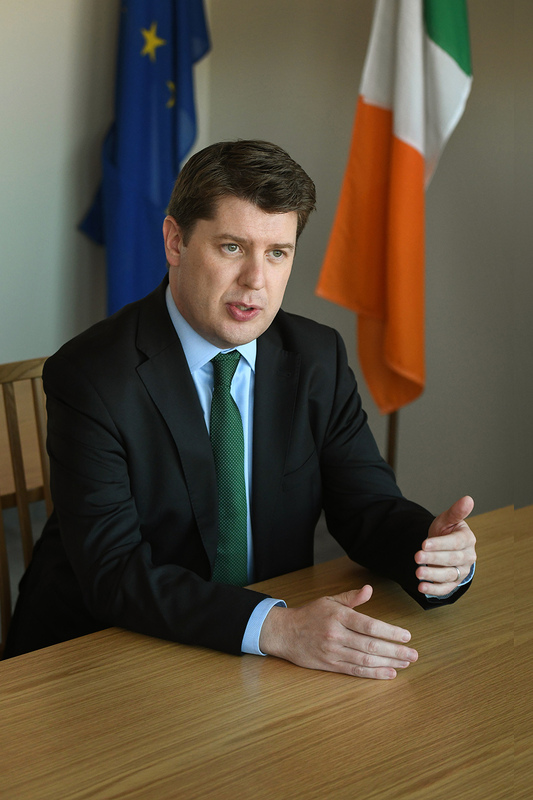
His excellency Ronan Gargan, the Ambassador of Ireland to Hungary, arrived to Budapest in December 2019, so he spent the coronavirus epidemic in Hungary. We asked him how he and his family feels in Hungary, what Hungarian products he would recommend for his Irish fellows, and what he likes most in Hungary. He also talked about the Irish community in Budapest and why Irish people move to Hungary.
DNH: You lived in Brussels with your family before coming to Hungary. What was your first thought when you found out that Budapest would be your new home for a couple of years?
Ronan Gargan: Excitement. I knew that I was coming to a really interesting city and country, with a fascinating if not complex history, not dissimilar to Ireland’s historical experience, and with a very rich culture. And I knew that my children would really enjoy it here, despite the lack of snow which I promised them! My experience of living here has only proven this and has been beyond my expectations.
DNH: Can you mention one thing that attracted you the most about Budapest?
Ronan Gargan: It is difficult to narrow it down to one but if pushed, it would have to be the culture – the arts, music, architecture, the café culture, the food culture. It such a vibrant city with so much to see and do and to enjoy.

Read alsoChilean ambassador in Budapest: Hungarians, Chileans have a very introspective personality
DNH: How many Irish citizens live in Hungary approximately? In what fields do they typically work?
Ronan Gargan: We estimate that about 1000 Irish citizens live in Hungary with about 500 in Budapest. Their reasons for being here are varied: some our retired and have an Hungarian spouse, others work for international companies here while up to 200 of our citizens here are students, mostly based in Budapest.
DNH: How cohesive is the local Irish community? Do they have a main base in Budapest?
Ronan Gargan: It is a small but very active and vibrant Irish community. They do a lot to promote Irish culture here, especially around St. Patrick’s Day on 17 March, Ireland’s national day and to strengthen people-to-people links. For instance, the community will organise a St. Patrick’s Day parade on the streets of Budapest on 19 March, the first parade since 2019 due to COVID. The main organisers behind the parade as well as other Irish cultural, social and business events in Budapest is the Irish Hungarian Business Circle, who the Embassy works very closely with. The local GAA club, Budapest Gaels, who plays Gaelic football, one of Ireland’s national sports, is also a good centre for the Irish in Budapest but they are always looking for new players, including Hungarians!
DNH: What cultural, economic and folklore programmes does the Embassy organise?
Ronan Gargan: The Embassy has a very busy events calendar all aimed at promoting Ireland in Hungary and furthering our bilateral relations. Our main events are around St. Patrick’s day but we also have events around St. Brigid’s Day on 1 February, Ireland’s other patron saint, which celebrates the creativity of women through contemporary art and music. Bloomsday on 16 June is also an important time for us as it celebrates the Irish writer James Joyce and his book Ulysses, which has a unique link with Hungary as the family of the main character, Leopold Bloom or Virág, hails from Szombathely where each year we support a Bloomsday festival. We had a range of special events this year, including music, art and readings, to celebrate the centenary of the publication of Ulysses.

Halloween on 31 October is also becoming a moment to celebrate Irish culture such as the Irish tradition of storytelling as Halloween originated in Ireland around the Celtic festival of Oíche Samhain. The Embassy also has a Book Club which meets monthly to discuss new Irish fiction and we will soon support the launch a new Irish film club. We also work closely with Enterprise Ireland, Ireland’s trade and business agency, which is also present in Budapest and supports events aimed at promoting trade between Ireland and Hungary.

Read alsoMoldovan ambassador: Russian aggression is highly destabilizing for Moldova
DNH: Thousands of people attended the St. Patrick’s Day event in Budapest before the COVID-19. What can we expect next year?
Ronan Gargan: The St. Patrick’s Day Parade in Budapest, which started in 2010 has grown over the years to be one of the biggest St. Patrick’s Day events in Europe outside Ireland. After a three year break due to COVID, the Embassy is delighted to support the IHBC in planning for the parade on 19 March 2023 which we hope will bring some Irish culture and colour to the streets of Budapest and once again attract thousands of Hungarians to share in our love of Irish culture and tradition and perhaps bring some Hungarian culture and tradition to the day.
DNH: A relatively large number of Hungarian workers have moved to Ireland and settled down there. However, there are also many who returned home after a few years with plenty of experience and life-long memories. Is there any link between the Embassy and Hungarians returning from Ireland?
Ronan Gargan: The Embassy very much values what we call our reverse diaspora, those Hungarian who have lived, worked or studied in Ireland, and continue to have a love for their home away from home. We consider them to be part of our extended Irish community here in Hungary and many get involved in our cultural events. I was delighted to see one such couple, Attila and Kinga Pécsi, who returned from Ireland after 10 years and opened a bakery in Budapest called arán, which means bread in the Irish language, and which does an amazing fusion of Irish and Hungarian baking traditions. There is also what we call the affinity diaspora, those Hungarian who have a love of Ireland, and who we work with, especially through some of the Irish Studies centres in Hungarian universities, to promote Irish culture. These people are invaluable to the strong links between the people of Ireland and the people of Hungary.