Hungarian astronomer leads discovery of hidden star in rare binary system

Change language:
In a breakthrough that sheds new light on how planetary systems like our own are formed, a team of international astronomers—led by József Varga of Hungary’s HUN-REN Research Centre for Astronomy and Earth Sciences (HUN-REN CSFK)—has identified a previously unseen star in a young binary system. The discovery offers unprecedented insight into the complex dynamics of planet-forming discs.
A Curious Cosmic Structure
Binary star systems, in which two stars orbit each other, are not uncommon in our galaxy. Yet the newly studied system, T Coronae Australis (T CrA), stands out. Located in the southern sky and enveloped in dense clouds of dust and gas, this young star has long intrigued astronomers due to the unusual structure of its surrounding disc—a key region where planets are believed to form, according to the press release.
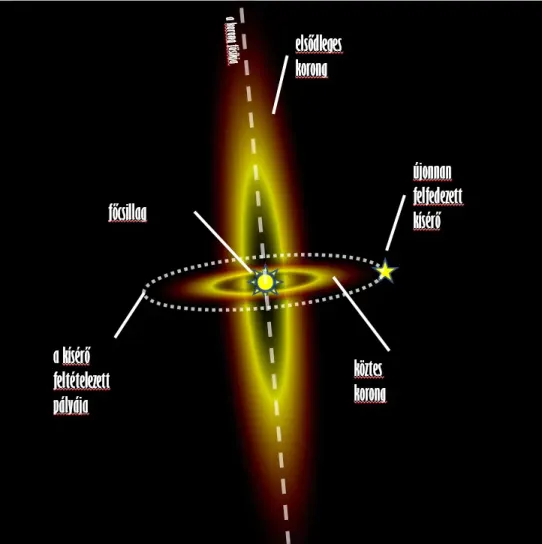
Unlike the symmetrical ring structures typically observed around young stars, T CrA’s disc is uniquely divided into two misaligned rings, with one nearly perpendicular to the other—an extremely rare configuration in astrophysics.
For years, scientists suspected that an unseen object—possibly another star—might be distorting the disc, creating a warped, intermediate structure. However, no such companion had previously been observed.
T CrA B: The Long-Sought Companion Star
That mystery has now been solved.
Using the Very Large Telescope Interferometer (VLTI) and the MATISSE instrument at the European Southern Observatory, researchers captured the highest-resolution infrared image of the system to date. It clearly shows the dusty disc surrounding the primary star, T CrA A, and—crucially—a second source approximately 23 astronomical units away: the newly identified T CrA B.