Subscribe to our social channels to get the latest news about Hungary!


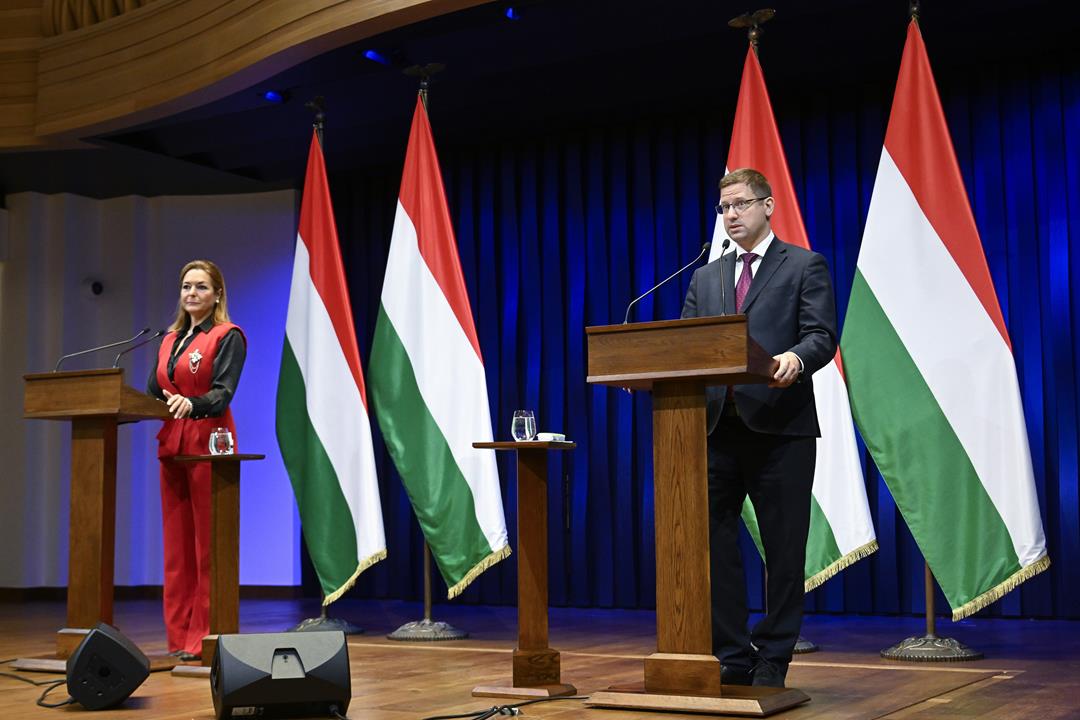
Gergely Gulyás, the head of the Prime Minister’s Office, shared some interesting information on yesterday’s press briefing about who the new constitution amendment concerning dual nationals may target. Scroll down for the details.
The government has decided to introduce a personal income tax exemption for mothers under 30 with one child from January 1, 2026, government spokesperson Eszter Vitályos said. Vitályos noted that the government had earlier decided to roll out a lifetime personal income tax exemption for mothers of two or more children. The exemption will enter into force for mothers of three from October, and for mothers of two in four phases starting in 2026, she added.
The government also decided earlier to double tax allowances for families and exempt child support from PIT, she said. From 2026, the measures will leave families with two children with an extra 189,000 per month, up from 40,000 forints, while that amount will rise from 99,000 to 307,000 forints for families with three children, and from 241,000 to 373,000 forints for families with four or more children.
The government spokeswoman said a government decree on allowing seniors in smaller towns participation in a home renovation programme has been published, adding that applications for a grant would be welcome from March 26 on.
Meanwhile, Vitályos said projects worth a total 13 billion forints have been completed in Hungary in recent weeks, and made special mention of a new 8 billion forint communications and optical cable factory in Kisbér, in northern Hungary. She also said Hungary’s “biggest ever” creche and kindergarten projects have taken place in recent years, worth a combined 2 billion forints.
Answering a question about exempting young mothers from the the personal income tax, Vitályos said the exemption applied to children already born, and to their full income rather than to the average wage. She added that the current benefit of 55,000 forints a month would increase to 100,000 forints.
Gulyás said if companies violated the new price margin regulations, they would face “sanctions ranging from a fine to closure”. Also, if companies tried to “counterbalance their losses” by through increasing the prices of other products not governed by the new rules, “then the government will intervene”. He said he hoped that the government would not need to take further steps and the current measures would be “sufficient to reverse a bad trend”.
Gulyás said the government was “prepared for the European Union to possibly attack the margin restrictions”, but added that the new instrument was “one currently applied by other EU members”. He also added that the government expected the new regulations to reduce inflation, and the central budget’s VAT revenues would not be impacted.
Meanwhile, he said the government was not expected to change its inflation forecast “for the time being”. He said the new measures would reduce inflation “significantly”. He added however that the effects were “yet to be seen” and it would be clear “in April or May if the goals have been realistic or not”.
Asked why the government had decided to refund VAT on certain foodstuffs rather than increasing pensions, Gulyás said that in light of a previous Constitutional Court ruling, pension hikes must be implemented uniformly, and this meant that retirees with a higher pension would receive more. But it was fairer if a big expense were reimbursed equally to pensioners, regardless of the size of their pension, he added.
Asked about peace talks, Gulyás said it would have been preferable for the EU to have a role in the peacemaking process, which Hungary had pointed out “countless times”. “Sooner or later Europe will have to be involved in the talks, and it would be good if by then the EU had a clear idea of what it wants … but for now there’s only chaos,” he added.
Gulyás said Europe was “weak” and was now “paying the price for having gone in the wrong direction”. Asked what outcome the government expected from the vote on Ukraine’s EU membership and what risks this would entail, Gulyás said he expected a “useful debate”, adding that the EU “doesn’t really allow debates among member states on Europe’s stance on the Russia-Ukraine war”.
Gulyás cited EC President Ursula von der Leyen as saying that Ukraine must join the bloc by 2030. “This isn’t the distant future, but a tangible close reality which already has as direct impact on the EU’s next budget,” he said.
As regards the risks that came with admitting Ukraine to the bloc, Gulyás pointed to the potential loss of cohesion funds, noting that agricultural regulations in the EU were different from those enforced in Ukraine. Noting last year’s debate on Ukrainian grain imports, Gulyas said Ukraine’s EU membership would also come with food security risks and, in Hungary’s case, general security risks.
Admitting Ukraine to the EU without merit “is against Hungary’s and central Europe’s interests, no matter how badly the European Commission, the European People’s Party and perhaps other European political forces want it,” he added.
Asked about Hungary’s upcoming vote on Ukraine’s accession, Gulyás said that on a technical level it will be organised similarly to National Consultation surveys, and voters will be able to return the questionnaire by mail. “The costs won’t be much different from the costs of prior National Consultations; if anything, it’ll be somewhat cheaper since we’re only talking about a single question, so it’s likely to cost a little over one billion forints,” he said.
Meanwhile, Gulyás slammed the measures Ukraine has introduced in connection with minority rights in the last ten years as “unacceptable”, saying they went against almost every European human rights convention and best practice. Hungary, he said, had always made it clear that good neighbourly relations with Ukraine were conditional on the restoration of the pre-2015 state of affairs.
Asked about reports that Fegyir Sándor had written a letter to the director of the State Opera House asking him not to allow a Russian singer to perform, Gulyás said he “understands the sentiment of Ukrainians towards Russians after three years of a heroic and patriotic war”, but it should be ensured “that this doesn’t turn into racial hatred”.
“A Russian athlete isn’t guilty just because they were born Russian. A singer isn’t guilty just because they were born Russian,” he said, adding that the rejection of the idea of collective guilt has been a principle since the second world war.
Commenting on Polish Foreign Minister Radoslaw Sikorski’s suggestion that it was Hungary’s EU membership rather than Ukraine’s that should be put to a referendum, Gulyás said: “The problem is that the Polish foreign minister isn’t familiar with the EU treaties, but that’s clear from what’s happening in Poland, with the Polish government indifferent to things like the rule of law and human rights.”
Concerning the state of the rule of law in Poland, he said the authorities were trying to undermine the presidential candidate of one of the major parties by denying him campaign funding. Meanwhile, he said, the government was conducting “mass criminal investigations on trumped-up charges”, and the EU was “not simply looking the other way, but loudly cheering them on”.
Asked about Polish Prime Minister Donald Tusk’s announcement that Poland is considering negotiating with France on the transfer of nuclear weapons to its territory, Gulyás said this was “speculation” and there was “no need to comment on it seriously at this stage”. He said a nuclear power did not have an interest in expanding the circle of countries with nuclear weapons, and urged caution regarding the transfer of nuclear weapons, adding that “the other side will just aim their own weapons where another country can strike from”.
Asked about a European Parliament declaration on supporting Ukraine, whose signatories included Tisza Party leader Péter Magyar — before his name disappeared — Gulyás said this was a “pitiful debate”, arguing that “if someone joins the party of alcoholics, it’s hard for them to put up a credible protest against the consumption of alcohol”.
He argued that a member of the European People’s Party was part of a community “that wants to provide financial support to Ukraine’s war effort until the very end”, adding it was “irrelevant whether or not they signed a document”.
Gulyás noted that EPP leader Manfred Weber has said the Tisza Party’s admission to the grouping was conditional on it supporting Ukraine. He added that the EPP had voted for a “pro-war proposal” and Tisza was part of the EPP group. “If they have a problem with this policy, they should’ve quit the EPP, but they joined fully aware of, and accepting, these terms,” Gulyás said.
Asked about reports that that former commander-in-chief Romulusz Ruszin-Szendi had used his social security funds to pay for a liposuction procedure, Gulyás said the Government Control Office (KEHI) was conducting an investigation. At the same time, “financing cosmetic surgery from social security is unlawful…” Gulyás said. “We are trying to preserve the dignity of the Armed Forces, even against the former commander-in-chief,” he said, adding that the government would not comment on the issue further.
Regarding an outbreak of foot-and-mouth disease, Gulyás said the outbreak appeared to be contained for now, and the last of the infected animals would be destroyed by Thursday. He said inspections were under way but no further infections had been discovered, “which suggested that the quick response was effective”. All of the infected animals are being destroyed and restrictions have been placed on animals in a 10km zone around the area of the outbreak, he added. The minister said that the European Union has issued a certificate requiring other member states to accept imports from Hungary.
Fifteen non-EU countries have temporarily banned imports of Hungarian meat products, he added. Farmers affected by the disease will be fully compensated by the state, he said. Gulyás said there was an investigation under way to ascertain how the virus had arrived in Hungary. Another strain has been identified in Germany, he noted.
Meanwhile, asked to comment on reports that US soldiers could be deployed to Hungary, Gulyás said the US government had not confirmed that information.
Regarding a meeting between US President Donald Trump and Prime Minister Viktor Orbán, Gulyás said such a meeting would be announced only once the date is fixed. Meanwhile, he said he expected that Antal Rogán, the minister leading the Cabinet Office, would be removed from the US sanctions list “in the foreseeable future”.
Gulyás confirmed that Israeli Prime Minister Benjamin Netanyahu is expected to visit Hungary before Easter. He said that while the government had not yet decided to leave the International Criminal Court, he personally “would support” such a move as the body “has lost its meaning when it engaged in political activities rather than legal ones”.
Gulyás said that Germany had made it clear “it will ignore the ICC’s arrest warrant against Netanyahu”, despite the fact that it had ratified regulations regarding the ICC. “Germany is breaching domestic regulations by not arresting the Israeli prime minister; Hungary has not ratified anything, so it doesn’t breach any regulations,” he said.
Put to him that the recent amendment of the Fundamental Law allowing the expulsion of dual citizens from Hungary could affect American financier George Soros and his son, he said: “The media has been fairly accurate on the intent”, adding, however, that the amendment had yet to be tabled in parliament. Asked who would decide on suspending Hungarian citizenship, Gulyás said: “There is a legal system already in operation on that matter… If Hungary wants to keep someone out, it can do so. This is clearly the government’s task.”
He said Péter Márki-Zay, the leader of the Everyone’s Hungary Movement, did not fall under the amendment’s purview as he served as the elected mayor of a city, he said. Regarding amendments to the Fundamental Law’s provisions on the state of emergency, Gulyás said the press had reported “several misconceptions” and the amendment was actually a restriction on the government.
“Should the government order a state of emergency under its own authority today, it would also be able to legislate. Regulations will change so that after declaring a national emergency, it will only be able to create laws with parliament’s approval,” Gulyás said.
Regarding the recent crack down on drug traffickers, Gulyás said the data collected would be summarised by the weekend. The police have taken action in all larger cities where drug trafficking has been suspected, he said. The government commissioner for eliminating drug trafficking will submit a package of legislation proposals on issues such as the seizure of assets, detention and the qualification of crimes committed to procure drugs, he said.
Meanwhile, Gulyás noted Hungary’s “extremely stringent” laws on drug abuse, adding that Budapest’s “liberal drug policies” had led to a drug-related death rate “twice as high in Budapest compared to the national average”. He added that the solution was not “to provide the conditions for drug abuse” but to wean users off drugs.
Concerning recent legislation under which a government finance commissioner could be delegated to ailing municipalities, Gulyás said local councils were autonomous and appointing a commissioner would be a “last resort” when a municipality was bankrupt of nearing bankruptcy.
Commenting on plans by the City of Budapest to take out a loan of 90 billion forints to finance the Rakosrendezo project, Gulyás said the government was not consulted, but, he added, “the capital suddenly found 50 billion forints to use its pre-emptive rights and purchase the area means that it is the richest municipality in the country.”
Gulyás was asked about a tendency of falling fuel prices that started in February, and he said the government saw it as a result of a deal with distributors under which fuel prices in Hungary could not exceed the regional average. He said the government monitored the prices weekly, adding that last week the prices were 6 forints below the regional average. “Everybody is abiding by the agreement, which is good,” he said. He also added that “approaching peace” had reduced oil prices, while the forint also strengthened in the past 3-4 months.
The government has authorised Márton Nagy, the economy minister, to negotiate with banks concerning their high monthly fees, as well as “to ensure that there is a ATM in every locality where the community wants it”.
Meanwhile, asked about press reports that company management at a battery plant at Iváncsa, in central Hungary, were encouraging employees give notice voluntarily “so that the company does not lose state subsidies over laying off staff”, Gulyás said he had no information about “that being common practice” and suggested that “nobody should sign a statement against their will”.
Concerning a battery processing plant in Sóskút, in central Hungary, Gulyás said “several plants have been built in Hungary in recent decades amid minor or major concerns, but none of those concerns have proved justified.” If construction of a plant is opposed by the municipality “it should not be built … but once it is completed the government office must consider the regulations and decide whether to grant permission for its operations,” he said.
Concerning an attack against Hungary’s ambassador to Greece by Antifa, Gulyas said the Hungarian government condemned all violent activities, adding that he would welcome “including far-left organisations on a list of terrorist organisations”. “Far-right organisations are included even when their political motivation can be disputed, while the far left is omitted even when they are in fact terrorists,” he added.


