Subscribe to our social channels to get the latest news about Hungary!


The fantastic tour guides of GoNativeGuide can help you see all of them while they tell many little ‘behind the scenes’ stories as well, making your stay in Budapest as colourful as you would want it to be. Among the multitude of the Hungarian startup’s offers, everybody can find the tour that best suits them.
GoNativeGuide is specialised in sightseeing tours for foreign tourists done by local tour guides. They believe that travelling and sightseeing are a lot more fun if you are not just a tourist, but you also get to know the locals. Thus, they show not only the famous, well-known sights but also all those
hidden corners and details that only those people know who live there.
In fact, they offer a multitude of different tours which you can check HERE while you can find further information about them HERE.
I met one of their amazing tour guides, Helga, on a sunny but rather chilly and windy day near the Dohány Street Synagogue. When we agreed before that she would show me the monuments of Budapest related to the Anglosphere, I thought that there was no way to walk 3 hours searching for them because there is simply not enough material to see and talk about. However, I soon realised that I could not have been more wrong.
My tour started at the synagogue which is the largest of its kind in Europe and the second largest in the world. It seats 3,000 people and is a centre of Neolog Judaism. However, many do not know that
famous American actor of Hungarian origins, Tony Curtis,
contributed a lot to the restoration of the building in 1996, and his Emanuel Foundation paid for the Holocaust (or Emanuel) Tree of Life Memorial, a weeping willow with the names and tattoo numbers of those who died or disappeared.
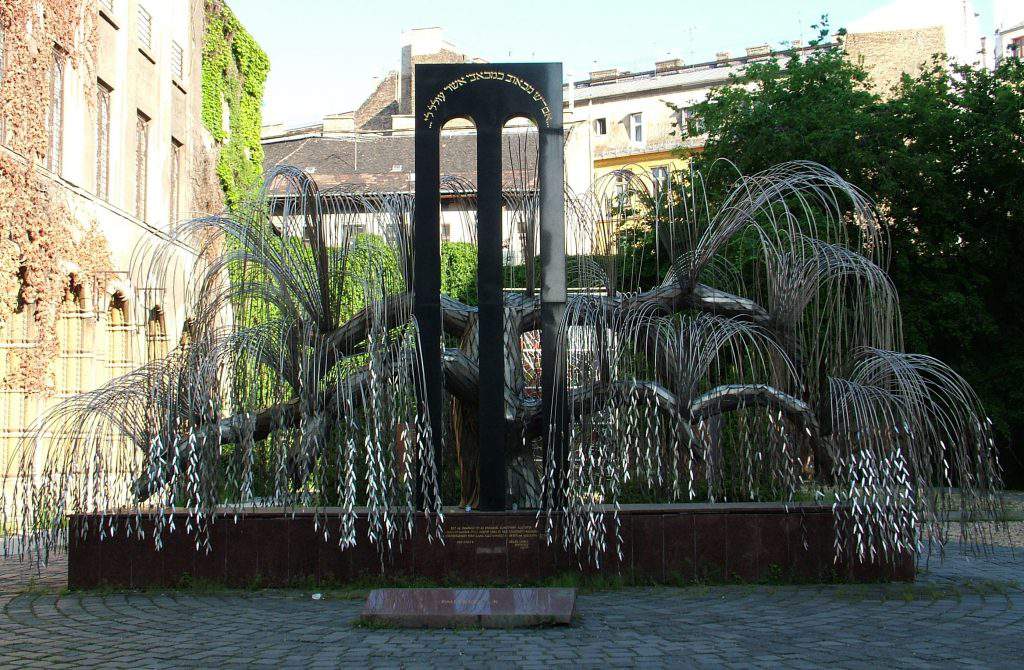
In fact, he did this for his Hungarian-born parents, Helen and Emanuel Schwartz. Even though he was already born in the USA, he never forgot his Hungarian roots. For example, in this video, he promotes Hungary:
Many people know that Count István Széchenyi did many things to develop Hungary in the 1820s and 1830s. For example, Pest and Buda were not connected those days by a stone bridge, so it was almost impossible to cross the Danube during winter when the river’s surface was frozen. Allegedly, after Count Széchenyi could not get to his dying father because of the lack of a stone bridge, he decided to build one. Therefore, he travelled to England and asked the well-known architect, William Tierney Clark, to design a suspension bridge over the Danube. However, since he was very busy, he sent one of his colleagues and friends, the Scottish Adam Clark, to Hungary to supervise the construction of the Chain Bridge, which is now a symbol of Budapest. Since he was already here,
Adam also designed the Buda Castle Tunnel.
This is why the square between the Chain Bridge and the tunnel is named after him even today.
On the opposite side of the bridge, there is the Széchenyi Square with the Hungarian Academy of Sciences. In fact, the square bore the name of American President Franklin D. Roosevelt after WWII, but it was renamed in the Communist era. The name-changes in Budapest are interesting in themselves, for example, before the change of the regime, the Hold Street of the 5th district was named after Julius and Ethel Rosenberg,
the American couple executed because of transmitting nuclear weapon designs to the Soviet Union.
On the other side of Hold Street, there is Liberty Square with the American Embassy and the statue of Harry Hill Bandholtz, the American general who saved the Hungarian National Museum. We wrote about him and his deeds HERE.
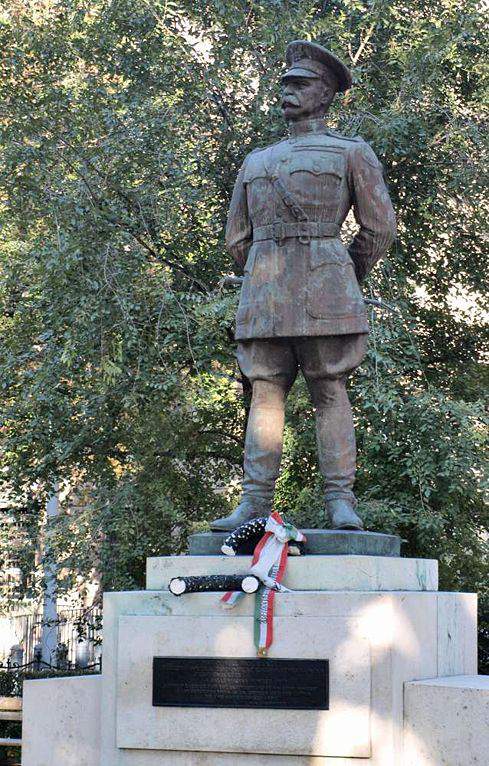
Probably not many people know how many British and American statues there are in Budapest. For example, President Ronald Reagen has a bust and also a statue in Budapest, the former in City Park while the latter on Liberty Square. Furthermore, the first American president, George Washington, also has a commanding statue in City Park, with British PM Sir Winston Churchill.


Not only politicians but also world-shaping inventors like James Watt and George Stephenson received a statue in Budapest, on the facade of the Eastern Railway Station. Moreover, Detective Columbo (Peter Falk) and his dog are also commemorated near the Grand Boulevard, on Falk Miksa Street. Allegedly, they are relatives; however, experts say that they only bear the same surname. Speaking of actors, even world-famous English playwright, actor and poet William Shakespeare has a statue in Budapest, near the Chain Bridge, which is the copy of a statue erected in the Australian Ballarat.


Source: Daily News Hungary


