Subscribe to our social channels to get the latest news about Hungary!


Budapest, May 10 (MTI) – Parliamentary Speaker László Kövér discussed bilateral relations with his South Korean counterpart and other officials in Seoul on Tuesday, parliament’s press chief said. Hungary’s relations with the Republic Korea have seen fast-paced development and many successes over the past 27 years, he said during a visit.
The Republic of Korea is one of Hungary’s major economic partners in Asia, Kövér said after talks with National Assembly Speaker Chung Eui-hwa. The government aims to maintain the current high level of economic cooperation between the two countries and expand ties in the areas of education, culture and tourism, too.
Kövér noted that Hungary plans to open a trading house and a cultural institute in Seoul.
The speaker said bilateral trade turnover increased by nearly 9 percent last year to 1.9 billion dollars. South Korea has so far invested over 2 billion dollars in Hungary, making it Hungary’s third largest Asian investor.
Tourism cooperation is also on the rise, Kövér said, noting that more than 100,000 South Korean tourists visited Hungary last year, a 10 percent increase over 2014. Kövér said visitor numbers are expected to increase further still with Asiana Airlines, South Korea’s second biggest carrier, having agreed to operate direct flights between the two countries’ capitals starting in July.
Kövér later visited the War Memorial of Korea where he paid tribute to the victims of the Korean War.
He also paid a visit to the Hankuk University of Foreign Studies and met the university’s president as well as instructors and students at the Department of Hungarian Studies. There are 34 students studying at the department. Hungary has 100 Korean students pursuing studies at its universities as part of the Stipendium Hungaricum scholarship programme signed by the two countries in 2014.
Kover later presented the Order of Merit of Hungary, Officer’s Cross to Dankook University President Chang Ho-sung on behalf of President Janos Ader for his role in launching the student exchange programmes and the overall development of relations between Hungary and the Republic of Korea.
The Hungarian delegation also met members of the Hungarian-Korean Inter-Parliamentary Friendship Group.
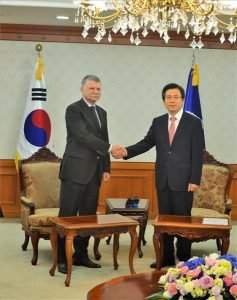 Kövér held talks with Prime Minister Kyo-ahn Hwang, who said Hungary takes a special place among South Korea’s partners as it was the first eastern European country to take up diplomatic relations with South Korea in 1989. The Korean prime minister welcomed the Hungarian delegation’s visit and said it could contribute to stronger relations advocated already by Prime Minister Viktor Orbán’s “opening to the East” policy. The Far East can thus become a source of growth for the Hungarian economy, he added.
Kövér said South Korea was a strategic partner for Hungary with one of the strongest ties developed there for trade and investment in Asia. Some thirty South Korean companies have provided jobs to 23,000 people in Hungary and investments exceed 2 billion US dollars, he added. After big companies like Samsung and Hankook Tyres have paved the way Hungary now hopes that small and medium-sized companies (SME) will settle in Hungary, too, especially from innovative sectors, Kover said.
Hwang thanked the Hungarian government for “its fast response in condemning the provocations levelled by North Korea”.

Kövér and his delegation will continue his visit in Japan on Wednesday, where he will be met at an audience by Emperor Akihito, and will hold talks with Prime Minister Shinzo Abe as well as Speakers of both the upper and lower houses of parliament. He will also meet with representatives of the Japanese-Hungarian friendship chapter of parliament and visit the Hiroshima Peace Memorial and the Nuclear Bomb Museum.
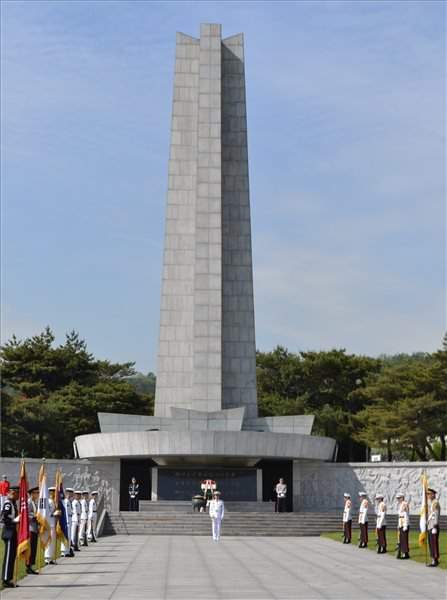
Photo: MTI
Source: http://mtva.hu/hu/hungary-matters


