Subscribe to our social channels to get the latest news about Hungary!


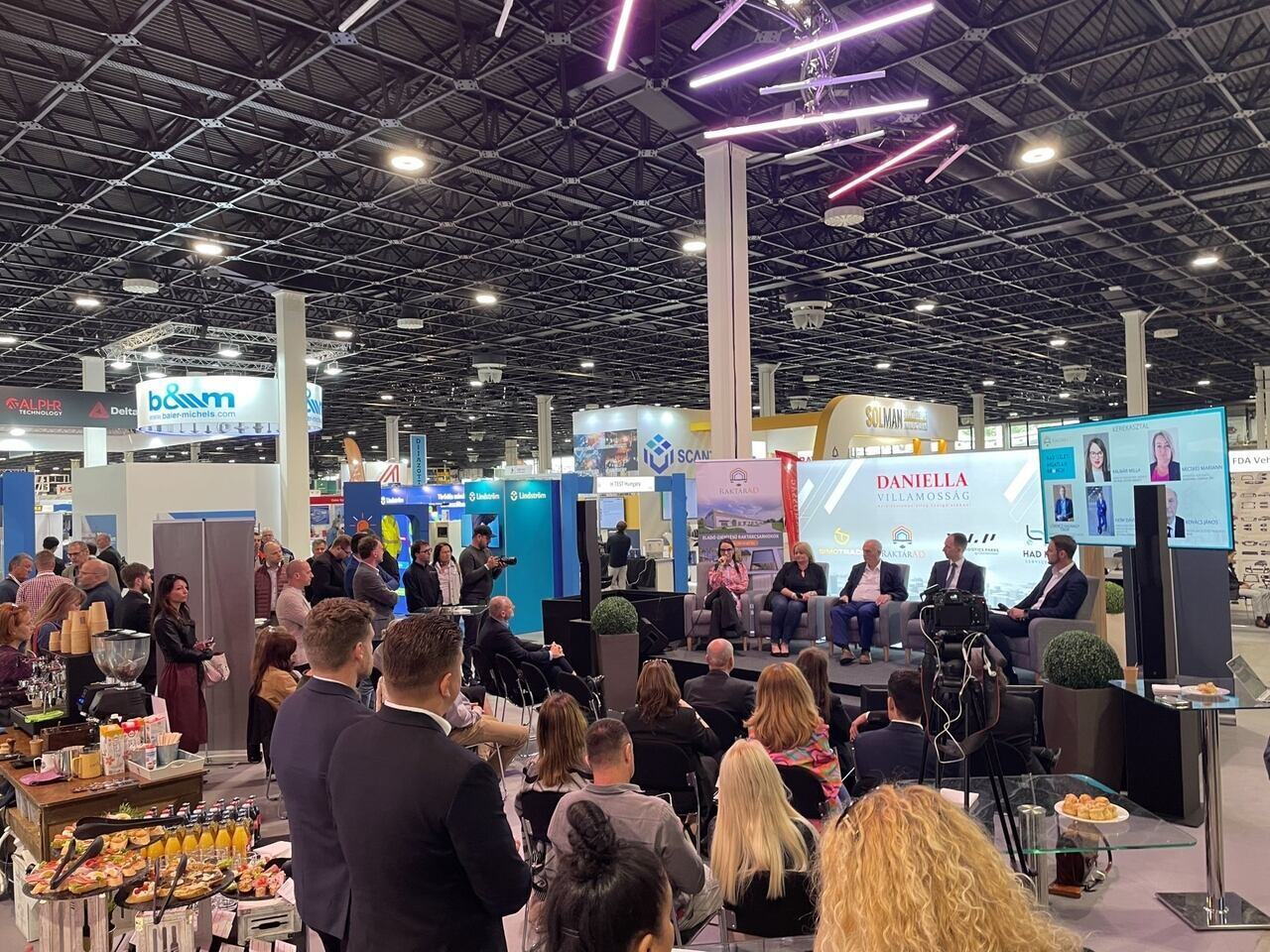
Leading representatives of the domestic real estate market gathered for the second time on May 15th, 2025, at the exclusive HAD Real Estate Business Brunch organized by RaktárAD, a Belgian-Hungarian-owned company, within the framework of the Industry Days exhibition, where the company group also won the award for the most beautiful stand this year.
The event focused on the inflation challenges of the domestic SME sector, investment opportunities, facility location selection considerations, and growth-enabling financing structures, which together determine the development trajectory of businesses.
The presence of top-tier invited experts elevated the event’s prestige: Milla Kalmár, head of the industrial real estate division at 108 Real Estate Hungary, Mariann Micskei, chief operating officer of Goodwill Energy Ltd., János Kovács, vice president of the real estate department of the Budapest Chamber of Commerce and Industry (BKIK), Dávid Heim, franchise partner & commercial real estate expert of Otthon Centrum and Tibor Lőrincz-Hadnagy, partner and business development manager of HAD Group, shared current market trends and practical experiences with the participants.
The prestigious professional event was opened by Ernő Hadnagy, president of HAD Group, who announced in his speech that RaktárAD, reflecting on the growth demands of businesses and the most sought-after locations in the region, is implementing a targeted expansion strategy that, in addition to existing developments in Alsónémedi and Vecsés, will launch new industrial projects in Nagytarcsa and Bag. Furthermore, it is initiating a strategic opening towards the northern and western agglomeration of Budapest – especially Dunakeszi and Budaörs – offering modern and competitive warehouse solutions.
Over the past ten years, the Hungarian economy has suffered nearly 80% inflation, well above the EU average of 30-35%. This has particularly affected small and medium-sized enterprises (SMEs), where significant productivity disparities have emerged. While the real-term performance of sole-proprietor micro-enterprises stagnated, the productivity of companies with 2-9 employees outpaced inflation by 60-70%, and medium-sized companies saw a productivity increase of 40% above inflation.
Although the number of businesses has increased by 50% in 10 years, the expansion is primarily due to one-person and so-called “zero-person” project companies. The number of small and medium-sized enterprises has essentially remained unchanged.
The SME sector accounts for 65% of the workforce, but in an inflationary environment, most of their resources are consumed by wage costs, leaving little for development. Companies that have strengthened their operations with conscious investments have now become more competitive, more capital-rich players, and appear more actively, for example, in the industrial real estate market.
Although the domestic banking system is currently operating in a state of abundant liquidity, lending activity is still subdued, as financial institutions can typically only serve creditworthy clients. “The vast majority of micro and small enterprises – especially sole proprietorships – typically do not meet these conditions, and are therefore excluded from effective financing. The number of domestic small enterprises is exceptionally high in comparison with the EU. Within this, the proportion of micro enterprises is also high, yet this segment lags behind the most in terms of development opportunities.
The reason for this is that such companies are often not established out of business considerations, but out of necessity to make a living. The disproportion in support systems further deepens the gap between multinational companies and domestic SMEs. In recent years, industry giants – especially players in the battery and automotive industries – have received significant state subsidies, while smaller enterprises are often excluded from these opportunities. In the interests of competitiveness of domestic companies, a reevaluation of the current support structure would be reasonable.” – explained János Kovács, vice president of the real estate department of the Budapest Chamber of Commerce and Industry (BKIK).
Most businesses lack a strategic approach tailored to the company, portfolio management adjusted to the projects, a digital presence – in many cases they don’t even have a website – and limited external market connections. A lack of competence, a lack of financial resources, as well as infrastructure and motivation deficits all hinder their growth.
Addressing these issues, the Sándor Demján Program was launched at the initiated by the National Association of Entrepreneurs and Employers (VOSZ), which offers targeted support to foster the development of small businesses. The program’s goal is not just to provide funding, but to map, develop and strengthen long-term cooperation opportunities, such as clusters and consortiums.
Economic uncertainty – especially inflationary pressures, international trade tensions and uneven state support –strongly obstructs the willingness to invest among both multinational companies and domestic SMEs. Large companies are postponing major property changes, and for SMEs, the unpredictability of the market environment makes developments risky. “While many SME leaders prefer to save, larger companies are increasingly using alternative forms of financing, such as installment payments or PPA (Power Purchase Agreement, electricity purchase agreement) constructions, in order to ensure the sustainability and cost-effectiveness of their operation.” – emphasized Mariann Micskei, chief operating officer of Goodwill Energy Ltd.
The number of new contracts in the rental market is decreasing nationwide. It is becoming more common to extend existing leases – even if the property is technically outdated and operating costs could be reduced by improving energy efficiency. For companies, moving to a new location poses not only a financial burden but also a workforce retention risk, so maintaining stability has become a top priority.
The SME sector is the driving force of the Hungarian economy. RaktárAD has not only recognized this, but has also made it its mission to support domestic family businesses. It believes that we don’t have to wait for miracles to happen, but we have to band together for development.
The strength of small and medium-sized enterprises unfolds in gradual, step-by-step growth strategies, for which the appropriate infrastructural background is essential.
A unique product developed by the company, the new generation of industrial condominiums offer a modern alternative, especially to businesses that previously operated in outdated, mostly residential or confined locations.
“Industrial condominiums not only provide a modern infrastructure background, but also encourage the development of a thriving, supportive business ecosystem. These collaborations – based on joint developments, energy-efficient technologies, and cost optimization – offer integrated, tangible logistics solutions for their owners. Through their incubator-like operation, they also find a direct connection to such decisive professional organizations as the Budapest Chamber of Commerce and Industry (BKIK) or the National Association of Entrepreneurs and Employers (VOSZ), while consulting and financing services also become available to them.” – highlighted Tibor Lőrincz-Hadnagy, partner and business development manager of HAD Group.
Location remains one of the most important factors in the value retention and yield generation of industrial properties. Well-located, newly built properties – even in the current gross yield environment of less than 5% – can provide outstanding returns in the long term, especially if demand exceeds supply in the given area over time.
This type of industrial assets depreciate at a significantly lower rate than high-value residential properties, which require constant maintenance and aesthetic updates. Market data from the past decade also supports this. While residential property prices have increased by 300%, industrial property values have increased by 200%, and rental rates in both segments have increased by 200% in the 50-250 million HUF property category.
“In the domestic industrial real estate market, Budapest and the agglomeration, as well as large cities with highway connections – such as Nyíregyháza, Debrecen, Szeged, Kecskemét and Győr – continue to be the most active regions. These regions attract the most companies that are looking for standard industrial real estate or are thinking about solutions developed in a “built-to-own” and “built-to-suit” construction tailored to individual needs. Decision-makers increasingly prefer halls optimized for the long term and tailored to their own use, as they provide flexibility (quick exit options in the case of an excellent location or easy rental later) and predictable operating costs, especially in terms of energy efficiency.” – highlighted Dávid Heim, franchise partner & commercial real estate expert of Otthon Centrum.
Some regions, such as Kecskemét, are showing signs of oversaturation due to previous intensive developments, while other areas, such as Debrecen, have embarked on a strong growth trajectory due to automotive investments. The south-eastern part of the country is not yet very attractive. Border logistics centers may play a prominent role in the post-war reconstruction processes, due to the expected transit traffic and construction demands.
In response to regional trends and the real needs of businesses, RaktárAD has also developed a targeted expansion strategy, in which the locations most preferred by the market are highlighted. “Having already established industrial real estate projects in Alsónémedi and Vecsés, the company is now proceeding with developments in Nagytarcsa and initiating operations in Bag. At the same time, it is also starting its strategic opening towards the northern and western agglomerations of Budapest – the Dunakeszi and Budaörs areas – with the aim of offering dynamically developing businesses modern yet affordable warehouse solutions.
Numerous examples prove that companies that have settled in already operating locations have been able to build a stable market presence and long-term existence. RaktárAD intends to transfer this experience to new locations so that even more businesses can profit from the benefits of a consciously designed, development-supporting environment,” announced Ernő Hadnagy, president of HAD Group.
“The industrial real estate market is increasingly being driven by the structural reshaping brought about the automotive and technology sectors. International automakers – including TIER 1-3 import supply chain players from Asia, North America and Western Europe – continue to play a significant role in developing demand, but the pace of previously expected capacity expansions has slowed. BYD’s production volume has decreased significantly compared to previous projections. At existing battery factories, production volumes have decreased by 30-50% compared to 2023.
In the first quarter of 2025, the market was mainly characterized by lease extensions rather than new transactions. The largest lease deal was closed in Budapest by a company operating in the financial technology sector. Statistically, the Q4 and Q1 figures, which often merge, often distort the real market activity, as many contracts are closed earlier for administrative reasons. FMCG sector players – especially companies selling clothing and household stationery products – were also active in terms of transactions, despite the fact that high inflation temporarily set back their decisions.” – analyzed Milla Kalmár, head of the industrial real estate division at 108 Real Estate Hungary.
The pharmaceutical industry and health preservation-related segments – such as nutritional supplements, sports and wellness products – are generating increasingly strong demand, especially among younger, more conscious consumer groups. Increasing activity can also be observed in the domestic market in the field of electromobility – specifically regarding the manufacturing and servicing of electric bicycles, scooters and mopeds.
The challenges and opportunities facing the sector both predict that the future of the industrial real estate market will be successfully shaped by those players who are able to quickly and flexibly adapt to the changing economic environment and the growing needs of emerging sectors.
Read also:


