
Meeting someone from Hungary whilst living or travelling abroad can be a quietly fascinating experience. Here are four things worth knowing about the cultural differences you are likely to encounter.
1. Dairy and paprika with everything
If you spend any time around Hungarians, you will notice a pattern fairly quickly: dairy products and paprika appear on virtually everything. Túrós tészta is pasta topped with cottage cheese and sour cream. Chicken paprikás — one of the great Hungarian comfort dishes — is finished with a generous dollop of tejföl.
Even french toast, which much of the world treats as a sweet dish, can arrive in Hungary topped with cheese, sour cream, and a dusting of paprika. The combination sounds improbable. It is, in practice, rather good.
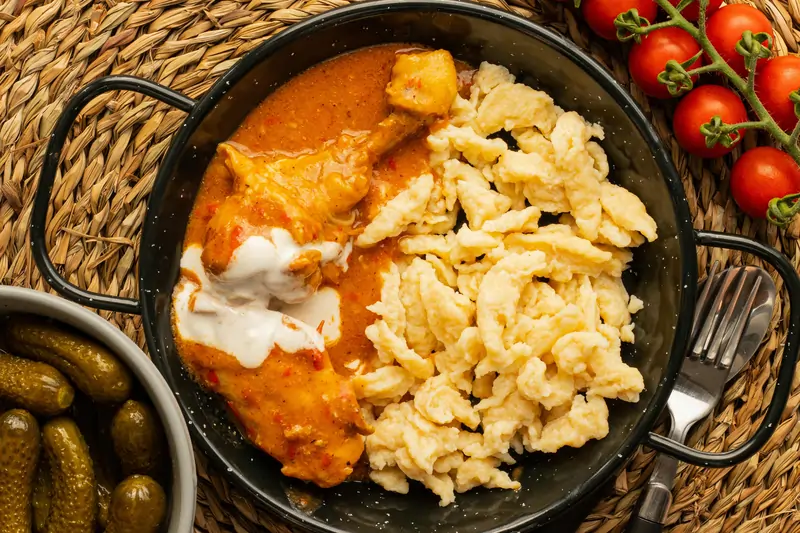
For anyone unfamiliar with Hungarian cuisine, the first encounter with this dairy-forward, paprika-laced approach to food can come as a mild shock.
2. The Hungarian sense of time
In Hungary, arriving ten to twenty minutes after the agreed time is not considered rude — it is simply how things work. Events do not start exactly on time, gatherings get going when enough people have arrived, and no one particularly minds. The scheduled hour is understood by everyone as a rough indication rather than a firm deadline.
Meetings, dinners, and social events in Hungary tend to have a built-in flexibility that is entirely unspoken but universally understood. Turning up precisely on time can, on occasion, even catch the host off guard.
3. Geography and mysterious language
One of the more noticeable cultural differences when meeting Hungarians abroad is how they relate to their country’s position. Hungary is a small country — it can be crossed in a few hours by car, has no domestic flights, and a population of around ten million.
There is also frequent confusion about where Hungary belongs on the map. Hungarians usually see themselves as part of Central Europe, based on history and culture, while many in Western Europe still label it as Eastern Europe — a distinction Hungarians often feel is too simplistic.
The language is perhaps the most striking feature. Hungarian is not related to most other European languages — it is not Slavic, Germanic, or Romance, which we reported on here. It is part of a small language family, with distant links to Finnish and Estonian. For most people, this is surprising; for Hungarians, it is something they are used to explaining.

4. The distinctiveness of Hungarian social culture
In their social culture, irony, self-deprecation, and a critical tone are entirely natural — these are accepted and expected elements of everyday communication. In other cultures, however, the very same approach can easily cause misunderstandings.
Western social conventions, for instance, expect that the answer to “How are you?” be positive and brief, regardless of the actual circumstances. People tend to communicate more openly, smile at one another readily, and strike up conversation with relative ease.
Hungarians, however, tend to answer this question quite openly and often go into detail about how they are really doing and what has been going on in their lives. In Hungarian culture, people generally do not ask ask such questions unless they are genuinely interested in the other person’s well-being and prepared to listen to a more honest and detailed answer.
If you missed it:



