Subscribe to our social channels to get the latest news about Hungary!


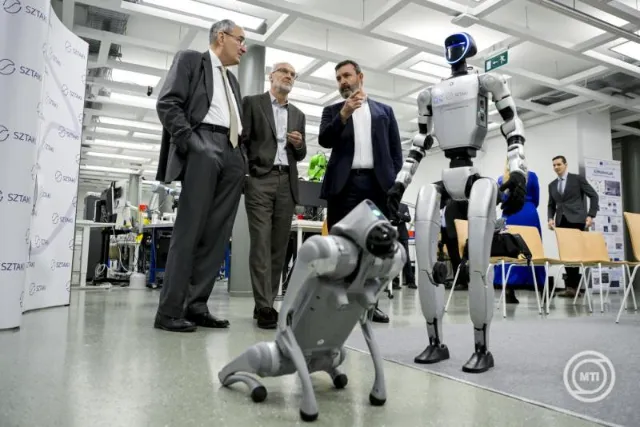
A new research group dedicated to humanoid robotics has begun work at the HUN-REN Institute of Computer Science and Automation (SZTAKI), building on expertise from the automotive and manufacturing sectors, as well as artificial intelligence and autonomous systems, government commissioner for artificial intelligence László Palkovics announced on Monday in Budapest.
At a press conference held at the institute, the commissioner emphasised Hungary’s readiness to serve the booming global robotics market. He noted that forecasts predict a spectacular surge in demand for humanoid robots – a development in which Hungary intends to play its part. The Government, he said, has resolved to create an economic environment that supports the development and production of humanoid and quadruped robots designed to coexist with people, and to provide appropriate testing facilities for these technological breakthroughs. Palkovics described HUN-REN SZTAKI as “Hungary’s premier and most influential research centre”, according to the Hungarian News Agency.
Palkovics noted that Hungary’s spending on automotive R&D as a share of GDP is on par with that of the Czech Republic and Austria. The country’s automotive sector holds a globally distinguished position, he said, and its accumulated research experience can be effectively channelled into robotics, underpinning the Government’s ambitions.
“Our Engineering and Business Intelligence Research Laboratory has long specialised in collaborative robots. The formation of this new research group is a natural progression, pushing the boundaries of our existing knowledge base and tools such as the Unitree humanoid robot and Boston Dynamics’ robot dogs,” said László Monostori, Director General of HUN-REN SZTAKI.

He added that HUN-REN SZTAKI coordinates the National Laboratories for Autonomous Systems (ARNL) and Artificial Intelligence (MILAB), where world-class research into robotics, sensing, and autonomous control has been underway for years. Monostori stressed that humanoid robotics uniquely brings together expertise in industrial robotics, autonomous systems, control theory, AI, and environmental sensing.
Humanoid robotics, he noted, is an area where mechanical engineering, computer science, and control theory intersect at the highest level. The knowledge amassed within SZTAKI’s Autonomous Systems National Laboratory enables research not only into robot locomotion but also into environmental sensing and autonomous decision-making to global standards, emphasised József Bokor, SZTAKI’s scientific director.
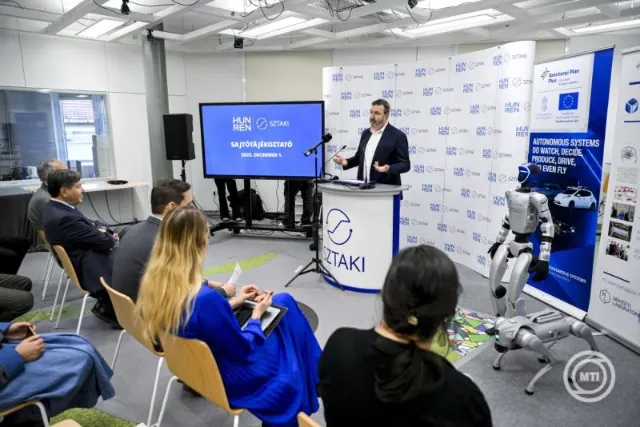
He added that the goal is for these robots to operate safely and efficiently in real, dynamic environments – not merely in strictly controlled industrial settings – working hand in hand with people.
Read also:
Click for more research-related articles.

 ZH
ZH IT
IT DE
DE HR
HR NL
NL FR
FR JA
JA RO
RO RU
RU ES
ES TR
TR


One wonders how they’ll program the creation narratives provided and describe the relationship we have to them. Undoubtedly honestly and transparently, as ethics would seem to require.