Subscribe to our social channels to get the latest news about Hungary!


Budapest is often called the capital of thermal baths. While it is true that the city has a dozen spas and impressive thermal parks, you may not be aware that spas can be found in abundance in all regions of the country and that there are more than 200 across Hungary in its entirety.
Thermalhungary would like to offer you a journey in four directions across the Hungarian countryside. You will get to see several remote spas that, because of their own unique qualities and infrastructure, really hold their own against those found in the capital.
My name is Vincent Laurent. I come from France and have been settled here in Hungary since 2011. In 2017, my team and I created Thermalhungary, the first platform to cover ALL of Hungary’s thermal baths, spa hotels and water parks not only in French, but also in four other European languages.
The need for this project was very clear to us, having been faced with tedious research on the topic ourselves. The difficulty of the Hungarian language coupled with a lack of content on the internet about the country’s spas outside of the 5 or 10 best-known resorts in Budapest sparked our desire to offer you the most optimal search engine and the most complete information source in existence.
In this article, I will cover around ten of the 220 or so spas in Hungary, but please bear in mind that I have so far personally visited only 40 of the approximately 220 spas!
Budapest is often called the capital of thermal baths. While it is true that the city has a dozen spas and impressive thermal parks, you may not be aware that spas can be found in abundance in all regions of the country and that there are more than 200 across Hungary in its entirety.
Having lived in this region for two and a half years, I would like to introduce two spas that are well worth the trip out west.
Located near the Austrian border, the Bükfürdő Spa is a wellness complex combined with a modern spa and open-air summer park. Many German, Austrian and Czech tourists, especially senior citizens, come here to take advantage of the medical expertise offered to them and to experience the water with its high concentration of sulphate;
I have yet to see water with a higher sulphate content anywhere else in Hungary.
The smell of the covered spa is surprising when you are not expecting it! The area with saunas and hammams is more extensive and comfortable than anything you can see in the capital.
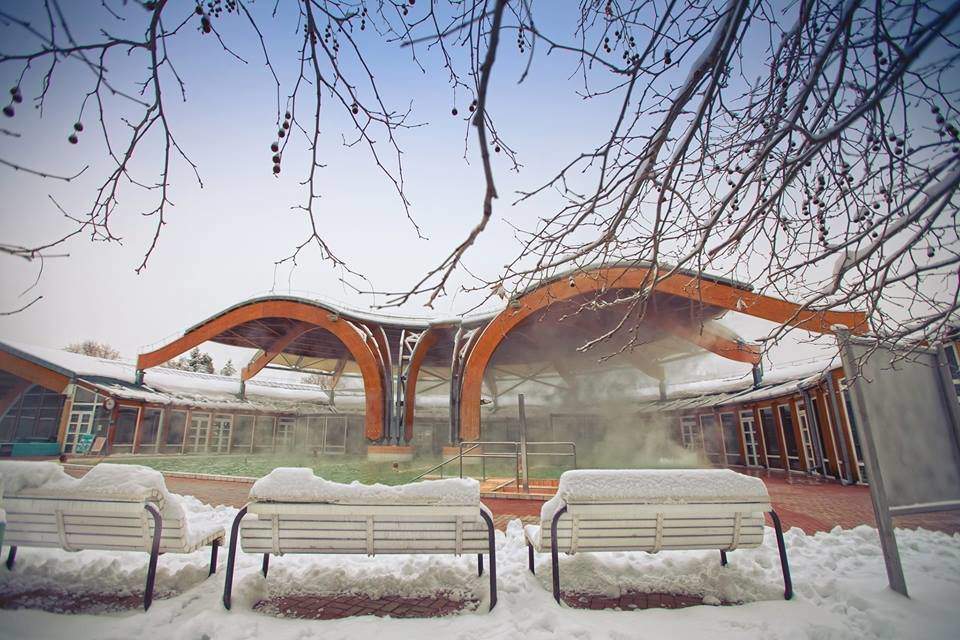
Further south, towards the southwestern tip of Lake Balaton, you will find the largest thermal lake in Europe at Hévíz, where the temperature never drops below 26-28°C, even in winter! This is a rather unusual place that surprised us the first time.
The 4.4-hectare lake has a depth of 38 metres and is fed by a source containing sulphur and minerals. Thanks to the high flow rate of the lake, the water is renewed in its entirety every 72 hours.
The region of Csongrád in the south, the country’s leading agricultural region where 80% of paprika is produced, is also home to high-quality thermal water with a relatively high temperature compared to the rest of the country. Many Romanians tourists make the trip here to bring back this water in their own bottles.
A first visit to Szentes, the city where I spent my first two years in the country, will give you the chance to discover a rather unusual place: an imitation Turkish bath that was built in 1962. This combination of periods gives the place a unique atmosphere.
You will find a 41°C pool; for comparison, the capital’s hottest pool, Rudas, is 42°C.
The city of Szentes is largely heated by thermal water in the winter.
I would advise you to then continue on to Szeged, the third largest city in the country. The city centre of Szeged is very welcoming and lively, and visiting the streets and squares of the centre makes for a pleasant time. A list of places to see during your visit to the city: the Votive Church (the 4th largest building in the country), the Synagogue, the Karasz pedestrian street, the water tower, the National Pantheon, the Stefania promenade, Gróf Palace…The city centre is compact enough to allow you to cover most of it in one afternoon and the city is also home to two interesting spas:
One is a century-old classical bath (1896), the Annafürdő, and the other is a large Aqualand, the Napfényfürdő Aquapolis, which has a large thermal section, as well as plenty of entertainment pools and slides, including the longest slide in Europe!
The cave baths of the North-East
Both of the two mountainous regions in the North-East of the country are home to a thermal spa carved into the rock, as well as the only multi-century Turkish bath to be found outside of Budapest.
The country’s fifth Turkish bath, outside of the famous four of Budapest, is located in Eger. A beautiful city in its own right, Eger is a historical site with a heavy tourist presence. Eger marked the first stop in the Ottoman invasion of Europe, which failed to prevent the Empire from occupying the city for a century during the 17th century and beginning to build a dome bath there in 1610. One thing to bear in mind is that the maximum temperature of this bath is 34°C.
On the road between Budapest and Eger, you will find the Demjén Cascade cave spa, the largest cave baths in Central Europe according to the spa’s website. The caves are fed by a source of medicinal water at 68°C, offering visitors a wide variety of areas with temperatures ranging from 30 to 38°C.
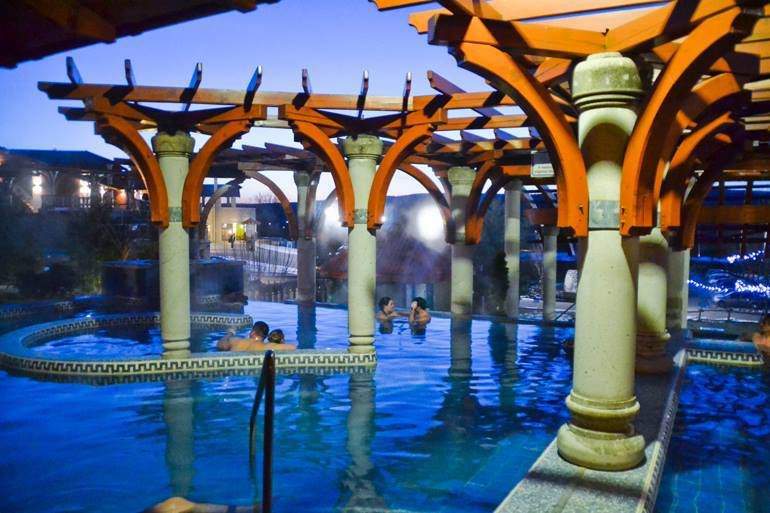
Further north-east, you can find the Miskolctapolca spa near Miskolc, unique in Europe due to its location in a cavern above natural underground hot springs. You will have the chance to bathe in underground passages shaped by nature over thousands of years, and also to hear the echo of the “starry” naturally dome-shaped room, something else that is the only one of its kind in Europe. The entire complex offers six bathing and swimming pools over an area of 9.3 km2, which will provide you with a variety of pleasant experiences. Allow at least two and a half hours on site to be able to enjoy all of the places at your disposal without feeling rushed.
If the most beautiful historic baths from the Ottoman Empire and the Hungarian Neo-Renaissance are in Budapest, it is in the East in Hajdú-Bihar, the second largest thermal region of the country, that the most immense spas exist on a disproportionate scale.
You can enjoy a visit to Debrecen, the second largest city in the country, to discover them.
In the northern suburbs of Debrecen, where the city’s spas are mainly concentrated, a colossal new project is in the works as you read this. The spa is scheduled to open in Spring 2020. See it for yourself:
The project may appear surreal but the site is well and truly under construction!
It seems that Debrecen wants to compete with the extravagant baths of Budapest with this pharaonic project, which will indeed have nothing to be ashamed of in comparison to Budapest’s offerings.
Since we are in the vicinity of Debrecen, it is impossible to avoid this exotically-named city: Hajdúszoboszló, the city with the second largest number of spas after Budapest.
Hajdúszoboszló is home to the largest concentration of hotels equipped with their own thermal springs, as well as the largest spa complex in Europe. I am planning to visit soon, and I will definitely share my experience with you. A colleague from this city once told me that he had never felt the need to go elsewhere for his summer holidays because he had everything one could hope to find in a summer holiday at home!
The resort has the largest outdoor swimming pool in Eastern Europe. The following photo will allow you to get a sense of what the resort looks like.
To my knowledge this is the Rudas in Budapest, specifically the Juventus bath in the modern section from 2014. Although the stated temperature is 42°C like that of the Turkish part, the modern upstairs seems slightly hotter to me. It is said that a bath reaching a temperature of 43°C can be found in the region of Hajdú-Bihar but I have not yet fully explored the area.
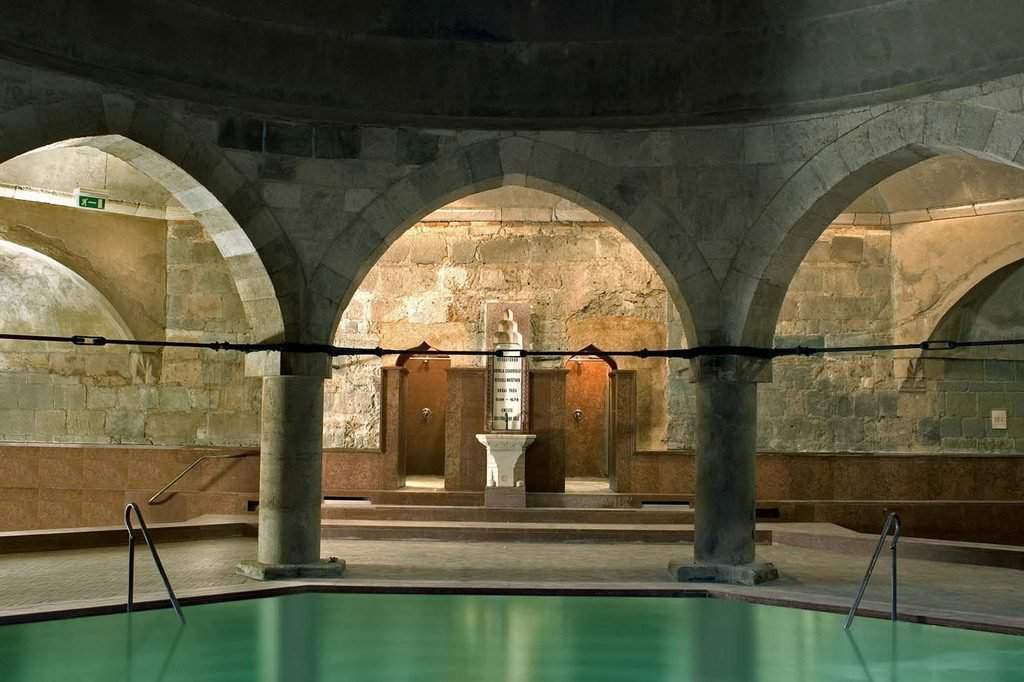
Before travelling to the far eastern prefecture of Nyíregyháza, I would have said Rudas or Gellért, but it is in the Júlia spa in Nyíregyháza that I discovered the most intense hammam in the country, impossible to withstand for even 30 seconds! Rudas seemed moderate in comparison.
The Spa Sárvár in the Vas region has in my opinion the friendliest and most spacious sauna area. Their sauna sessions are free of charge and the larger sauna provides access to both the interior and an outdoor courtyard equipped with a hot tub. I was unable to find a photo highlighting the sauna area but you will not regret your visit:
The Király remains my favourite, its rustic and modest atmosphere giving the impression of being in a sincere and authentic place, without the artificial feeling of most tourist sites, and it in my opinion possesses the most “Hungarian” feel of all the thermal baths in the centre of Budapest. The small bath in the outdoor courtyard is the only bath in the capital where I always get to chat with Hungarians. It is therefore a very friendly place that I hope will never be modernised at the risk of losing its quaint charm.
My favourite in all of Hungary
The aforementioned Turkish imitation of Szentes is the one from which everything began, the origin of my desire to discover them all. Discover all the thermal baths of Hungary on our interactive map!


Thank yo for mapping our spa regions. I am not sure, you didn’t not mention the name of the Eger cave bath. Is it part of a hotel?
Lovely article.
Eva