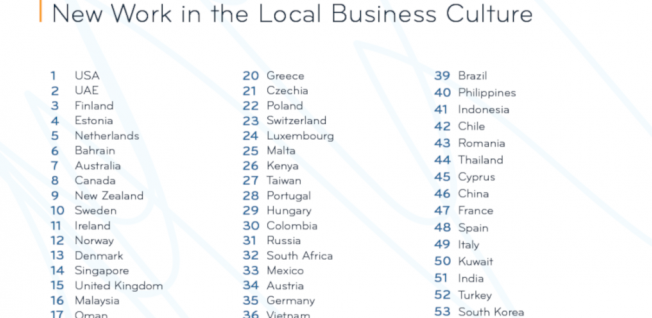
In which countries is the concept of New Work most important?

Change language:
Why do expats move abroad? According to the Expat Insider 2021 survey by InterNations, 47% of working expats name their career as the most important reason for relocating to another country. Most of them found a job on their own (17%), were recruited internationally (15%), or were sent by their employer (13%). Just 2% moved abroad to start their own business.
The key focus of this year’s Expat Insider survey, conducted by InterNations, the world’s largest expat community with more than 4 million members, is the future of working abroad. Expats all around the world shared what it is really like to work abroad and described their working conditions. They also provided insights into how new working arrangements (e.g., remote work) are changing their working life and what they would like to see in the future.
The Future of Working Abroad
Expats Working Abroad Are Well Educated
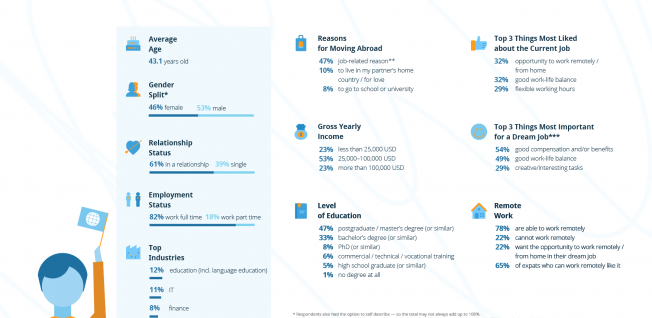
Expats working abroad are on average 43.1 years old, and the gender ratio is a fairly even split between male (53%) and female (46%) expats.
Overall, they are well educated, with four in five working expats either holding a postgraduate degree / master’s degree (47%) or a bachelor’s degree (33%). Another 8% have a PhD, followed by one in twenty with qualifications from commercial / technical / vocational training (5%). Just 5% have only graduated high school, and 1% have no degree at all.
When it comes to their current employment situation, 30% are in a senior / specialist position, followed by lower / middle management (17%) and top managers / executives (13%). More than one in five (11%) are self-employed / a freelancer, 9% are teachers / professors, and 7% each either work in entry-level jobs or have their own business.
Education, IT, and Finance Are the Most Common Fields of Work
The most common fields expats work in are education (12%), IT (11%), and finance (8%). Other frequently mentioned fields of work include manufacturing & engineering (7%), healthcare (6%), and advertising, marketing & communication (5%).
About one-third of working expats (33%) have a gross yearly income ranging from 50,000 to 100,000 USD. Four in nine (44%) make 50,000 USD or less, while 23% make more than 100,000 USD.
Lower Working Hours and a Higher Satisfaction with their Work-Life-Balance
While the vast majority of expats works full time (82%), the share has slightly decreased by four percentage points since 2015 (86%).
The changes in the way they work become even clearer when it comes to expats’ working hours: In 2015, the average number of working hours per week — for full-time and part-time workers combined — was 42 hours; in 2021 it is just 39.9 hours. This seems to have an impact on personal satisfaction: 70% of working expats are happy with their working hours in 2021 (vs. 64% in 2015), and 68% rate their work-life-balance positively (vs. 63% in 2015).
While the satisfaction with working hours and work-life balance has slightly increased since 2015, expats are less happy with their local career opportunities: less than half the working expats (49%) are satisfied with this factor in 2021, compared to 60% in 2015. On the other hand, expats rate their job security better now, with 67% saying they are happy with this factor (vs. 60% in 2015). Overall, 73% are happy with their job in general, which is 5 percentage points more than in 2015 (68%).
In Which Countries Is the Concept of New Work Most Important?
Close to three in five working expats (58%) say that factors like autonomy, freedom, creativity, personal development, and self-fulfillment are important in the business culture of their host country. These values are closely related to the concept of New Work, which describes the new way of working in the global and digital age.
The top 10 countries where expats rate the importance of New Work in the local business culture the highest are the USA, the UAE, Finland, Estonia, the Netherlands, Bahrain, Australia, Canada, New Zealand, and Sweden.
For example, 74% of working expats in the USA say that New Work plays an important role in the local business culture.
When asked to compare the importance of New Work in their home country and their current country of residence, 49% of working expats say that New Work is more important in the business culture of their host country than in their home country.