Subscribe to our social channels to get the latest news about Hungary!


A competitiveness pact dubbed the Budapest Declaration submitted by the Hungarian presidency of the European Union was approved at the informal meeting of EU heads of state and government in Budapest on Friday, Prime Minister Viktor Orbán told a press conference after the meeting. He added that it was necessary to “make Europe great again”.
At a joint press conference with President of the European Commission Ursula von der Leyen and President of the European Council Charles Michel, Orbán said that on behalf of Hungary he condemned the “anti-Semitic attacks” that had taken place in Amsterdam on Thursday.
The attack was unacceptable also to Hungarians, he said. Orbán added that Budapest, where Europe’s largest synagogue was only “a stone’s throw away” from the city’s largest Catholic cathedral, was a meeting place of different cultures, East and West, North and South, which made the city “uniquely tolerant”. “That’s why we live together in peace and security here in Budapest, and I wish Amsterdam’s residents to succeed with the same,” he added.
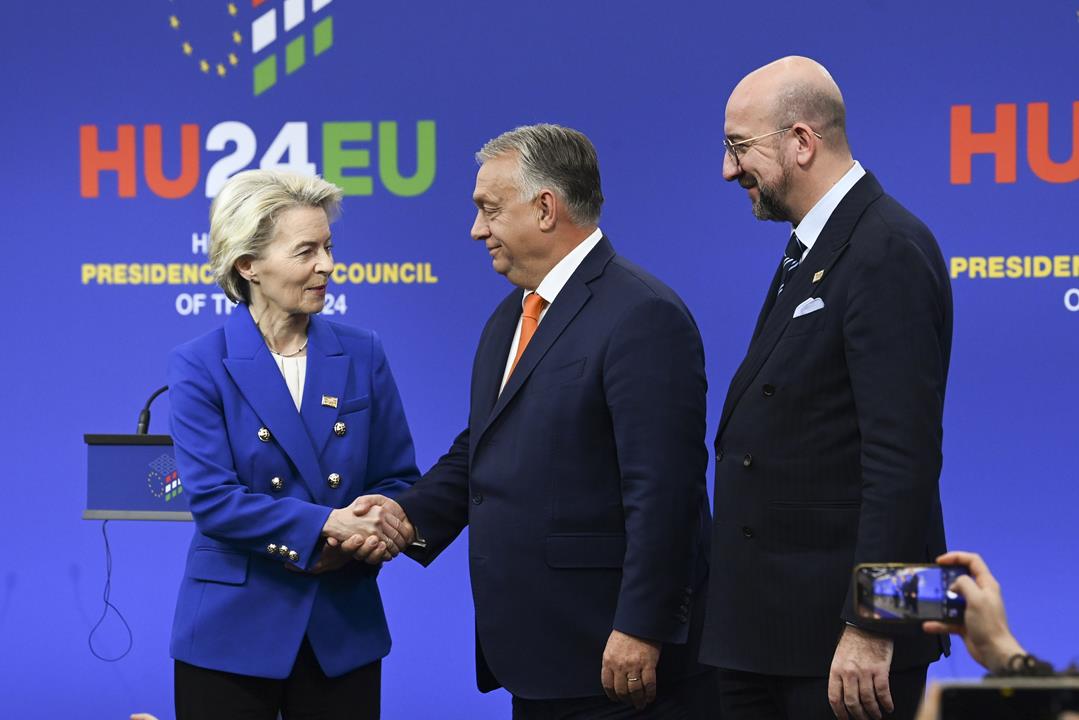
Commenting on the EU summit, Orbán said it was common knowledge that there are serious political conflicts between the EC and Hungary and he had also had disputes with von der Leyen. At the same time, he said the EC president was this time a guest in Budapest and she deserved a polite welcome and respect, so there had been no disputes at all at the meeting.
“We will fight our battles in Brussels,” he said.
Orbán said there was full consensus about the main topic of the summit, which was competitiveness, and a competiveness pact had been approved in line with the Hungarian presidency’s goal. He referred to the document as the “Budapest declaration” and thanked all the related work of his colleagues, the president of the commission, the president of the European Council, and Mario Draghi who had prepared a report on competitiveness.
The document places a focus on competitiveness in the next five years, and states that immediate action is needed, he said.
The growth of the European Union was slower in the past two decades than the growth of China or the US, and the EU’s productivity is growing slower than its competitors’, with the EU’s share in world trade decreasing. EU companies pay three times higher price for electricity and four times higher price for natural gas than their US competitors, he added.
Outlining a number of points of the Budapest Declaration on competitiveness, Orbán said a “simplification revolution” would be implemented and companies’ reporting obligations would be “drastically reduced” by the end of the first half of 2025. A capital market union will be implemented in full, a European defence industry base will be established, urgent measures will be taken to bring down energy prices and a “genuine” industrial policy will take shape in the coming period, he added.
Orbán said everybody at the summit had agreed that R+D spending should be raised to 3 percent of GDP by 2030.
He said the capital market union would be fully implemented.
Orbán said Europeans’ savings totalled more than Americans’ but Europeans keep their savings in banks and banks are “genetically” unsuitable for financing various high-risk high-tech investments.
Bank deposits should be transferred to capital funds, European citizens should be convinced to do this in order to make the money more easily available for innovative economic solutions, he said. Steps will be taken to achieve this, the prime minister added.
Orbán said it had been decided that a European defence industrial base would be established.
He said that it had been agreed that an assessment or so-called competitiveness test would be prepared for all new legislative proposals, in order to see their impact of new legal regulations on competitiveness.
He added that the EC president and the members of the Council were in agreement that competitiveness issues would be regularly addressed at the meetings of the European Council.
The prime minister said teh Budapest meeting gave reason for optimism. “Nobody wants to manage a decline, rather we all want to make Europe great again,” he added. Orbán said that if the Americans had decided to make America great again, the only possible European response was to “make Europe great again”.
In response to a question concerning why competitiveness had not been improved and bureaucracy reduced already despite these being among the Lisbon Treaty’s goals, Ursula von der Leyen said that huge transformation had taken place in competitiveness, for instance in research and development. The performance of the various European sectors has been reviewed at the talks, identifying the strengths and weaknesses, she added.
She said red tape and reporting obligations would be cut and a related joint proposal would be submitted to parliament and the council.
Commenting on planned talks with the US president-elect on trade, she said relations would be continually maintained and consultations are planned on shared interests. She said one such area was the purchase of liquefied natural gas, adding that a large amount of it was still being purchased from Russia, and it should be replaced by purchases from the US. This could also help reduce energy prices, Von der Leyen said and added that consultations should be started about this, as well as on the trade balance.
Answering a question, President of the European Council Charles Michel said that energy in the EU was a national competence but the member states should still act together to reduce prices. It must be taken into consideration that energy is a means of sovereignty and also a strategic issue, he said.
The same applies to financial markets, he said, adding that they also served as a means for directing investments towards European innovation. He highlighted the need for the capacities to be freed in the interest of economic development and added that Orbán had demonstrated with examples that the EU was falling behind its competitors.
Commenting on competitiveness, Michel said it was necessary to see that the situation called for urgent action. In response to a question on new financial instruments, he said solidarity should not be forgotten. Mutual trust depends not only on financial support and a willingness for making internal reforms was also important, he added.
Von der Leyen said it was obvious that more private investment and more state investment was needed. The priorities must be defined first, she added. She said there were two solutions for financing at a European level: with new own resources or by making payments to the common budget. Both required capital increase, she added.
Commenting on the newly approved pact, the Hungarian prime minister said it had been easy to reach an agreement on competitiveness because it was a pragmatic matter and not a matter of ideology. In response to a question, he said the goals defined in Lisbon were not realistic anymore because of the great changes that have taken place since. He said that fulfilling goals was a management issue, and if Europe had good leaders then they could be achieved.
Orbán said that prior to the summit, much could be heard about Hungary’s isolation and a dislike for the country, a failure of the summit and that European leaders would refuse to attend. Yet, the summit had been excellent, with good cooperation, he added. The competitiveness pact has been approved whereas earlier everyone said this would be impossible, he said. They trust each other, and being good leaders, they will be able to achieve the competitiveness goals presented, he added.
Commenting on future relations with the US, he said he expected some tough negotiations. Donald Trump will surely have some ideas on how trade should develop “obviously along US interests”, he said. Europe will have to stand up for itself, engage in talks and reach a deal in the end, he added.
In response to another question, Orbán said there were two more months left of the Hungarian EU presidency, “this has been a good gathering with nice results”, but he still held some surprises up his sleeve.
Commenting on financial support for Ukraine, Ursula von der Leyen said that in addition to a 50 billion euro loan package from the G7 would also be available for Ukraine until 2026. She said that Russia posed a threat to the security of not only Europe but the whole world. Russia is increasingly lining up with Iran and North Korea and together with China they “feed and fuel this war”, she added. Russia uses Chinese and Iranian technology in the battlefield which shows that the security of the Pacific region and Europe are interconnected, she said.
Michel added that steps must be taken in the interest of just peace but “nothing should be decided about Ukraine without Ukraine”. If Europe sends a sign of weakness to the Kremlin, it will also send a message to other regimes that they could violate international law and Europe would become vulnerable, he added.
Orbán said he had first presented his position about the war in March 2022 and it has not changed ever since. “The Hungarian position is clearly pro-peace and pro-Hungarian,” he added. He also said that since the outbreak of the war,
Hungary had provided the largest humanitarian aid to Ukrainians, receiving several hundred thousand refugees, but it refused to get involved in the military conflict.
He said that when someone holds a different opinion from others, it does not mean isolation, only a dispute. That’s how democracy was born, he said, adding that “functioning in headwind from a political point of view is part of my DNA,” he said. Orbán added that Hungary had been alone in 2015 when it started building a fence and holding the position that migration must be stopped at the border. “We were alone, but we did not get isolated, we were part of the debate,” he said.
In response to an additional question about the war, Orbán said Ukraine was a sovereign country and the Ukrainians must decide if they continue the fight.
“I never try to dictate to the Ukrainians, it is their country, their future, and their life … but I am ready to help them any time,” he said. The prime minister added that during visits to Kyiv and Moscow it became clear to him that neither of the warring sides was ready for ceasefire and they were both convinced that time was on their side. He said that he had tried to create an international pro-peace environment to allow that the warring parties could sooner or later sign a ceasefire agreement.
Read also:


It is a tragedy that P.M. Orban actually has to waste time talking to incompetent van der Leyen.