Subscribe to our social channels to get the latest news about Hungary!


Budapest, November 17 (MTI) – The majority of people in NATO member states agree that NATO remains the primary pledge of common security, parliamentary speaker László Kövér said in Budapest on Thursday.
The continued enlargement of NATO and the number of member applicants serve as proof that the collective protection and transatlantic solidarity offered by the organisation still represent considerable attraction to countries in the Euro-Atlantic region, he told an international parliamentary conference about NATO in the wake of the Warsaw summit.
Kövér said he trusts that transatlantic solidarity, the US’s commitment to European security which increased stability and a peace of mind to central and eastern European countries, will remain unchanged after the new administration enters office.
Foreign Minister Péter Szijjártó told the event that NATO’s European leg needed to be strengthened in order to have the capacities required for self-defence. He argued that it was not right that Europe needed to rely on the US in case of trouble. He highlighted four factors that have decisive influence on the international environment: the future development of the relationship between NATO and Russia, the fight against the Islamic State, the effects of the US’s new foreign policy and the stabilisation of the situation in the Middle East and North Africa.
The minister underlined the need for pragmatic relations between NATO and Russia which he said should be based on mutual respect. He said that whenever relations between the East and the West were tense in the past, central Europe was the region that suffered the most.
If the US and Russia fail to reach an agreement on how to handle the crises in the Middle East and North Africa, there will never be peace in Syria or an end to the migration pressure on Europe, Szijjártó warned. He stressed that Hungary is committed to its role in the international coalition fighting against the Islamic State.
Speaking about US foreign policy under the incoming administration, Szijjártó said the world should wait and see what kind of policies Washington would pursue.
He reiterated Hungary’s commitment to supporting EU-NATO cooperation. He said NATO should assist Europe in its struggle against migration pressure, arguing that overcoming the migration crisis was a security issue for the EU.
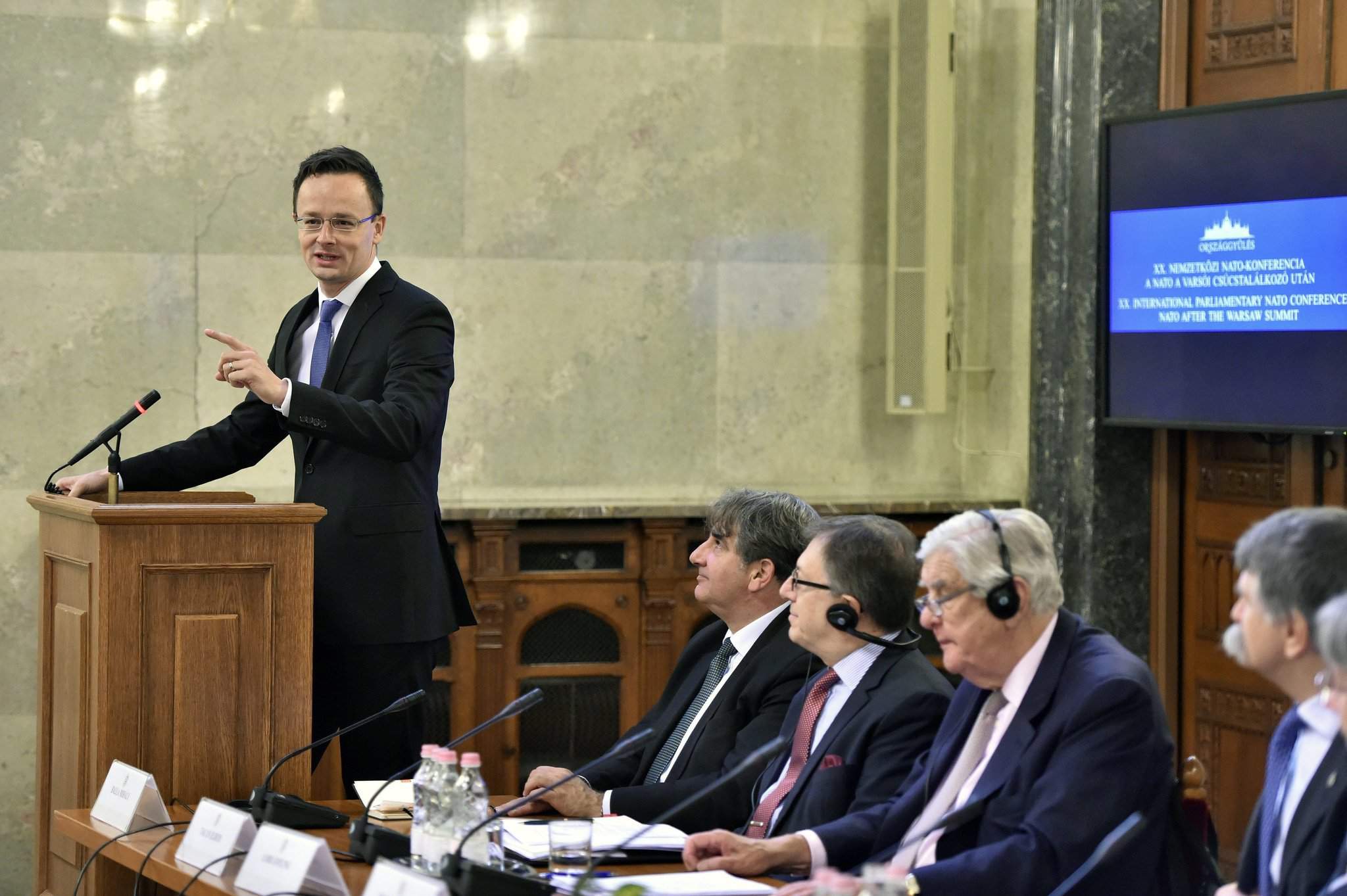
Szijjártó said the enlargement of NATO would have to go beyond just the accession of Montenegro to the alliance. Macedonia and Georgia also deserve to join and their membership would strengthen NATO, he argued.
He added that the decisions made at the NATO summits in Wales and Warsaw needed to be implemented with no delay because any hesitation could ruin the chances of handling the current severe challenges.
Szijjártó highlighted the war in Ukraine, the rise of the Islamic State and the threat of terrorism, energy and cyber security and the situation in Europe’s southern and south-eastern neighbouring regions as NATO’s main challenges.
Defence Minister István Simicskó told the conference that Hungary is a dedicated and reliable ally in NATO that demonstrates solidarity and cooperation. Hungary is fulfilling all its promises and will continue to do so, he added. He described EU-NATO cooperation as crucially important and added that the EU is slowly starting to “make a move” and sense the expectations of the citizens and the dangers of terrorism. He called for concrete steps and argued that Europeans must take greater responsibility and make sacrifices to ward off the dangers that exist.
Simicskó said Hungary is actively involved in initiatives to shape Europe’s security. Hungary’s security rests on three pillars: the Hungarian Armed Forces’ capabilities and strength, the country’s NATO allies, and Hungarian citizens’ willingness to make sacrifices. “We would like to strengthen each of these three pillars”, he added.
NATO Parliamentary Assembly Vice President Lord Jopling said the military alliance now had to face significantly more challenges than ever before while also having to fulfil more responsibilities.
Photo: MTI
Source: MTI


