


19th-century giant crocodiles in North America? Hungarian study investigates

Change language:
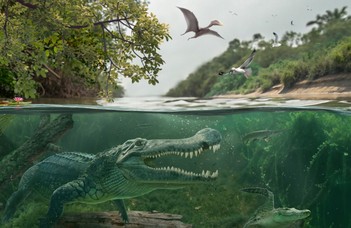
The extinct Deinosuchus, once the apex predator of North America’s aquatic habitats, posed a threat even to large dinosaurs. A research team led by Márton Rabi reveals in the journal Communication Biology what may have been the key to this “dreadful” creature’s success some 82 to 75 million years ago. The researchers believe that relatives of the ancient crocodile—modern-day giant specimens—disappeared in the 19th century mainly due to habitat loss.
The secret of the giant crocodiles
Species of the genus Deinosuchus were among the largest crocodiles that ever lived, predating the well-known Tyrannosaurus rex by more than ten million years. They were widely distributed across the western Atlantic’s wetlands and coastal areas as well as both shores of the vast Western Interior Seaway that split the North American continent from north to south during the mid to late Cretaceous period. Earlier studies concluded that their diet likely included dinosaurs, an assumption supported by bite marks found on dinosaur bones.
Márton Rabi, a researcher at the University of Tübingen and member of the Hungarian Dinosaur Research Group at Eötvös Loránd University, along with his international team, published a new study examining this fearsome predator. They determined that its success may have stemmed from its ability to tolerate salt water and its massive size—traits likely supported by the high productivity of its ecosystems.
Until now, scientists believed these “terrible crocodiles”—as their scientific name suggests—were relatives of freshwater alligators and caimans, but it was unclear how they managed such a broad distribution given the inland sea that split North America. “Since the sea existed even before the earliest Deinosuchus fossils, it’s unlikely it caused population separation,” Rabi explains.
To determine the evolutionary lineage of Deinosuchus, the researchers reconstructed a comprehensive family tree of crocodilian species. Their analysis included fossil data from previously unexamined extinct species, specifically skull and skeletal remains, along with genetic information from modern crocodilian species.