Subscribe to our social channels to get the latest news about Hungary!


According to pestbuda.hu, the seventh bridge of Budapest was inaugurated 80 years ago, on the 12th of September, 1937. The bridge connecting South Buda and South Pest was originally called Horthy Miklós Bridge, but it was renamed to Petőfi Bridge after WWII.
The construction of the bridge was necessary due to the dynamic development of Budapest. The Council of Budapest Public Works already suggested the construction of a bridge named after Boráros Square in 1906. But the investment was postponed due to administrative and financial reasons, and the outbreak of WWI. The construction of the bridge was ordained by the law commemorating the 10th anniversary of Miklós Horthy’s regency. It was also ordered that the bridge had to be named after the regent (along with several other institutions).
10 designers entered the tender of the Hungarian Royal Trade and Transport Ministry. Out of the plans three were awarded, three were bought, but the ministry decided to execute the plans of Pál Álgyay-Hubert, the head of the ministry’s bridge department, in the end. One third of the expenses were covered by the government, while the municipality of Budapest paid for the remaining.

The construction works started on the Buda side in 1933, and one year later on the Pest side as well. This was the first time when big ferroconcrete pontoons were used at the coastal pillars, which was even broadcasted by the Hungarian Radio. The production of the steel structure and the construction of the iron structure were done by MÁVAG, the execution works were led by engineer Alajos Kováts until the construction works ended in 1936.
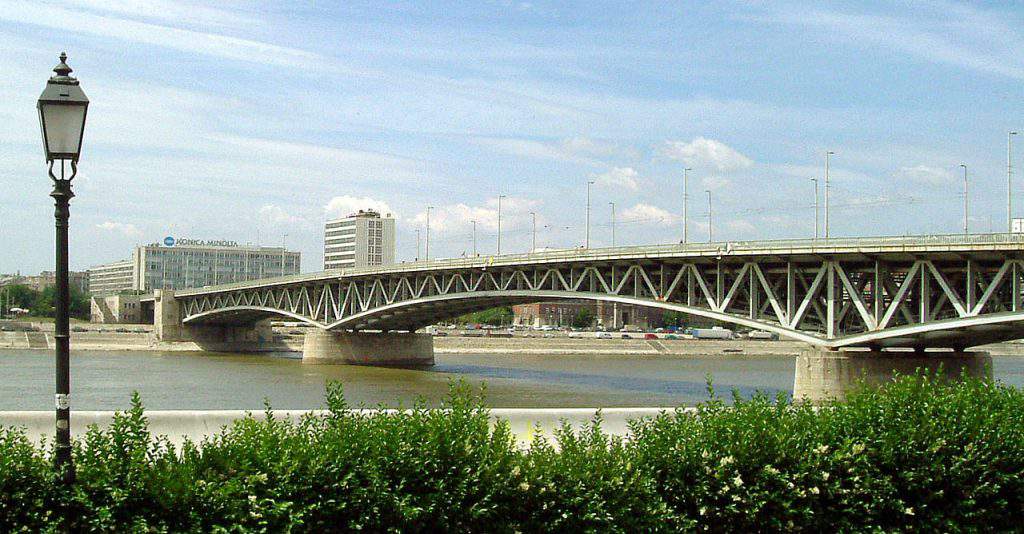
The slender, three holed, four main ossatured bridge spanned the Danube with bed holes of 112, 154 and 112 metres. With the gangways it reached a length of 514 metres and a width of 22.7 metres, out of which 15.7 metres functioned as a wagon-way with two tram lines in the middle. There were 3.5 metres wide pathways on the sides with one metre wide cycling lanes separated from the roadway and pathway.
The Buda bridgehead was decorated with the monument of the Austro-Hungarian navy and the miniature version of the Fiume lighthouse, while the Elevator House stood at the Pest bridgehead along with the terminal of tram 6. The proof load was held in the August of 1937 with a train made up of two locomotives and four carriages, and 32 water-carts weighing 11 tons. The bridge was inaugurated on the 12th of September, 1937. The whole construction cost 10 million pengő (Hungarian currency at the time).
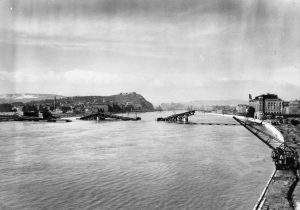
At the end of WWII, the withdrawn German troops exploded the bridge. The Soviet army built a temporary military bridge in its place to provide the gas supply of Pest. The restoration works started in 1951. Fortunately the detonation didn’t affect the under-structure, so “only” the pillars and half of the steel structure had to be reconstructed.
The new bridge turned out to be wider but lighter than the original one, as 500 tons of steel were saved during the restoration. The roadway was broadened to 18 metres, while the pathways were broadened to 3.8 metres. The bridge was opened to traffic on the 22nd of November, 1952 and was also renamed to Petőfi Bridge.
The tram rails were modernised between 1966 and 1970, and the whole bridge was repainted. The bridge-deck and the whole deck structure were renovated in 1979-80. The width of the roadway was broadened to 20.4 metres with the cancelling of the cycling lane, and the tram rails were replaced to the level of cars so that they could also use them. When the Boráros Square was reconstructed in 1982, the tram stops were completed with underground passages.
The last serious renovation happened in 1996, when the tram lines were rebuilt in a way that cars couldn’t use them anymore. Small reparation works have been executed since then. However, in the March of 2016 big stone and ferroconcrete pieces fell to the Buda quay along with loose pavement elements. This signals that the reconstruction of Petőfi Bridge is quite urgent, but it will only happen after the reconstruction of the Chain Bridge (not before 2020).
Featured image: Wiki Commons – transferred by Tambo
Ce: bm
Source: http://pestbuda.hu/


