Subscribe to our social channels to get the latest news about Hungary!


It seems like the coronavirus not only affected our everyday lives and both the catering industry and tourism but it also greatly impacted Hungarian healthcare as surgical waiting lists at Hungarian hospitals can be yearslong.
According to Blikk’s information, there are several procedures that can be deferred, and the waiting time for such procedures has sharply increased compared to how long it was before the coronavirus pandemic. There are some patients whose condition might significantly worsen over time and would need fast intervention. GPs might suggest operations for certain patients to prevent later health issues or to cure them, but if waiting lists are half-a-year to a year long, and people are in pain, that period seems like an eternity.
Living in the shadow of a serious illness is a burden for the patient. Renáta Urbán underwent surgery for breast cancer three years ago. Her CT last November was unsuccessful, as the machine failed.
She got a new appointment to May 2020, but the examination was postponed once again due to COVID-19.
Renáta told Blikk that she has done chemotherapy, radiotherapy, and surgery, and she has to go to strict control examinations every quarter. She said that she is so anxious she has nightmares sometimes. Even though she goes to these examinations, the results sometimes do not arrive for two weeks, and the fact that her CT examination has been postponed worries her as cancer could reoccur. She also said that healthcare professionals perform beyond their strength, and most of them seem to be very tired. Sometimes patients undergoing chemotherapy may need to wait 8 hours before being called in; meanwhile, the doctor never comes out, not even for a break, she said.
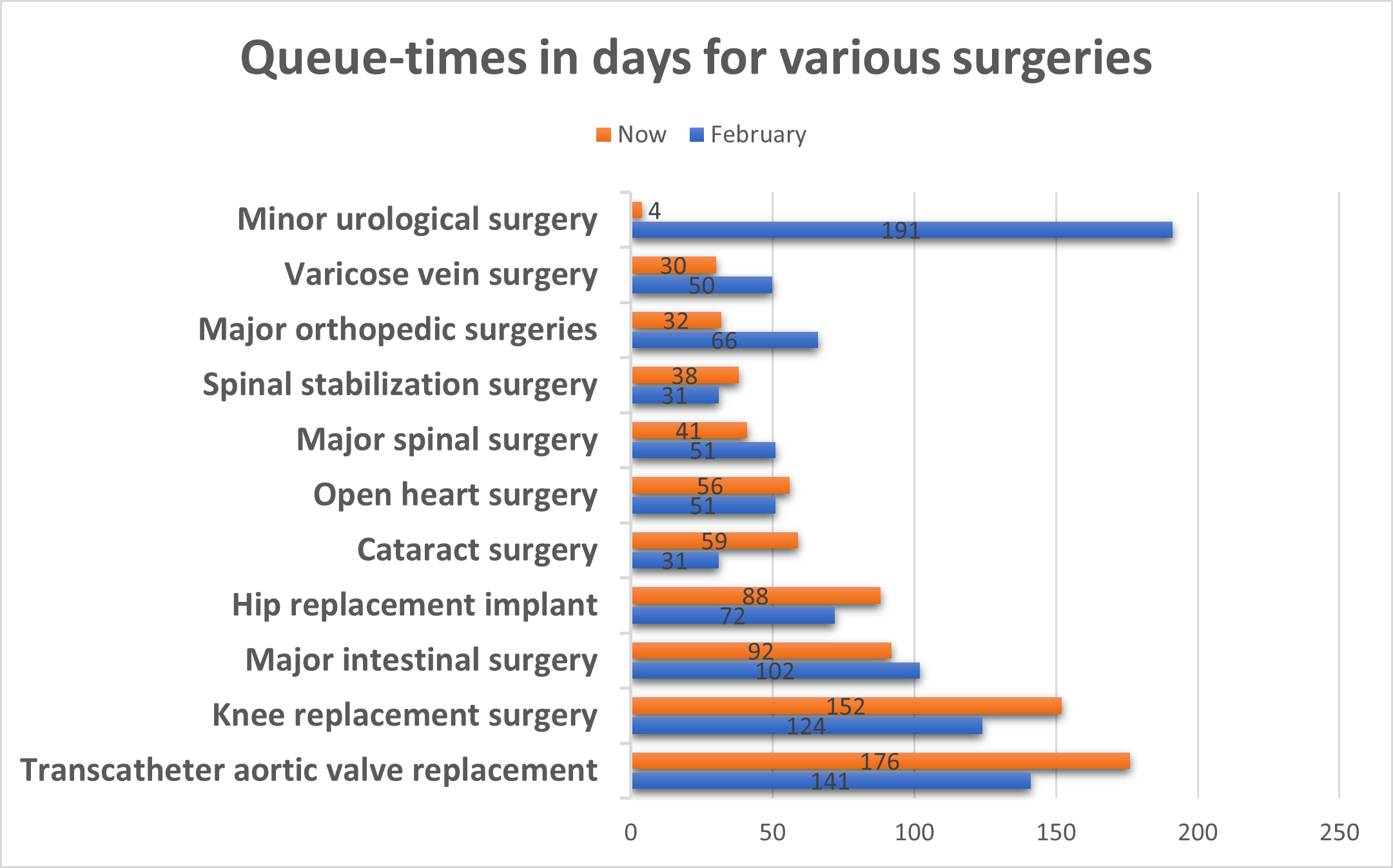
There are procedures, such as cardiac valve surgery, for which a patient currently has to wait 176 days on a national average, but in the Northern Great Plain region, it is already 208 days. This February, before the pandemic, it was somewhat lower: 141 days on average. Although this is worrying, some other procedures might have a shorter waiting time than they had in February: minor urological or varicose vein surgeries are two examples from the database of the National Health Insurance Fund. These waiting times, of course, are subject to change depending on other circumstance as well, so in Blikk’s compilation, they used numbers from six months ago to today, and they compared it to February’s numbers.
A significant amount of healthcare institutions are required to be prepared for the mass reception of severe coronavirus patients.
Departments, sometimes whole wings, are emptied out or relocated to other hospitals in some institutions. Naturally, this greatly affects specialist care, such as surgeries. Tonsil removal surgeries previously had a waiting list of three weeks, but now it is almost two entire months.
Zsombor Kovácsy, a healthcare lawyer, told Blikk that the pandemic affected almost all other countries as well, and institutions are trying to catch up with such long waiting times if and when possible. He said that in this current situation, it is almost impossible to solve the issue of long waiting time, but he added that the waiting list for inpatient care was not long but rather uneven compared to international numbers, while the situation for outpatient care was much worse even before the pandemic. Some people tried to get ahead in the queue by registering at emergency rooms, which in turn overburdened these departments in many hospitals.
He said that apart from simple annoyance, waiting for a procedure can result in the original condition worsening, and many procedures cannot be postponed indefinitely.
Kovácsy also said that the key to shortening waiting time is to strengthen primary care, so instead of constantly writing referrals and prescriptions, GPs should spend more time treating patients so specialist care would not be overburdened. He highlighted that currently, it is everyone’s duty to be a little bit more patient and to make some degree of sacrifice in such times.
According to the central records, the waiting time for the same surgery can vary significantly by region within Hungary. One should even consider moving to another part of the country to get the necessary surgery done sooner. A knee replacement surgery’s waiting time is 61 days on average in Central Hungary, but it is 333 days in Northern Hungary. Interestingly, the waiting time for arthroscopic surgeries, including simple knee surgeries, was two days in Northern Hungary, but it is two months in the country’s Western region.
More than 10,000 people are waiting for cataract surgery, roughly half of that, 5,800 people, are waiting for a knee prosthesis, 400 people are waiting for a hip prosthesis, 1,500 people are scheduled for cardiac catheterisation, 271 people are being prepared for corneal surgery, while there is no queue for eyelid surgery as no one is on the waiting list.
Source: Blikk.hu


