Subscribe to our social channels to get the latest news about Hungary!


In one of their latest surveys, the Hungarian Central Statistical Office (KSH) investigated which cities in Hungary are the most liveable. Esztergom, Győr, Szeged, Tatabánya and Veszprém were in the best, while Salgótarján and Szekszárd were in the worst condition.
There has been a great deal of research on the measurability of smart cities in the past, but few comprehensive studies have specifically addressed Hungarian cities. Now, Hungarian Central Statistical Office (KSH) investigated which cities in Hungary are the most liveable in terms of economic and environmental sustainability. For this, the UN development indicators were used.
Mitigating global climate change and reducing its negative impacts on the environment has become one of the biggest challenges for cities.
“United Nations Environment Programme (UNEP 2018) estimates that the use of raw materials associated with cities will increase by 40 billion tonnes in 2010 to 90 billion tonnes in 2050.”
The spread of views on sustainability is also seen as increasingly important by policy makers. This is also reflected in the UN’s Sustainable Development Goal (SDG) 11. In Hungary, the SDG survey has so far been carried out on a county level, under the supervision of the KSH. The institute has now examined the performance of Hungarian cities with county status in some of the SDG Index’s priority components. It is important to underline that the analysis of the SDG indices for both European and US cities has highlighted the problems of data availability and comparability.
The three main areas of environmental, social and economic structures are reflected in the SDG Index. These are crucial for the development of cities. The former is about the environment, the second one is about equity, well-being and meeting basic human needs. Meanwhile, the economic part takes into account the economic competitiveness of urban areas.
One part of the research looked at the economic performance of the cities in the county. Here, the number of job seekers, net income per capita, number of businesses, employment rate, and dependency rate of the elderly population were taken into account. Based on the economic scores, Esztergom, Győr, Szeged, Tatabánya and Veszprém were in the best position, while Salgótarján and Szekszárd were in the worst position. However, there is a wide variation in the results, with a difference of HUF 600-700,000 (EUR 1,572-1,834) in average per capita net income between the best and worst placed Székesfehérvár and Baja/Sopron, for example.
In Salgótarján, the proportion of unemployed people who have been unemployed for more than 180 days is high. But it is more than 10 percent which points higher than even Nagykanizsa, the second worst performer. Győr is above average in terms of industrial data, innovation and infrastructure. In terms of sustainability and community aspects, Érd, Esztergom and Veszprém have the most balanced performance. Salgótarján and Nyíregyháza have the most negative indicators. In the latter, fine dust concentration is higher than average.
Due to the difficulty of comparing data, groups are identified in the following way below. In each cell, the status of the target reach is indicated by blue squares.
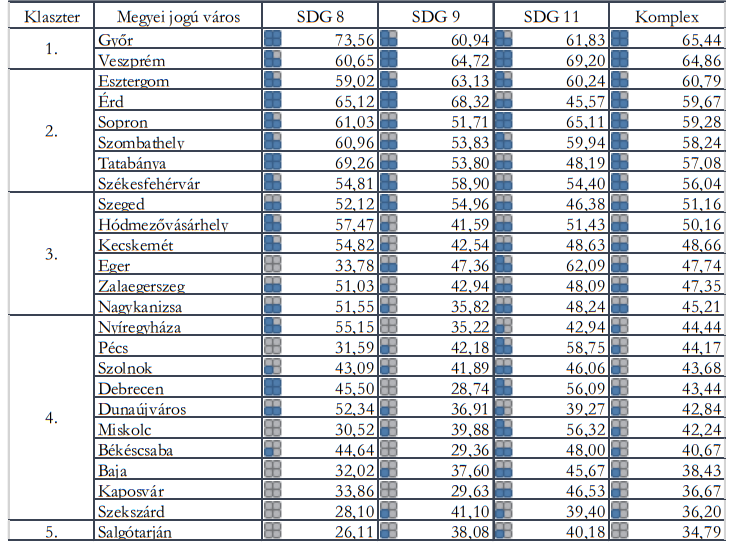
The data shows that by far the best ranking was achieved by two cities, Győr and Veszprém. The former is now the most dynamic and innovative city in the county, partly because of the Audi Hungaria factory, Index.hu reports. R&D has always had its foundations linked to the University of Pannonia, according to the KSH researchers on Veszprém. The university remains a key contributor to the city’s scientific activity.
The loser among the most liveable cities in Hungary is Salgótarján, as it is the worst performer in the three SDG targets examined. “We can conclude that one of the former “socialist” flagships has become a city abandoned by industry. Its development has not been accompanied by new elements of urbanisation functionality, thus it has become a runner-up among the cities with county status,” the research concludes.

Source: index.hu, ksh.hu


