Subscribe to our social channels to get the latest news about Hungary!


Hungary has been a member of the European Union since 2004, but its currency is still the Hungarian Forint and not the Euro. Hungarian Forint coins have been the official currency in Hungary since August 1, 1946. Only one side of the coins shows its value; the other side has an image, a symbol.
We use it every day, we hold it in our hands, but we may not be able to list which coin has which symbol. Especially few people know why some signs are on coins. The coins are produced by Magyar Pénzverő Zrt. on behalf of the Hungarian National Bank.
5 Forint— Great egret
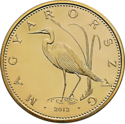
On the back of the five Forint coin is the great egret bird. This 80 to 100-centimetre bird is about a pound. Besides Europe, it can also be found in North America, Africa, Asia and Australia. In Europe, it is most common in the Carpathian Basin in Hungary. This is partly why the great egret is on the coat of arms of Hungarian nature conservation. It is interesting that when the Forint was introduced, the five Forints were the largest denomination. Now, since there is neither 1 nor 2 Forints, it has been the smallest valid payment. The great egret is also on the New Zealand $2 coin.
10 Forint, 100 Forint— Coat of arms of Hungary
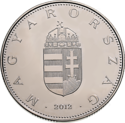
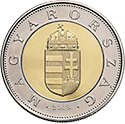
At this point, I have to cheat a bit with the order, as the Hungarian coat of arms can be found on the back of both the 10 Forint and the 100 Forint coins. The Hungarian coat of arms is one of the main symbols of Hungary. The coat of arms contains several symbols, most of which date back to medieval Hungarian history. The banding on the left side of the coat of arms can be connected to the Árpád house, while at the top of the coat of arms is the sacred crown. The unique feature of the 100 Forint coin is the outer silver-white ring. While it is interesting about the 10 Forint, its shape and weight are similar to the Croatian 2 Kunas coin. The head of a Croatian parking company admitted that 10 Forint coins were found in the vending machines several times.
20 Forint— Steppe iris
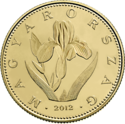
It is located on dry steppes and forest edges. In addition to Hungary, it can also be found in Romania, Moldova, Italy, Slovakia and Ukraine. The 10-30 centimetre flower opens in April and May. Its flowers come in shades of purple, dark purple, or violet-blue. This is a rare and protected plant. Its nature conservation value is HUF 100,000 (€ 280).
50 Forint— Saker falcon
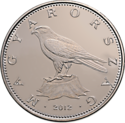
The saker falcon is a large bird of prey. It is native to Europe and Asia. The 50-centimetre bird has played an important role in the Hungarian religion. Some believe that the Turul in the legend was probably a saker falcon. This bird is nesting in the Carpathian Basin and is a highly protected and endangered species.
200 Forint— Chain Bridge
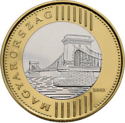
The highest value Hungarian coin currently in circulation is the 200 Forint. On the back of the coin can be seen the most iconic bridge of the Hungarian capital, Budapest. This is Hungary newest coin, as it has been in circulation for just over 10 years. The Széchenyi Chain Bridge was named after István Széchenyi, who initiated the construction of the bridge. This was the first bridge that connected the two parts of Budapest, Buda and Pest. The Chain Bridge is one of the most defining symbols of Budapest and the whole of Hungary. By the vote of the Hungarian National Bank in 2008, more than half of the voters chose the Chain Bridge to be at the back of the new coin.
The Hungarian National Bank creates individual coins on certain occasions. These unique commemorative symbols are most frequently put on the 50 Forint coin. However, there are 10 Forint coins with the portrait of Attila József, 20 Forint coins with the image of Ferenc Deák and 100 Forint coins with Lajos Kossuth’s picture on the back.
Of the 50 Forint coin, however, there are several types. A particular coin was issued on the anniversary of the 1956 Hungarian Revolution and the War of Independence, on the occasion of the Hungarian Division 1/A Hockey World Championship, on the occasion of the Hungarian FINA World Championship, as well as on the occasion of the Hungarian Wrestling and Fencing World Championships. It was also made in memory of the organised fire department, in honour of the Year of the Families and on the occasion of the anniversary of the Hungarian Red Cross. These unique commemorative coins are typically produced in a maximum of 1-2 million copies.


