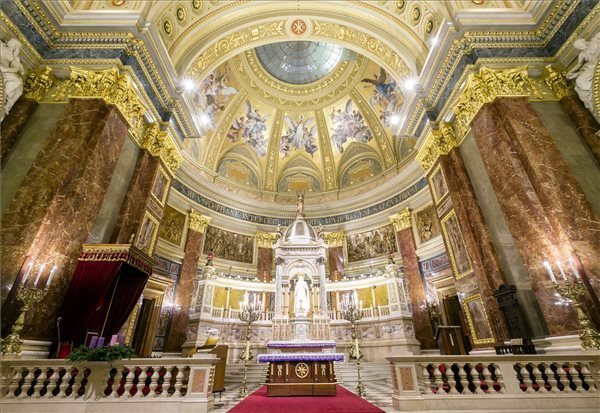
Reliquary in the Heart of Budapest – St. Stephen’s Basilica

Change language:
Approaching from the adjacent streets, only minor details of the huge, imposing building can be seen. After a few steps, it stands in its full glory and enormous dimensions. On its steps, usually foreign-speaking crowds flow; and tiny-looking people are lined up at the edge of the dome to admire the view.
Late in the afternoon, there is an especially beautiful view: the rays of sunset gives a golden shine to the mosaic image at the entry.
Apart from its beauty, grandeur and monumentality, it is also famous for its long construction. Nearly 60 years of hardships had passed until it was built up. The work of three renowned architects, tenacious will, and unprecedented imagination were needed for the birth of this church.
The desire for a church strengthened at the middle of the 1800’s, when the newly built part of the city (next to the city centre) was named as Lipótváros, to commemorate the coronation of Leopold II. As locals craved for a church, a temporary one was erected in 1817, on the basis of János Zitterbarth’s plans. In 1838, during a devastating flood, it provided security for many. Today’s basilica is due to the people survived here: they vowed to build a large church in this place.
In 1845, József Hild was commissioned by the Pest City Council to build a massive domed church. In 1848, the works were stopped by the Hungarian Revolution, so the foundation stone was only set in October, 1851. The Basilica is the biggest church in Budapest, no wonder that due to the proximity of the Danube, three basement levels were needed. The citizens of Pest largely contributed to the cost of building. Among others, Ferenc Liszt donated a considerable amount of 200.000 crowns for this purpose.
After Hild’s death in 1867, Miklós Ybl was entrusted to conduct the construction. Hild’s neoclassical plans had to be redesigned: the giant pillars holding the huge dome started to sink; consequently, the walls broke apart and the dome collapsed. For the continuation of the works, 10 years had to pass. During this time, Ybl has redesigned the previous plans. The dome was put on new bases, the main facade was changed, and he created an image of a neo-Renaissance-style church. However, he could not live to see the completion of the Basilica. After his death in 1891, József Kauser was entrusted with the completion of the construction. Internal works took place entirely on the basis of his ideas, because Ybl left no information about it.