Subscribe to our social channels to get the latest news about Hungary!


At least half a dozen legendary stories are known about the fearful Hungarians who have raided half of Europe and kept the rest in terror just by their reputation. There are another half dozen stories about the mysterious Hungarian Conquest, involving mythical and magical creatures. There is no certain version of the truth, but you might choose your favourite one if you continue reading.
Before coming to the Carpathian Basin, the Hungarians occupied a territory called Etelköz, that became slowly overcrowded and overpopulated for them. It is not sure whether they moved to the Basin because of their military endeavours or because they had no other place to turn to, as Kiev was under Rus leadership, the south of the Danube was in Bulgarian hands and to the east other Steppe people lived.
Historians themselves differ on the exact date when the Hungarians conquered the Carpathian region and Pannonia, but most of them agree on the event taking place around the 9th and 10th centuries. Another meeting point for the scholars is the fact that near the end of the 9th century, the Carpathian Basin was controlled by three ruling nations: the 1st Bulgarian Empire, East Francia and Moravia.
Since all three territories were governed from the outside, the Hungarians were not presented with a difficult task upon arriving in the region with intentions of settling down.
In the following, we will crack some of the most popular and realistic theories we have found regarding the Hungarian land-taking.
There is already serious division among sources regarding the time of the Hungarian Conquest. There are but few mentions of Hungarians in European history records from the 9th century, so it is no wonder that opinions differ.
The “Hungarian Illuminated Chronicle” (commissioned by Hungarian King Louis 1st, written around 1360) sets 677 as the land-taking’s date. Anonymous then jumps to 902, to which contemporary sources are very close, as the historians of our day state that the conquest started in 894, based on records of the Byzantine-Bulgarian war. There is another source as well; an entry on 894 in the Annals of Fulda refer to the Hungarians, describing them as godless savages.
The Hungarians gained knowledge of the land when they participated in the wars between Svatopluk 1st of Greater Moravia and Arnulf of Carinthia around 892. The Annals of Fulda recalls that the Hungarians allied with Svatopluk, but when tides turned, they sided with Arnulf against Svatopluk. Later on, when Arnulf was out of the picture, the Hungarians returned to Svatopluk’s side who has taken his country to war against the Franks.
It is argued that the Hungarians got territories in the Carpathian Basin as compensation form Svatopluk.
According to some contemporary sources (from the 1990s), the Hungarians participated in the conflict between Byzantium and Bulgaria as mercenaries (894-895), gaining familiarity with the Carpathian Basin. The Hungarians – setting up camp near the Carpathian Mountains – made an agreement with the Byzantine empire, which encouraged them to attack their neighbours, the Pechenegs. However, the Hungarians were afraid of them, because they outnumbered them and were even more fearful savages than the Hungarians themselves.
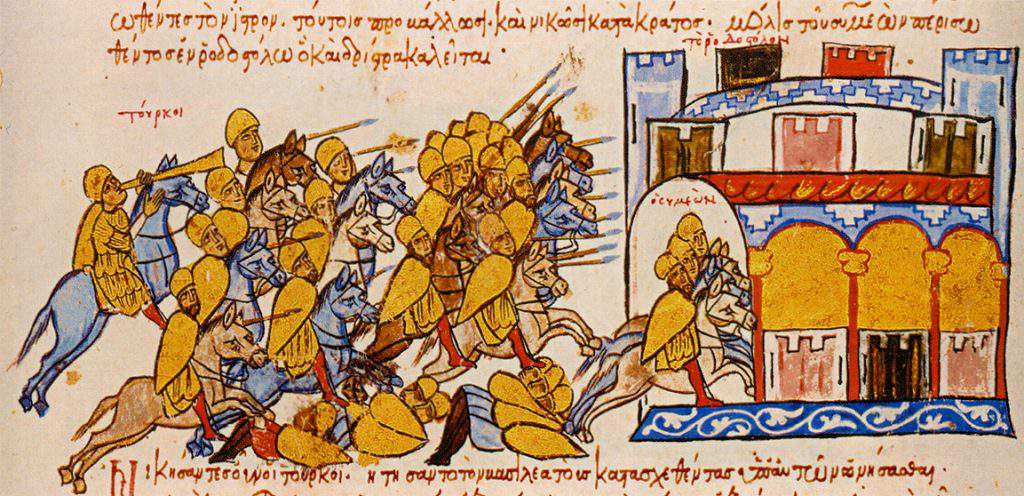
Bulgaria was attacked from both the south (Byzantines) and the north (Hungarians), so Tzar Simeon, ruler of Bulgaria, had no other choice but to propose a truce with Byzantium. At the same time, he sent an envoy to the Pechenegs to incite them against the Hungarians. The latter part of his plan succeeded, the Pechenegs attacked the Hungarians and thanks to their superiority in numbers, the Hungarians were forced out of their current home to cross the Carpathian Mountains into the Basin.
One stance on this is that the Hungarians had no intention of moving forward and crossing the Carpathians, but upon being forced to cross them, they decided to settle in the Basin. The other is that they had devised strategies for crossing the Carpathians and expanding their territories, but were forced to accelerate their plans.
“The fact that, despite a series of unfortunate events, the Magyars managed to keep their heads above water goes to show that they were indeed ready to move on” (Róna-Tas, 1999)
Based on the writings of the greatest Hungarian chronicler, Anonymous, a group of contemporary historians argue that the conquest was a pre-planned military action. The land was occupied through intended raids and over several decades.
Gyula László argues, following the reasoning of Anonymous and historical artefacts, that a group of Finno-Ugric people have arrived in the Basin in 670, which constitutes the first phase of the land-taking.

The second phase in his view was when Árpád lead the Hungarians to the territory while taking part in the war between Svatopluk and Arnulf and in the Byzantine-Bulgarian conflict. László calls on several records, mainly referring to Anonymous’ mention of the Huns and Hungarians as two separate people. He brings further arguments to support the differentiation between Huns and Hungarians, by referring to the Nestor Chronicle (Rus) that describes the arrival of black (pagan) Hungarians, who were followed by the white (Christian) Hungarians. However, this should be taken with a pinch of salt, as it is widely claimed that the Hungarians took up Christianity with Stephen, after 1000.
It occurs on many occasions that people derive the Hungarians from the Huns or the Székelys. However, if we believe the early Hungarian chronicles,
the Szekler people were already living in the territory to which we refer today as Transylvania.
Historians argue that different Slavic people lived in the Basin, telling of this are the Hungarian city names with Slavic origins, such as Veszprém, Pécs or Esztergom.
The Hungarians gained their fearful reputation thanks to their looting adventures after they have finally claimed land for themselves. They have mostly raided Italian territories (mostly beaten there, so eventually had to withdraw), moving on to the north of the Danube, keeping Moravia and East Francia in terror too.

Despite the Hungarians being feared collectively, their leader, Árpád was well-respected by leaders of other nations. He called on the first Hungarian National Assembly in 902 at Pusztaszer, which served as a meeting point of the seven tribe leaders (Anonymous: Álmos, Előd, Ond, Kond, Tas, Huba, Töhötöm) for several decades to come.
featured image: Mihály Munkácsy: Honfoglalás
Source: Daily News Hungary


