Traditional ways to say Goodbye to Winter: Carnival time in Hungary!
Photo: Alpár Kató - Daily News Hungary
Change language:
Carnival is all about joy, entertainment, having fun and preserving the carnival rituals in Hungary. The whole point of carnivals was to oust winter and warmly welcome the new season: spring. Officially, carnival season is from Twelfth Day (5th or 6th January) to the last week before Lent. During ‘carnival tail’, one can carouse and have lots of fun loudly. Carnival’s most attractive and spectacular part is when people parade in fancy or scary masquerades.
There are a couple of Hungarian traditions to chase away winter and welcome spring. The most well-known is busójárás and tikverőzés. Besides these two, other old Hungarian traditions are still alive, szeretlekmagyarorszag.hu gathered some unique Hungarian festivals at this time of year.
WHEN IS IT?
Officially, in 2019, carnival season is from Twelfth Day (5th or 6th January) to the 6th of March. The first day of carnival tail is ‘Carnival Sunday’. This day used to be the day of choosing one’s mate. The girls sent bouquets of posy to those boys whom they liked, and the boys put that girl’s bouquet on their hat that they liked back. So, this is how the young boys and girls chose each other as mates.
The second day (Monday) was women’s carnival day; the day when women could carouse and drink alcohol just like men.
The last day of carnival tail, Shrove Tuesday, marks the beginning of Lent, the 40-day fasting period before Easter. This year, Shrove Tuesday is on the 5th of March 2019.
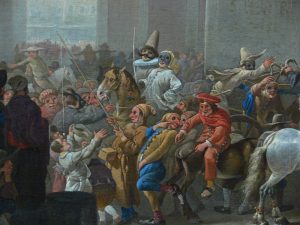
Painting ‘Karneval in Rom’ circa 1650
TIKVERŐZÉS IN MOHA:
Moha has a history with its tradition ‘tikverőzés’ that is on Shrove Tuesday. Boys wear masquerades as clowns with rag tapes or chimney sweeps. They go from house to house and gather eggs from hen-houses. The clowns imitate beating the hens to make them ‘more fertile’. The chimney sweeps make everyone’s clothes sooty. These guests drink wine and eat doughnuts.
The citizens of Moha still preserve their habits even today. The ‘tikverőzés’ made its way to the National Cultural and Intellectual Heritage List in 2011.
‘Tikverőzés’ is on the 5th of March 2019 in Moha.
BUSÓ WALKING IN MOHÁCS:
The tradition called ‘busó walking‘ in Mohács is probably the most famous Hungarian folk custom to oust winter. People walk around and sing in horrifying wooden masks and in fur coats. They also make a parade with loud music and ‘busó dance’. At the end of the day, busós burn a coffin that symbolises winter.
Legend has it that the natives chased away the Turkish during the night, so ‘busójárás’ in Mohács is also linked to chasing away the Turkish nation from Hungary.
UNESCO in 2009 enrolled ‘busójárás’ in the representative list of the Spiritual Cultural Heritage of Humanity.
Busójárás in Mohács is held between February 28th and March 5th.
CARNIVAL TAIL FESTIVAL IN SZENTENDRE:
In the city centre of Szentendre, a festival similar to the Venice Carnival is held, with masquerades, stunts, music and folk music. After dark, the Main Square is lit up when the torch parade begins, and the fire jugglers start to make their spectacular show.
The Carnival in Szentendre is on the 2nd-3rd of March 2019.
Szentendre Carnival short film from 2017:
TRADITIONAL CARNIVAL IN PANYOLA:
The tradition of ousting winter from the small village ‘Panyola’ is becoming more and more popular. The day starts with traditional pig slaughters, then comes the next program: drinking Panyola pálinka, eating the pork, and then it is time for the parade with masquerades. There is also a little storytelling chat night about the old traditions, playing films, photo exhibitions, a doughnut contest with tasting, concerts and dancing.
The Panyola Carnival is on the 9th of February 2019.
There is a solemn event in Tihany, where the participants can travel around the town making lots of noise. There is also a very fun event called Tihany New Wine Competition – people taste mulled wine at this event.
The funeral of winter in Tihany is on the 23rd of February 2019.