Celebrate the anniversary of the 1848 Hungarian revolution with these recipes
Jókai bean soup. Photo: Canva
Change language:
Everyone knows that you cannot start a revolution on an empty stomach, so in this article, you will find recipes that not only represent the colours of the Hungarian national flag, but some of them were also the favourite dishes of contemporary Hungarians and freedom fighters. Let us dig in!
Foodyny asked the writer and literary historian Krisztián Nyáry what the Hungarians who took part in the 1848 revolution must have eaten on a daily basis.
According to Nyáry, since most of the revolutionists were young intellectuals; university students, writers, journalists who were either newlyweds or single people, they often ate at restaurants and coffee houses.
Mór Jókai was a nobleman, novelist, dramatist and a revolutionist of the era, and according to sources, he was quite a foodie in his time; Nyáry mentioned that his favourite was French cuisine, but he liked mushrooms and seafood as well. Lucky for him, he had a lovely wife, Róza Laborfalvi, who was an excellent cook.
Jókai often ate roasted duck with steamed cabbage, but his favourite dish was the good old bean soup with smoked pig’s trotters,but without sour cream, the historian added.
Since then, his name became connected to the typical Hungarian dish, Jókai bableves (Jókai bean soup). This will be representing the colour red in the Hungarian flag.
Jókai bableves (Jókai bean soup)
source: www.canva.com
Ingredients:
180 grams of dry beans or 300 grams of fresh, podded beans
a piece of smoked trotters
100 grams of carrots
80 grams of turnips
few bay leaves
one clove of garlic
150 grams of green peppers
70 grams of tomatoes
300 grams of sausages
40 grams of fat
30 grams of flour
30 grams of onions
5 grams of paprika
parsley
0.5 litres of sour cream
30 grams of flour
dumplings
Preparation:
Rinse the dry beans well and soak them in water overnight. You can skip this step if you use podded beans. Cook the trotters in 1.5 litre of water until very smooth.
The next day, roast the chopped-up carrots and turnips on the fat that formed overnight on the surface of the cooking water. Add the beans and the soaking water to the roasted vegetables, and add some of the cooking water in which you cooked the trotters. Add a few bay leaves, the crushed garlic, the chopped-up green peppers and tomatoes, a pinch of salt and let them cook until the beans soften.
Meanwhile, cook the sausages and cut them up into circles. Then, add the chopped-up onions and the flour to the leftover fat of the sausage to make a thickening mixture. Sprinkle it with paprika and parsley.
Add this thickening mixture to the soup, then thicken it further with some sour cream. Add the dumplings and the sausages at last. Before serving, cut up the trotters, put some meat on the bottom of the plate and pour over some soup.
Enjoy!
The expert said that Petőfi, one of the leading characters of the revolution, was not a gourmet. Since he often ate at hostels and inns, he was not particularly choosy either, but he disliked the tejfölös tormamártás (sour cream-horseradish dip).
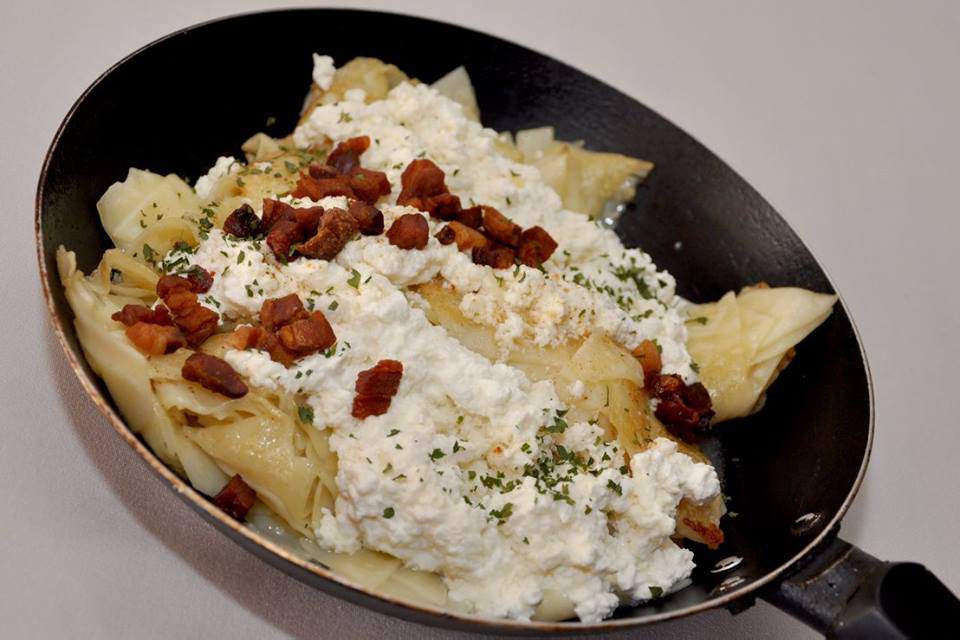
However, according to some sources, one of his favourite dishes was túrós csusza (Hungarian curd pasta). This will be our ‘white’ dish.
Túrós csusza (Hungarian curd pasta)
Photo: Facebook.com/1619806688303183
Ingredients:
250 grams of noodles
150 grams of smoked bacon
250 grams of cottage cheese
0.5 litres sour cream
salt, pepper
some butter
some chives
Preparation:
Boil the noodles in salty water until they are ready (the packaging usually indicates the cooking time). Cut the bacon into tiny pieces and put it on the stove until it gets nice and crispy.
Add the grease to the noodles, along with half the amount of cottage cheese, the bacon and the sour cream, and add some salt and pepper. Put it in a buttered tin and bake the mixture, in a 200 °C oven for a couple of minutes.
When you remove the dish from the oven, add the rest of the sour cream, cottage cheese, bacon and chives and then you are ready to go.
Enjoy!
There are not that many pure green coloured Hungarian dishes to choose from, but since we have already established that
many revolutionists were young it is certainly possible that before the revolution some of their meetings might have escalated into storytelling merriment and drinking.
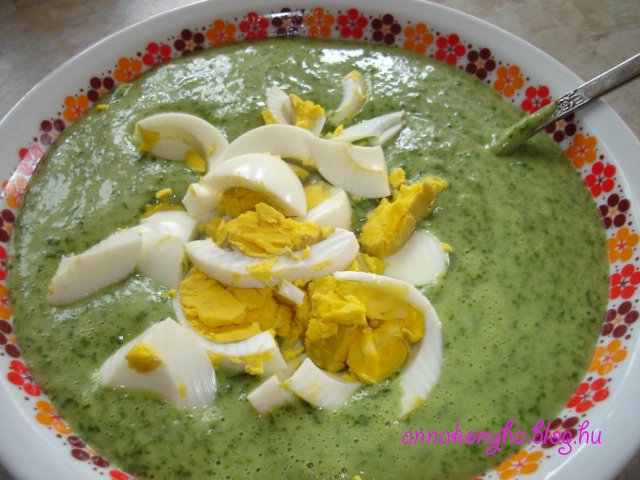
Coincidently, one of the best remedies for hangover is a big, steamy plate of spinach stew with eggs. You can find the original recipe at Annakonyhája. This will represent the green colour of the Hungarian national flag.
Spenót főzelék főtt tojással (Spinach stew with boiled eggs)
Wash and then chop the spinach leaves. Cut the bun/bread roll into four pieces, place them into a bowl and then pour the milk into the bowl. Let them soak in the milk.
Press the garlic, add it to the oil and flour and make a roux. Add the chopped spinach leaves to the roux, mix it well and then add in the soaked bun/bread roll with the leftover milk. Bring it to boil and add some salt and pepper.
Turn down the heat and use a hand mixer for the spinach and soaked buns to make them become pulp. Place the mixture on the heat and add some spices for flavour. If it turns out too thick, you can add some more milk. Serve it hot with boiled eggs.
Enjoy!
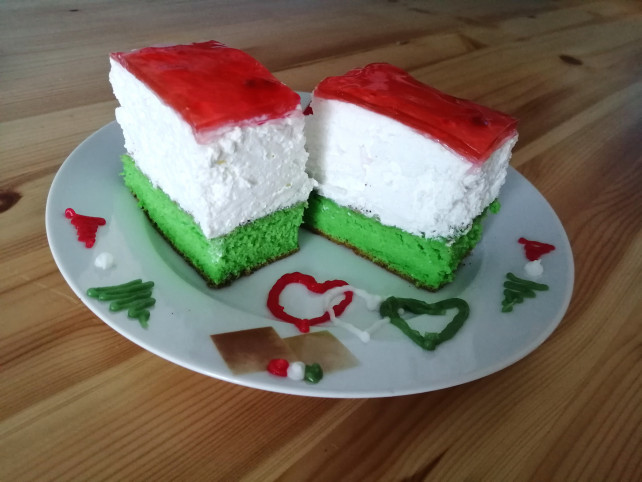
For the dessert you can combine all colours into one delicious túrós (curd) dish, the Magyar szelet (Hungarian slice). The recipeis from Nemes-Pádár Csilla at Mindmegette.
Magyar szelet (Hungarian slice)
Magyar Szelet (Hungarian Slice)
Source: mindmegette.hu / Nemes-Pádár Csilla
Ingredients:
6 eggs
6 tablespoons of sugar (granulated)
half a packet of baking powder (~ 6 grams)
5 drops of green food colouring
4 tablespoons of strawberry jam
0.5 litres of confectionery foam
250 grams of túró (curd)
8 drops of lemon aroma
1 packet of red cake jelly
0.2 litres of water
Preparation:
Separate the yolk and whites. Beat the whites with the sugar until they become a solid foam and then add the yolks and work them in.
Add the baking powder, flour and food colouring to the mixture. Carefully work it all together and put it in an approximately 20cm by 20cm pan. Bake it in a pre-heated oven at 175°C for 25 minutes. You can check if it is ready with a toothpick. It is ready if the dough does not stick to it. Once it is done, let it cool and spread some strawberry jam on top.
To make the cream, beat the confectionary foam with a hand mixer. If it becomes a solid foam, sprinkle the curds into the foam and add the lemon aroma as well. Carefully mix these into the foam and then spread it on top of the green dough.
Put the red jelly into a metal bowl and add in the water. Heat it up and keep it on low heat for 2 minutes. Turn down the heat and let the jelly cool for five minutes. Spread it on top of the foamy layer.
Put the dessert into the fridge and let it cool for two hours. Cut it into slices to serve.
Dear Péter, are you sure about 5 litres of sour cream in the Jókai bableves? That’s 5000 ml (or 1.32 US Gallons or 1.09 Imperial Gallons for readers in the US or the UK for instance). It seems a bit excessive given the other quantities.
Thank you! Actually a good observation. Unfortunately for some reason the editing tool took out all instances of 0. before numbers. Now I have added them back in.
As my friend says, “this is Hungary”. 5 litres of sour cream? Anything’s possible ……. 😉
It was just a minor mishap due to the content management site, it’s being edited 🙂





Dear Péter, are you sure about 5 litres of sour cream in the Jókai bableves? That’s 5000 ml (or 1.32 US Gallons or 1.09 Imperial Gallons for readers in the US or the UK for instance). It seems a bit excessive given the other quantities.
Thank you! Actually a good observation. Unfortunately for some reason the editing tool took out all instances of 0. before numbers. Now I have added them back in.
As my friend says, “this is Hungary”. 5 litres of sour cream? Anything’s possible ……. 😉
It was just a minor mishap due to the content management site, it’s being edited 🙂