Subscribe to our social channels to get the latest news about Hungary!


Hungarians’ heating bills would quadruple and electricity bills double if the Ukrainians’ plan to prevent European Union member states from buying Russian energy pans out, Prime Minister Viktor Orbán said in a weekly interview with public radio on Friday.
Orbán said it would cost Hungary an additional 800 billion forints (EUR 2.0bn) a year if the country had to replace its energy from Russia with other sources. He added that amount was equivalent to the annual government support for the regulated utilities price scheme for households.
Orbán said the majority of EU member states had adopted energy policies that made hurting Russia, and thus helping Ukraine, a priority, rather than supporting their own countries’ families and businesses.
Hungary is opposed to that position and is clashing with the member states that take it, Orbán said. He added that the government would not allow sanctions on Russian energy to be extended to Hungary.
Orbán said the Ukrainians were behind the policies to raise energy prices, adding that it wasn’t unreasonable to speak about “Ukrainian energy threats”.
He said the Ukrainians shared the same goals as the European leaders who believed that they were hurting Russia by helping Ukraine.
Ukraine, the prime minister said, was demanding something from Europeans “which will ruin families”, adding that Hungarian families faced the same threat.
The prime minister said the debates in Brussels weren’t happening “over people’s heads”, but rather “in their homes”, and Hungarians’ electricity and heating bills were at stake.
Orbán said efforts to ban Russian gas from Europe “must be stopped”.
He said the pipeline infrastructure through which Hungary gets Russian gas wouldn’t matter if that gas was banned. Such a measure would burden Hungary’s budget to the same degree as the regulated utilities price scheme for households, he added. Nobody, he said, had addressed the matter of the sustainability of the measure amid the circumstances.
“This is what I usually say in Brussels: ‘I understand you want to hurt Russia and help the Ukrainians … but why do Hungarians have to pay the price? Where is the money? Give it here and then we’ll be even’,” he added.
“We can be negotiated with,” the prime minister said, adding that “it’s a different situation if Brussels agrees to pay the costs of the negative effects their policy has on Hungary.”
So far, Orbán said, Brussels was ignoring the issue and thinking that Hungarians should be the ones to pay the price. “But I’ve always told them that this isn’t our war, and that I won’t allow Brussels to make us pay for supporting Ukraine,” he added.
Orbán noted that the project to build the Nabucco gas pipeline bypassing Ukraine was thwarted at the time, but the Hungarian government, “having recognised the danger”, linked its gas network with Slovakia’s and set up a pipeline running through Serbia, Bulgaria and Turkiye by linking up existing interconnectors.
Since the outbreak of the war in Ukraine, Slovakia, too, has been receiving gas via this network, the prime minister said, adding that though this project may not have been in line with short-term business considerations, it had turned out to be aligned with long-term energy security considerations.
Orbán said Türkiye was a key country in terms of Hungary’s gas supply, noting that the country receives gas from both Azerbaijan and Russia, and “is brave enough to allow the transit of Russian gas no matter what they are told”.
Hungary, he said, has signed an agreement with Azerbaijan under which Hungarian businesses could acquire shares in the country’s gas fields.
This allows Hungary to lower the price of its energy needs, he said, adding that a country like Hungary “which lost the territories where its energy resources were located” had “a lot to do”.
Orbán said Hungary wanted to keep Ukraine out of the European Union because if it was admitted, “it will absorb all of our money like a sponge”, and central Europeans, including Hungarians, would be paying the price.
“For some reason, western European leaders have decided to broker an agreement with Ukraine on maintaining an army of roughly one million troops,” Orbán said. He said this would be financed by Europeans, emphasising that instead of bolstering its own military, western Europe would be paying Ukraine.
He warned that this could pose a “serious security risk” for Europe, arguing that the bloc could end up financing an army “whose intentions won’t always be friendly, or at least there’s no guarantee that they will be”.
The issue of Ukraine’s EU membership, he said, was related to this, arguing that it was “much easier to make financial decisions in favour of Ukraine if the country is in the EU than if it isn’t”.
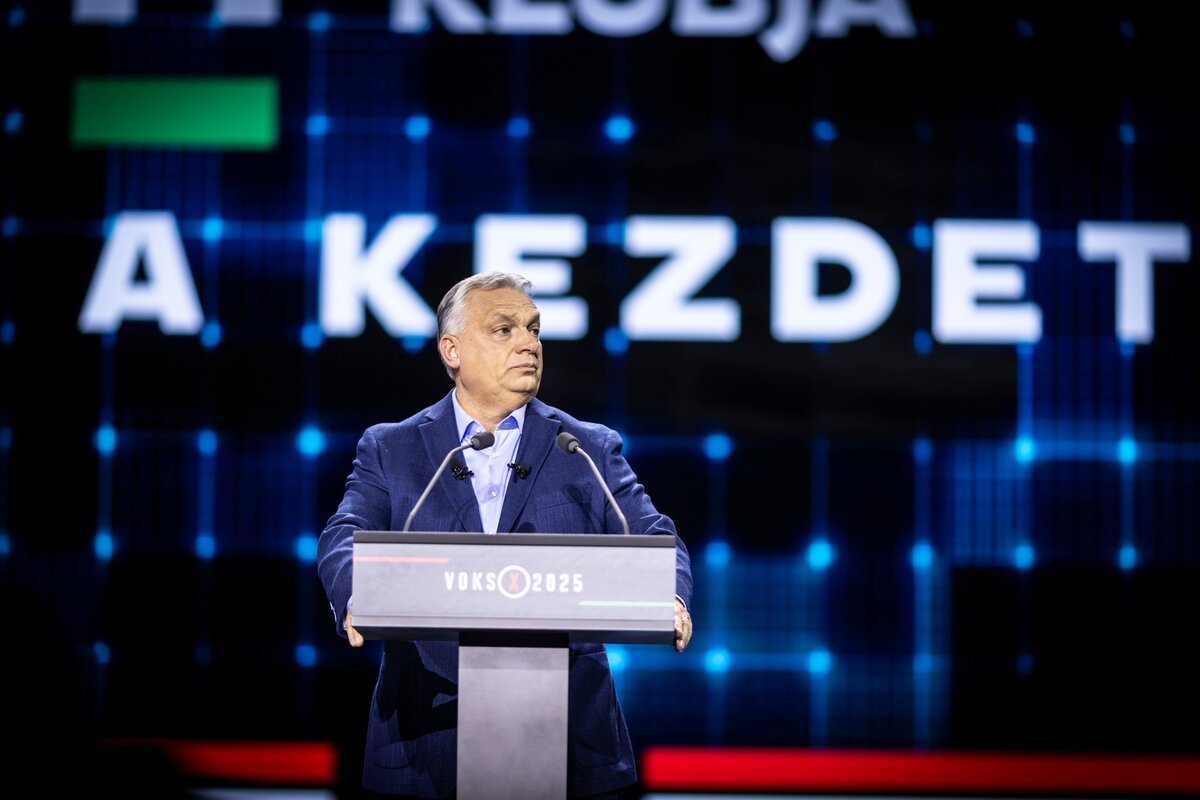
Orbán encouraged the public to participate in the Voks 2025 vote on Ukraine’s EU membership. “Let’s not let others decide over our heads,” he said.
The prime minister said he trusted that the vote, which more than a million people have participated in so far, would strengthen the government’s position opposing Ukraine’s EU membership.
He noted that the opposition Tisza Party has held its own vote on the issue, with 58 percent of its base voting in favour of Ukraine joining the bloc.
Orbán said the Hungarian opposition parties “essentially have Ukrainian connections” and the Ukrainians had an easy job involving themselves in Hungarian politics through the opposition parties.
He said “there is a pro-war, pro-Ukrainian propaganda network operating in Hungary … pushing pro-Ukrainian positions” every day, but “we have taken the necessary moves to counter this” by submitting the transparency bill to parliament.
The opposition parties were known to be pro-Ukrainian as they supported Ukraine’s EU membership, Orbán said, but it was not expected that the Ukrainian secret service “maintains such a deep relationship with them”.
As regards the Ukrainian man arrested in Budapest, he said there was “intensive Ukrainian espionage activity” in Hungary. All states have some kind of intelligence system, which must be tolerated in international practice, he said, adding, however, that experience showed that Ukrainian activity had intensified in Hungary and operational actions were also being organised.
“They create a fake story that spies considered Hungarian are arrested in Ukraine, which, of course, we have nothing to do with, and they are making demands about state leaders and the functioning of Hungary,” the prime minister said.
“We are ready to counter this,” he said, adding that “as soon as they accused us of spying in Ukraine, we took the countermeasures here”.
Ukraine, Orbán said, was waging a disinformation campaign, and “we submitted the transparency law, which does not allow the Ukrainians to operate a pro-Ukrainian propaganda network here.”
“I have seen a video showing the Ukrainian agents identified by the Hungarian state providing services, organising visits, building relationships for the Hungarian opposition parties,” he said. “This cannot be denied; it is there with their own voices, with images on the international network, in the digital world,” he said.
“All this points in the same direction,” the prime minister said, adding that the aim was to “somehow force the Hungarian government and Hungarians to support Ukraine’s EU accession even though it will cost us an arm and a leg”. He said that Ukraine was mobilising serious resources for this purpose and had built serious relationships with the Hungarian political elite.
Concerning the transparency bill submitted to parliament, the prime minister said it was in Hungary’s national interest to prevent political and civil organisations and political media from accepting foreign funding.
The majority of the public believes that those who are involved in politics should not accept support from abroad, Orbán said, adding that even the civil and “pseudo-civil organisations” in question accepted this position.
“I think there could be a national consensus in Hungary on this,” the prime minister said. Orbán said it was not the job of the Hungarian people to “constantly look behind the curtain” so that they could tell whether a civil group or a media outlet was publishing its own opinion, or “is on someone’s payroll” and receives money from abroad.
“This matters. When I read an article, I also want to know whose opinion I’m reading,” he said.
He said the bill was “particularly mild” compared with the American regulation. There is also a rule concerning parties on what can and cannot be done, but there isn’t such a rule for civil organisations, “so we thought we should create one now,” he said. Orbán added that there could be arguments about the details but there should be consensus about the goal.
Meanwhile, Orbán personally pledged to ensure the rollout of tax allowances for mothers of two and three children.
“We set that goal and will guarantee its implementation for Hungarian voters, that families, and especially mothers, will be supported by the budget in 2025-2026,” the prime minister said.
He added that personal income tax exemptions would be introduced for mothers raising three children from October and for mothers of two under the age of 40 from January 1, 2026, while gradually all mothers with at least two children would get the PIT exemption.
Orbán said this was an unprecedented move, unmatched anywhere in the world.
Meanwhile, Orbán said next year’s budget was based on the assumption that in 2026 the government would be able to prevent both in Budapest and Brussels Hungarians’ money being channelled to Ukraine.
He said the government trusted US President Donald Trump’s peace policy, adding that they did not know if there would be peace, but expect there to be a ceasefire and that “the tensions of war will ease”.
Orbán said the war had cost the Hungarian economy some 20 billion euros over the last three years, adding that if these resources were available, “everything would be booming, but now nothing is booming” because as long as the war continued, it would be difficult for the economy to grow.
He said that despite this, he had not given up, and encouraged everyone in the government not to focus on the difficulties but on finding the solution.
“I’m focused on having our own goals no matter how hard the situation is, and on not giving up anything from those goals,” he said.
Asked about the 12 percent decline in investment volume in the first quarter and Chinese vehicle maker BYD’s developments in Hungary, OrbOrbán n said investments were down, and growth was being driven more by consumption than production.
He said this was good in the short run because it meant that people had disposable income and the state budget could remain balanced from tax revenues. At the same time, he added, the economy was healthier in the long run if there was enough investment each year, which was why the government had launched the scheme to set up new factories.
He said China was the leader in electromobility, “and we always have to bring the best to Hungary”. The prime minister also welcomed that BYD will employ some 2,000 highly trained development engineers at the development centre it is bringing to Hungary.
Orbán met Chen Wenqing, Secretary of the Central Political and Legal Affairs Commission of the Chinese Communist Party, in Budapest on Friday morning, the Prime Minister’s Communications Department said.
The stability of Hungarian-Chinese relations is greatly valued in the current challenging global economic environment, the prime minister said. “Hungary’s position is that Europe’s competitiveness is served by cooperation with China and strengthening connectivity, rather than an artificial separation of East and West,” Orbán said.
In 2024, China was the most important foreign investor in Hungary in terms of investment volume, Orbán said. “Chinese companies such as CATL, Semcorp, EVE Power or Sunwoda operate in our country and they significantly contribute to the performance of the Hungarian economy,” the prime minister added.


“I don’t think we can rule out the possibility that Orban might provoke – or just simulate – a small ‘border incident’ early next year.” Noting the opposition Tisza party’s current 14-point poll lead over Fidesz, he continued: “Such an incident would provide an excellent excuse for Orban to cancel the [next spring’s general] election, which he otherwise seems destined to lose.” (Retired senior Hungarian diplomat inteviewed by BIRN who wishes to remain anonymous for obvious reasons)
Correction: our Politicians WANT Russian gas – and oil. With unsurprising echos from MOL (two guesses who or what holds “B” series shares in MOL, granting special rights, including veto power over significant corporate decisions, anyone). All for the benefit of “Hungarian Families!” of course – and perhaps some choice friends, family and toadies?