


Hungarian engineers once put two jet engines on a tank and called it a fire truck

Change language:
Oil well fires are terrible disasters, and much more difficult to extinguish. As the well burns, it continuously pumps large volumes of highly flammable oil to the surface. But Hungarian engineers came up with a brilliant solution even for this catastrophe.
These fires aren’t just extremely dangerous—they also cause enormous financial damage and severe environmental pollution. Traditional methods, such as injecting vast quantities of seawater directly to the base of the well, while effective, tend to be slow and prohibitively expensive.
During the 1991 Gulf War, as Iraqi forces retreated from Kuwait, they set fire to an estimated 600 oil wells in an effort to cripple the country’s oil industry, according to IFLScience. The resulting infernos created widespread devastation and toxic smoke plumes that conventional firefighting tactics struggled to contain.
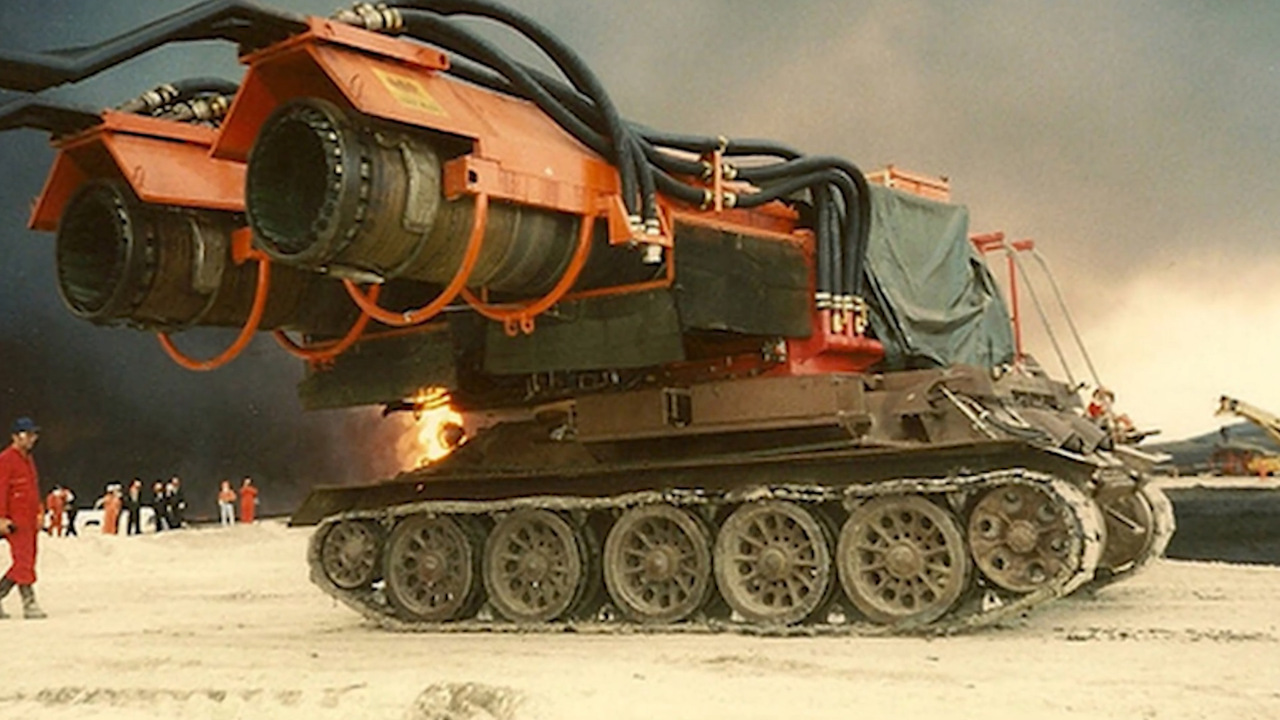
It was in this critical moment that the Big Wind entered the scene—a remarkable machine designed and built by Hungarian engineers. The Big Wind is a firetruck mounted on a 42-ton tank chassis, outfitted with two MiG-21 jet engines. As Earthly Mission reports, the base of the machine was a Soviet-era T-34 tank stripped of its cannon to make room for the two three-meter-long jet engines.
The Big Wind operates by combining the powerful airflow generated by the jet engines with water vapor dispersion. It could blast up to 830 liters of water per minute into the blaze, propelled by air currents approaching the speed of sound. This combination rapidly smothered flames by depriving them of oxygen and cooling the oil, effectively breaking the chain reaction of combustion.