Subscribe to our social channels to get the latest news about Hungary!


Autumn will be “tough” in Hungarian domestic politics, independent lawmaker Ákos Hadházy said in Budapest on Tuesday, at a demonstration demanding the withdrawal of amendments to the law on the freedom of assembly, and against the adoption of the law on the transparency of public life.
Hadházy said he expected that “those in power” would not issue “further tough measures” until the elections next April, unless “their numbers are also showing that they are in trouble.”
He said “it should be taken seriously that they tried to squeeze me off the road” in Hatvanpuszta, in central Hungary. The transparency law is also still on parliament’s agenda, he added.
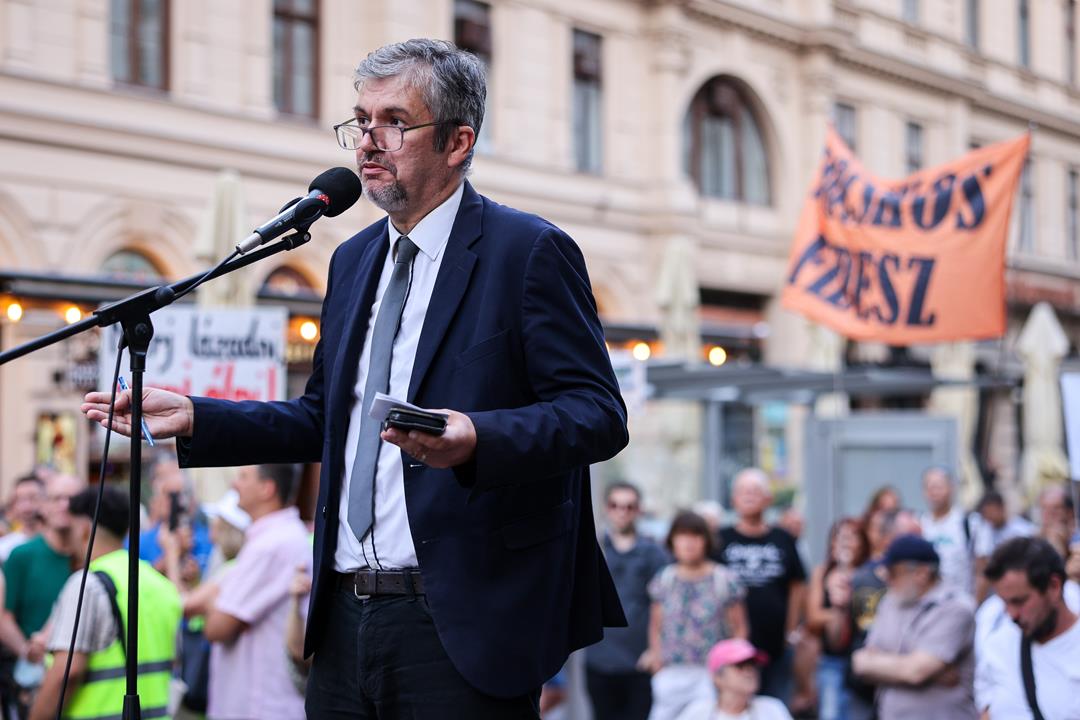
Demonstrators have been successful, “they proved wrong those who think Hungarians are unwilling to demonstrate for their freedom. They showed what the Pride was really about, that banning it was an infringement on the right to assembly as well as harming the rights of our gay compatriots. They also made sure that the spring cleaning announced by the prime minister did not happen, and that those in power have lost a little confidence,” he said.
He pledged to continue the demonstrations on Ferenciek Square in two weeks’ time, to hold “visits to Hatvanpuszta” and a demonstration in Dunaujvaros, central Hungary, next Tuesday.


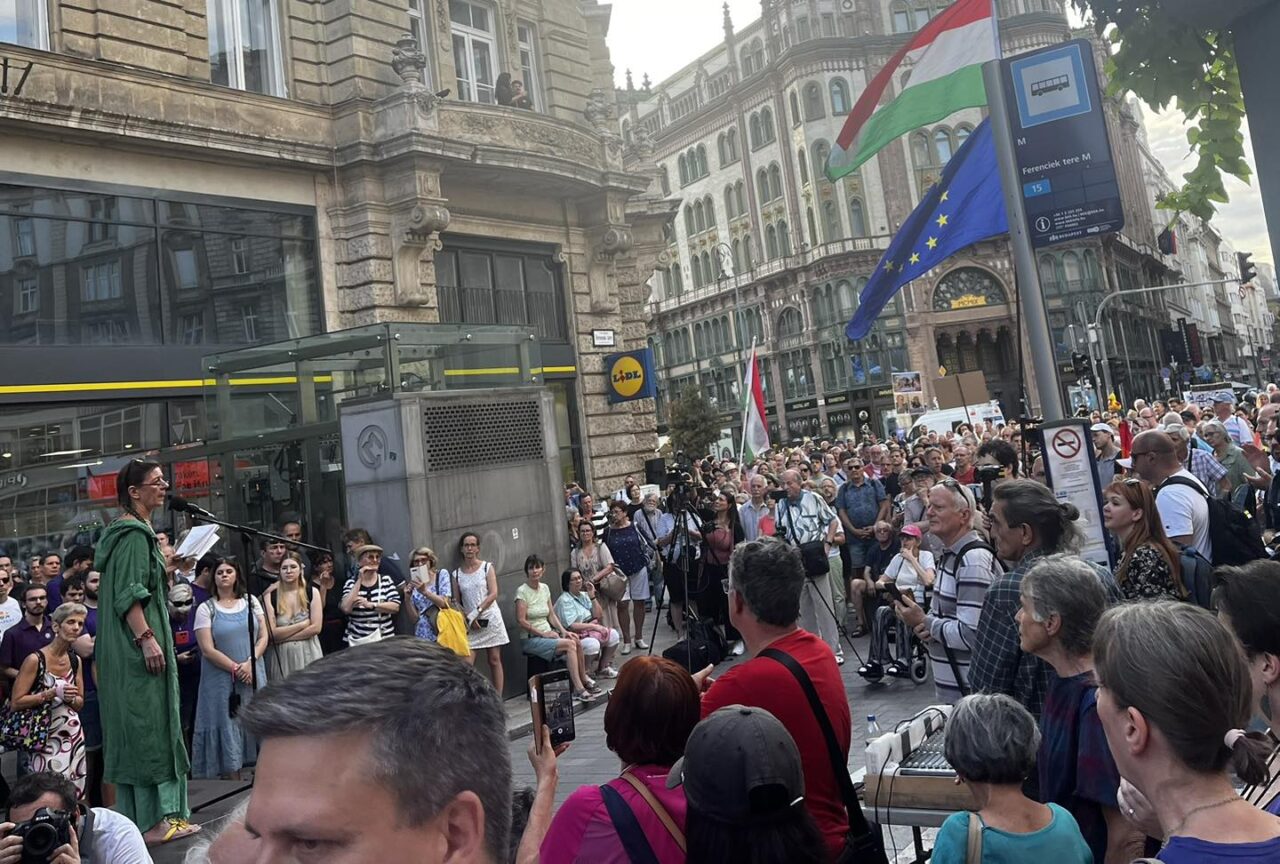
The fact that they’re waving E.U. rags tells you everything you need to know.
Before you step into that voting booth, ready to support a pro-EU candidate who will ultimately place Hungary under the control of Brussels, take a moment to consider the larger picture. Let’s use Germany as an example. Germany, the EU’s largest contributor, is staring down an economic collapse. How did we get here? Reckless decisions during the COVID-19 pandemic, a self-inflicted energy crisis, and an unrelenting push for green energy. We’ve been told over and over that the world is about to end in five years unless we act. But the reality is, the planet is far tougher than they want us to believe. It’s endured volcanic eruptions, ice ages, and cosmic cataclysms. Yet, we’re being sold a story by elites eager to consolidate power, claiming they’re the saviors of the Earth—while they crush the working class under a mountain of taxes. People are waking up, and the era of lies is coming to an end. And last but not least the sanctions against Russia, cutting the EU of off a reliable flow of cheap gas. Remember Nord Stream?
Germany’s social systems are hanging by a thread, stretched thin by mass illegal immigration and an economy on the brink. Sovereign debt is at catastrophic levels, and the EU’s response isn’t just mismanagement, it’s a crime. The reality is simple: who’s going to buy Germany’s bonds to keep this Ponzi scheme afloat? No one. So, what’s the solution the EU proposes? More centralization. More regulations. More unchecked migration. It’s a way to control, not to solve.
Then there’s the looming threat of war. Germany is pouring 5% of its GDP into NATO spending, an unsustainable commitment that signals destruction and inflation on the horizon. It’s clear: it’s either default or war. History has shown us this pattern too many times to ignore.
But the problem runs deeper than economic mismanagement. The EU is actively dismantling the very idea of national sovereignty. The centralization of power means the individual has little say, and the states have even less. More than just raising taxes and controlling the economy, the EU is eroding self-determination and undermining democracy. Citizens are being governed by an unelected elite in Brussels, whose interests rarely align with the needs of everyday people.
We’re at a crossroads where the sovereignty of nations is being traded for an illusion of unity and stability. But in reality, this is an erosion of democracy. The unelected bureaucrats in Brussels hold far more power than elected officials in individual countries. Laws are being made in far-off offices, disconnected from the realities of local people. This isn’t just a question of policy; it’s about who has control, and right now, it’s not the citizens of the countries affected.
Where does this lead us? To a Europe where countries lose their identity and their ability to make decisions for themselves. Where political power is increasingly concentrated in the hands of a few global elites, accountable only to themselves. It’s a future governed by technocrats, where the voices of ordinary citizens are drowned out.
This centralization isn’t just theoretical, it’s already happening. Politicians are no longer truly accountable to their citizens. Instead, they serve the interests of a far-reaching bureaucracy, a distant power that doesn’t have to answer to the people. The truth is, we’re moving toward a system where national sovereignty is sacrificed on the altar of a united Europe. But what happens when there’s nothing left to unite? When nations are dissolved into one large state, governed by a few?
The real danger here isn’t just economic collapse or war, it’s the loss of freedom. The loss of the ability to shape your own future. Technology is advancing fast, but as it does, it will make it harder for people to push back against an ever-growing, unaccountable system. We’re heading toward a place where governments no longer reflect the will of the people. Instead, they serve the will of a globalist agenda, pushing policies that ordinary people never had a say in.
The result? More taxes, more regulation, more pressure to conform, and no room for dissent. No more free speech. No more private property. But most tragically of all, no more peace. In the rush to centralize power, we are being dragged into conflicts that have nothing to do with the real needs of ordinary citizens. The costs of war, economic collapse, destruction, and loss of life, are immeasurable. Yet, under the EU’s increasingly aggressive stance, war seems inevitable.
NATO is already draining resources, pouring billions into defense with little regard for the consequences at home. Military conflicts across the world are escalating, while the EU’s foreign policy only exacerbates tensions. Do we really want to keep paying the price of war, both in terms of our resources and our lives? The war machine feeds itself at the expense of the very people it’s meant to protect.
This is not the future we should be building. We don’t need more weapons, more destruction, more inflation, and more bloodshed. We need peace, and that starts by stopping the endless cycle of escalating conflict fueled by unaccountable bureaucrats who don’t live with the consequences of their decisions. No more wars. It’s time we focus on building a future where cooperation doesn’t mean surrendering our sovereignty or marching toward conflict.
Think about it. The path we’re on will shape our world for generations. It’s not too late to change course, but we need to act now. Because once we lose our sovereignty, our freedom, and our peace, getting it back will be nearly impossible.
What a load of BS, full of lies, straight out of Fidesz-Russia propaganda storybook.
People demonstrate for preserving freedom. Our current anti-EU government is taking us to the opposite direction, towards the hands of eastern dictator.
The best part of the Daily hungarian news- channel are its comments.
Dear Micheal and Peter Steiner,
Hungary is the poorest nation in the EU because of its domestic policy, not because of the EU.
Hungary has the worst healthcare in the EU because of its domestic policy, not because of the EU.
Hungary has consistently stood up for Russia, thwarting much EU legislation, because of domestic policy, not because of the EU.
Your assessment of Germany is way off. Why do you spout such conjecture while ignoring what is going on at home?
Hungary is waking up to the fact that healthcare is crumbling, transportation is crumbing, the economy is in free fall, the debt is crushing ordinary citizens, inflation is higher than any other country, all the while Orban’s family lives in unparalleled luxury in hidden palaces with his daughter and son in law running away with billions.
These are real facts, not opinions.
Viktor Orbán’s stance on the EU is fundamentally about defending Hungary’s national sovereignty and preserving Hungarian values. The characterization of Hungary as moving toward an “Eastern dictator” is unfounded and lacks factual basis, and should be rejected. Orbán is not aligning with authoritarian regimes but is rather resisting what he views as undue overreach from Brussels, while simultaneously maintaining pragmatic economic ties with Russia.
In conclusion, the debate surrounding Orbán’s policies is rooted in differing definitions of “freedom” and “sovereignty.” His supporters believe that his focus on national sovereignty is essential to protecting Hungary’s autonomy in the face of what they perceive as external interference from the EU. This clash of perspectives is deeply intertwined with both ideological and geopolitical divides.
If one is to criticize the actions of the government, or the opinion of a concerned EU citizen, it would be far more productive to engage with thoughtful arguments, raise valid questions, and propose better ideas, rather than resorting to name-calling or equating opposing views with extremism. Genuine debate thrives on understanding and intellectual exchange, not on reducing differing opinions to simplistic or inflammatory labels like animal feces.