


Orbán cabinet pleased there’s no Mohamed at the Oroszlány school

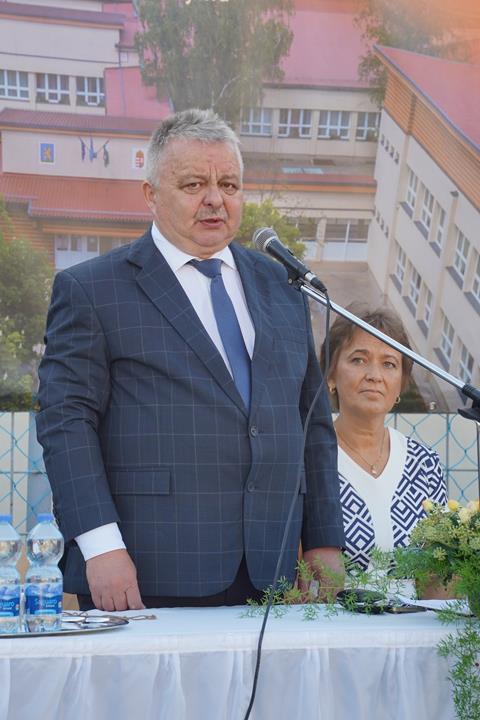
Oroszlány Mayor Károly Takács, a member of the ruling Fidesz party, ignited a storm of outrage among parents following a controversial comment he made during his speech at the school-opening ceremony on 1 September. While reading aloud the names of the first-graders, he added that he was glad none of them were named Mohamed. Critics argue that immigration debates have no place among young children, though the government has defended the mayor.
Mayor happy there’s no Mohamed
It is customary for municipal leaders to attend school opening ceremonies and offer brief remarks to welcome students, parents, and teachers at the beginning of the academic year. These speeches usually stick to well-wishes and fond recollections.
But on 1 September, during the ceremony at Hunyadi Mátyás Elementary School in Oroszlány, Mayor Takács deviated from that tradition. After reading the full list of first-grade student names, he remarked into the microphone that he was pleased none of them were named Mohamed. He justified this by stating that Mohamed is the most common name in Germany and suggested it was good that Oroszlány had no children with that name starting school.
Mayor’s advice: Move away
Many parents were outraged. Some questioned why contemporary political issues were being introduced in a school setting. Others shared positive stories about doctors with immigrant backgrounds working in Hungary’s healthcare system. Takács appeared undeterred by the criticism. In a Facebook comment responding to one parent, he dismissed the backlash, saying those who dislike the speech should simply not listen.
He later clarified that his problem wasn’t with the name Mohamed itself, but what he claimed it represents: migration. According to Takács, those who support migration should “move to a migration country”.
The controversy quickly escalated into a national scandal, prompting a show of support from government officials. Just one day later, politician Tamás Menczer publicly defended Takács in a Facebook post. Echoing the government’s longstanding anti-migration stance, Menczer claimed Western Europe had “fallen” by allowing mass migration, leading to terrorism, crime, and integration issues. In contrast, he said, Hungary built a border fence and avoided these problems.
Migrants aren’t staying in Hungary
In reality, data shows that even in 2015, most migrants were not looking to settle in Hungary but were trying to move further west: much like many Hungarians who leave the country in search of better wages. Still, unregulated immigration has posed serious public safety concerns, as it can allow individuals with potentially dangerous backgrounds to enter the country unnoticed.
Mayor Takács continues to enjoy strong political support locally. His Fidesz–KDNP alliance holds six seats on the municipal council, giving him a comfortable majority. The opposition consists of a local independent group and a representative from the Mi Hazánk Movement, which often aligns with Fidesz in Parliament.
Read more:
- Austria imposes strict new immigration and refugee policies: “Integration is Over”
- More immigrants or emigrants in Hungary? The unexpected 30-year trend
Click for more coverage on migration.
To read or share this article in Hungarian, click here: Helló Magyar
It is child abuse to encourage racism and Islamophobia to them by authoritiy figures.
Yawn.
Do Lefties know anything other than calling everyone under the sun all kinds of -ists and -phobes!?!?! It’s really mind-numbingly boring already.
Steiner, shut your idiot mouth.
No one cares about your idiotness.
What if that Fidesz sack of shit said “Good thing none of you were named Jakub or Ariel? Oh, that’s anti-Semitism and we can’t have that! People need to be treated with basic dignity by others and if people who are politicians don’t understand that they are in the wrong profession.
We are all happy about that, and may it stay that way forever.
And then we will find out that Steiner’s daughter got married to an middle eastern man and have a baby called Mohammed!!!!!!! 😀
Concerns about immigration are often dismissed or silenced, especially when framed as critiques of how it’s managed. The conversation quickly becomes polarized: critics are labeled xenophobic, while others resort to extreme rhetoric to fuel fear and division.
What’s often overlooked is that immigration, like any major issue, brings both challenges and benefits. The real issue isn’t whether immigration is inherently good or bad, but how societies manage the tensions between these challenges and the opportunities immigration can offer.
So, what’s the answer? Open borders, closed borders, or something in between?
Balance, more than ideology, is key. Open borders might be idealistic for some countries, but a pragmatic, flexible immigration system that takes into account things like economic needs, security, and social cohesion is likely the most sustainable approach.
But let’s not kid ourselves: this isn’t about blindly following bureaucrats in Brussels. Their open-border stance has contributed to human smuggling, fractured societies, rising violence, overwhelmed education systems, and drained resources. Just to name a few! How do we reconcile an ideal of openness with the real-world consequences we’re seeing?
Here’s the food for thought: As a nation, we should prioritize immigrants who can prove they will contribute positively. Our citizens shouldn’t bear the full cost of absorbing endless waves of refugees. We don’t owe anyone anything. But if we continue down a path of unchecked immigration without regard for societal capacity, we’ll eventually reach a breaking point.
What happens when we’ve hit that tipping point? When does a nation cease to be able to absorb, and begin to feel overwhelmed? How much is enough before the cost of compassion becomes unsustainable?
These are the hard questions we need to answer before the policiy of a closed border can be changed.
It must be a win-win situation. Period.
Well said Péter.
The solution is by being realistic and not fall neither to the far left nor right.!
Almost true, except that BS claim that EU has an open-door stance for migration. It does not. And nobody is “blindly following bureaucrats in Brussels”. Pure propaganda fueled claims. Rules apply to EU migrants and unwanted migrants are deported.
https://ec.europa.eu/eurostat/statistics-explained/index.php?title=Returns_of_irregular_migrants_-_quarterly_statistics
There is no simple solution to migration, that is true. Plenty of hard questions still exist about how to even better manage migration and how to separate the unwanted troublemakers from those who really deserve protection.
This article has nothing to do with immigration. This article is about a Fidesz politician teaching children to be racist Islamophobes. What he said was an offence to the thousands of Islamic people living peacefully in Hungary. There has always been a small Islamic minority in Hungary and comments like this are an offence to these families including their children which may include some named Mohammed. I can imagine the a-hole politicians going into schools saying “I hope none of you are gay.” There will always be some kids growing up knowing they are gay and what kind of terrible pressure does that put on children leading to mental health issues all the way to suicide?
If one examines the long-term consequences of mass immigration into Europe, particularly the sustained influx of young men from countries such as Syria, Afghanistan, the Sub Sahara region and Nigeria, just to name a few, it becomes clearer why Hungarian Prime Minister Viktor Orbán might express relief or even happiness that his country has largely avoided similar challenges. Whether these issues manifest now or in the future, they inevitably shape the social environment in which the next generation grows up.
The challenges associated with poorly managed integration policies include: increased instances of violence (both among immigrant groups and directed toward others), rising rates of sexual harassment and assault, unrest in public institutions such as schools and public transport systems, gang formation, spikes in youth unemployment, housing pressures, and in some urban areas, the development of parallel societies with limited adherence to national laws. In extreme cases, such as certain districts in Sweden, local authority has weakened to the point where informal systems like Sharia law reportedly influence community behavior.
Hungary, in contrast, has taken a different path. Hungarian voters have opposed policies they perceive as leading to such outcomes. Whether one agrees with Orbán’s methods or not, it is worth asking: What would the situation look like had his government chosen the opposite course?
One could imagine a statement like this: “I am pleased that nearly every boy in the classroom is now named Mohammed; I am pleased that education has failed to respond to rapid demographic change; I am pleased that parts of our cities are no longer governed by national law, and that Hungarian citizens no longer feel safe walking their own streets. I am pleased that our healthcare system is overwhelmed, and that we ignored the will of the people in the name of ideology. You and your children must now bear these burdens, both today and in the years ahead. Thank you, and you’re welcome.”
Of course, no responsible policy debate should suggest that immigration be halted altogether. But the key issue is how immigration is managed, and whether the host society retains the right to determine the scale, pace, and cultural framework under which integration occurs. When democratic consensus is ignored and concerns dismissed as prejudice, the resulting backlash is not only predictable, it’s justified.
What are you talking about man?
I have kids attending Hungarian school.one is 10 and one is 5.both of their names have MUHAMMAD in it.
I totally agree with government policy that no one should be allowed to enter Hungary illegally.
But with these type of statements you are making my children unsafe,people like me who entered Hungary 9 years ago ,legally and living here.donot put danger to our kids life.
You can do politics on national and adult level but don’t do this on schools.
Thanks
I have 2 kids. 10 year old and 5 year old.both are attending public school and public kindergarten.i have been living in Hungary for last 9 years.its first time that I feel unsafe about my kids after this mayor speech because both of my kids name have MUHAMMAD in it.
I have no problem that government policy is on national level but it will make my kids unsafe in school.
I have always felt safe and even after having options of moving to west Europe.i chose Hungary because of people.i haven’t met such friendly and amazing people like Hungary.
But I strongly condemn the mayor.
Please leave our kids out of this.
Play your political games on adult level
Larry is right, it not about Imigration- its about a ideology that calls for death of others that don’t follow the Quran.