Subscribe to our social channels to get the latest news about Hungary!


Construction and Transport Minister János Lázár says it is time to acknowledge that current driving speeds on Hungarian motorways routinely exceed the legal limit of 130 km/h.
During a press conference on Monday with Zsolt Hegyi, CEO of the MÁV–Volán Group, Lázár announced that the government would launch a nationwide consultation to gather public opinion on speed limits and broader road traffic issues.
Lázár pointed out that actual motorway speeds often hover around 140–150 km/h, making the current legal limit outdated. He believes speed limits could be increased on certain sections of motorway, but public acceptance is essential.
“Experts agree that this could be technically feasible, but public opinion so far has been against it,” the minister said at the press event.
He also addressed plans to raise speed limits for buses and lorries: buses could increase from 100 km/h to 110 km/h, while lorries over 7.5 tonnes could rise from 80 km/h to 90 km/h. Personally, Lázár supports slower speeds in urban areas and faster ones on motorways to enhance safety and traffic flow.
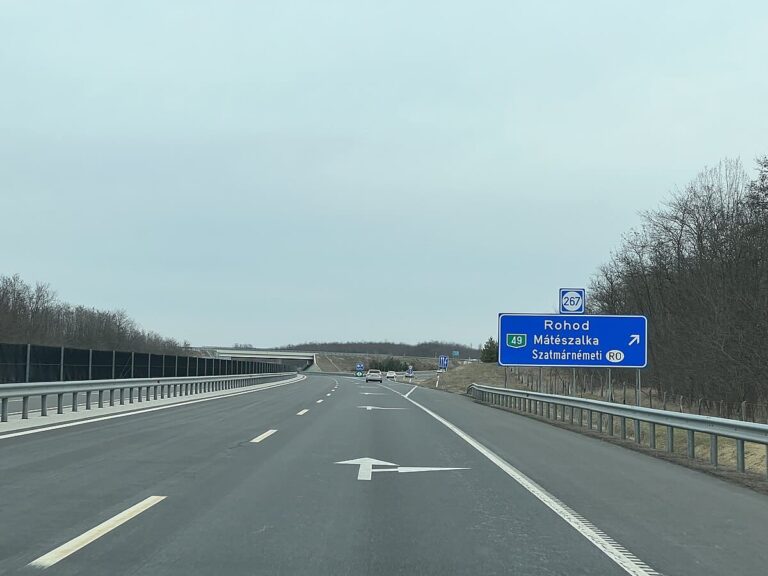
The government plans to launch a nationwide consultation to allow citizens to give their views on motorway speed limits and key traffic regulation issues. “We will be launching an online platform for the public to share their views on various topics,” Lázár said. “The consultation will cover the full contents of Hungary’s traffic code (KRESZ), focusing on the most important issues.”
He also commented on average speed monitoring, saying he personally does not support its introduction, referring to it as a “pretty nasty system” that would be unduly strict on drivers. Still, he emphasised that public opinion is crucial, and questions around regulating speeding will form part of the consultation.
Lázár cited Germany’s dynamic speed regulation on some autobahn sections, where there is no fixed speed limit and drivers are trusted to exercise personal responsibility based on traffic and road conditions. However, he views this approach as difficult to implement in Hungary due to local driving culture and the current condition of the vehicle fleet.
“Hungarian society is not prepared to adopt such a system,” the transport minister said.
He also stressed the importance of reducing speeds in urban areas to prevent accidents. Statistics show that inappropriate speed choices account for about one-third of serious or fatal accidents, though the leading cause remains failure to give way.
Experts, including Csaba Tóth of the Clean Air Action Group, warn that increasing speed limits is not merely a technical matter. “Speeding is not just a technical issue,” Tóth told 444.hu. “It has serious communication implications—it amounts to a wink at speeders.” He added that by condoning speeding on certain roads, the minister could inadvertently encourage it elsewhere. The government, however, maintains that accountability and a realistic view of current conditions must guide policy.
Following the press conference, Lázár also addressed traffic safety in a Facebook post on Tuesday. Referring to a fatal incident on Árpád Bridge, he wrote:
“Anyone who uses public roads to race, who deliberately disables driver-assistance systems to exceed safe limits, or who endangers others out of impatience is putting lives at risk. In such cases, the vehicle becomes a weapon capable of killing. That is why I consider the hit-and-run on Árpád Bridge an act of murder.”
Lázár noted that the new draft of the KRESZ is part of a comprehensive overhaul of the country’s traffic regulations. Speeding and road safety will remain central topics in both the public consultation and forthcoming legal reforms.
Read more from us:
To read or share this article in Hungarian, click here: Helló Magyar


If you increase the speed limits to 150 you won’t make the people doing 140-150 suddenly drive within the speed limit because many will then drive 160 or more. In my opinion buses should be able to go faster than 100 but I would cap it at 120. Driving is the most dangerous activity the average person ever does and if something goes wrong it is worse at higher speeds. Be careful.
Studies verify: more speed = more accidents.
But people like to drive fast and raising speed limits will raise political popularity. If decision makers were to think about the safety of road users, they would need to decrease limits. Especially in Hungary where roads are full of old cars with less safety features. But lowering speed limits is a very unpopular decision. With the “public consultation” politicians will get a good reason to increase limits and gain some popularity. When the data later shows that accidents have increased, politicians don’t need to take any blame on themselves since they just followed the peoples will.
That’s an interesting observation about right-wing politicians giving people faster speed limits. That’s exactly what happened where I live in Ontario, Canada. The government increased the speed limit from 100 to 110 on some sections of highway. Instead of driving at 120 drivers are driving at 130. The problem with Ontario highways is that outside of cities they have no guard rails except in especially dangerous spots. If you lose control you go off the highway and down an embankment where most times your car will roll over crushing you inside.