Subscribe to our social channels to get the latest news about Hungary!


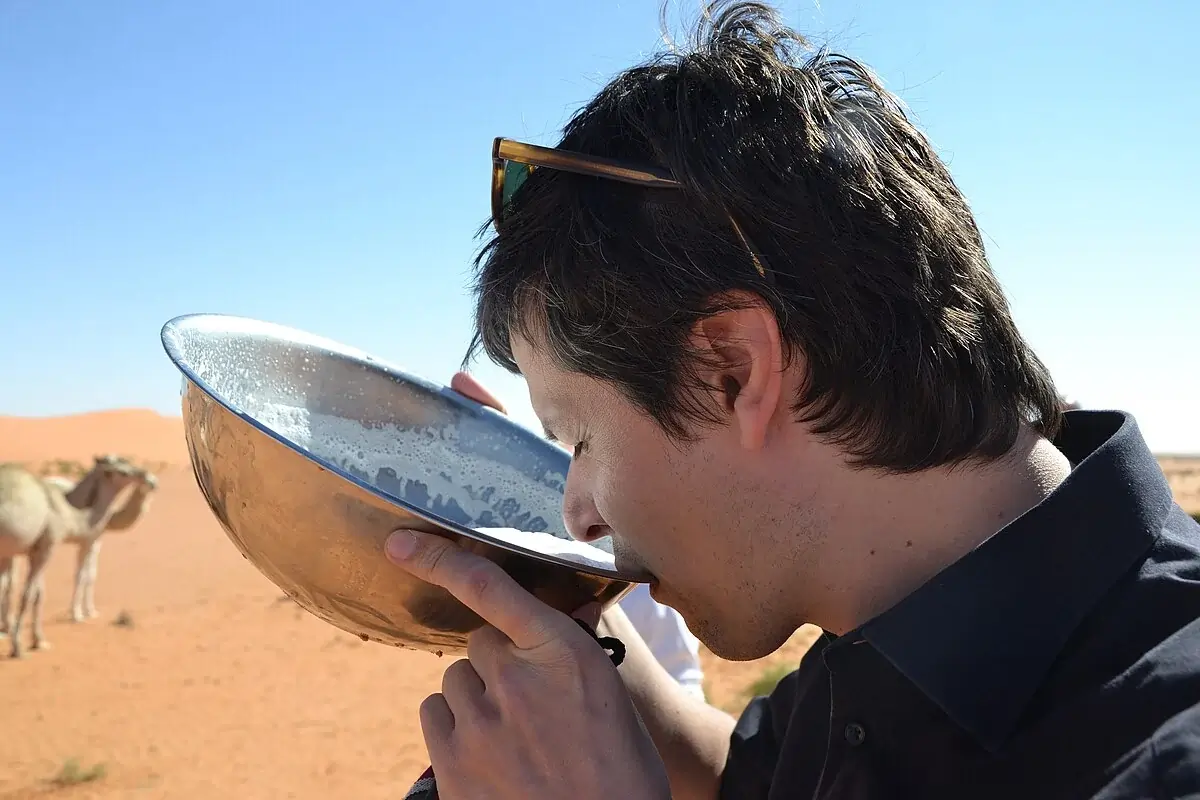
Interest in camel milk has visibly grown in recent years. In Western Europe, it’s starting to appear on store shelves from time to time, while in Hungary, only a few have tasted it. What few people know is that Hungarian specialists played a key role both in building the world’s largest camel farm and in several other large-scale projects.
Hungarian involvement began in Dubai in 2006, when, on the ruler’s commission, two Hungarian veterinarians, Péter Nagy and Judit Juhász, set up the Camelicious farm. Today it is the largest facility of its kind, milking around nine thousand camels and operating a modern processing plant. The expertise gained there helped keep Hungarians at the forefront of the industry.

Since then, the Dairy Research Institute (MTKI), part of the Hungarian University of Agriculture and Life Sciences (MATE), has worked closely with Camelicious. For more than a decade, they’ve carried out joint research and development — a track record that helped attract new partners.
Chad is in a unique position: it has the world’s largest camel herd, close to ten million animals, yet it still hasn’t broken into the top five camel-milk producers. The potential is enormous, but the nomadic system of husbandry has so far limited commercial returns.
MATE wants to change that. This summer the foundation stone was laid for the Centre of Excellence for Camel Breeding and Camel-Milk Processing in Chad. Construction is due to start in November, financed by the Hungarian side. The new facility will not only process milk but also conduct research, and Hungarian experts will train local professionals. The aim is to raise daily yields from the current 5–7 litres per animal to 10–15 litres, creating a stable, export-ready sector.

According to market research, the camel-milk sector is growing rapidly. As Oeconomus.hu summarises, Straits Research valued the market at $14.09 billion in 2023 and expects 6.6% compound annual growth to $25.04 billion by 2032. Grand View Research is even more upbeat, projecting 9.4% annual growth, which would push the market above $24 billion within a few years.
People in the Middle East and North Africa have been drinking camel milk for a very long time; some even call it a “healing milk.” Its taste isn’t outlandish — broadly similar to cow’s milk — though many describe a faintly salty note and a creamier texture. As with cows, the quality depends a lot on how the animals are kept: whether they’re free-range and what they eat — all of which strongly shapes the milk.

Camel milk’s main appeal is its nutritional profile. Compared with cow’s milk it typically contains more vitamin C, calcium, iron, and potassium, while lactose levels are generally lower, and it lacks beta-lactoglobulin, a protein often implicated in milk allergies. Studies suggest it may help lower blood sugar and could have beneficial effects in preventing the onset of diabetes, effects often linked to insulin and insulin-like components naturally present in camel milk.
Large-scale dairy logic doesn’t really work with camels. A camel gives around 6–7 litres a day, while a cow yields thirty to forty; camels can be milked for a shorter period, and in many places the milk let-down often requires the calf nearby or targeted stimulation. That means more labour, time and cost, which shows up in the price per litre.
In Western Europe, it’s typically well above the price of “regular milk”:
In Hungary, it remains a speciality for now, but the Chadian program could bring camel milk a step closer to European markets.
Cover photo: Sammy Six / Wikimedia Commons


