Subscribe to our social channels to get the latest news about Hungary!


Another small new satellite built at BME is awaiting launch, now in the United States for final testing and adjustments. The satellite, named Hunity, developed with the professional partnership of the National Media and Infocommunications Authority (NMHH), has reportedly already been integrated onto its launch vehicle: none other than Elon Musk’s SpaceX Falcon 9 rocket.
The satellite was built at the Faculty of Electrical Engineering and Informatics (VIK) of BME, by the staff of the Department of Broadband Infocommunications and Electromagnetic Theory’s Microwave Remote Sensing Laboratory, in cooperation with students and the University Radio Club, and funded by the NMHH.
Weighing 868 grams and measuring approximately 5×5×15 centimeters, the device carries several innovations. Compared to earlier student satellites, it features newly developed deployable solar panels and instrument panels, as well as a high-resolution onboard camera and a magnetic and motorized attitude control system.
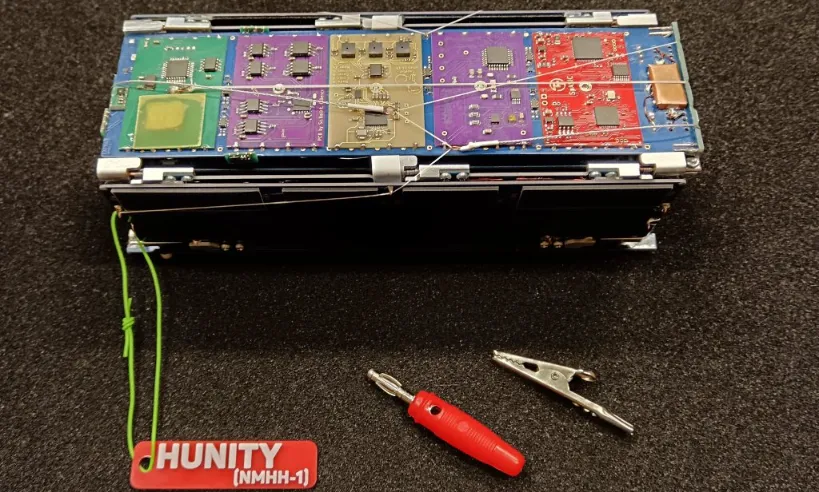
“Continuing the inter-university cooperation launched with the MRC100 satellite, four experimental panels from the development team of Széchenyi István University were also placed onboard.
In addition, the finalist teams of last year’s Cansat Hungary high school competition were able to include a total of six of their own experimental panels,” said Levente Dudás, technical lead of BME’s pocket satellite projects, to bme.hu.
The satellite will communicate via the amateur radio band, with its primary ground control station located on the roof of Building E at BME. The launch is scheduled for November as part of the Transporter-15 mission.
Read also:
US tech billionaire Elon Musk’s SpaceX is preparing to launch 28 Starlink satellites into low-Earth orbit from Vandenberg Space Force Base in California on Sunday as part of its ongoing constellation expansion. The Falcon 9 rocket will lift off from Space Launch Complex 4 East, carrying satellites for the company’s global broadband internet service, the Turkish Anadolu news agency wrote.
The launch is currently scheduled for 6.28 pm local time (0128GMT, Monday), but delays may occur from time to time due to external and technical reasons. The mission represents the 28th flight for the first-stage booster, which has previously supported various missions, including Sentinel-6 Michael Freilich, DART, and 18 previous Starlink launches.
After stage separation, the first stage will attempt to land on the “Of Course I Still Love You” droneship positioned in the Pacific Ocean, continuing SpaceX’s rocket recovery operations. The company said residents in Santa Barbara, San Luis Obispo, and Ventura counties may hear sonic booms during the launch, though the experience depends on weather conditions.
The launch continues SpaceX’s rapid Starlink deployment schedule. The company has conducted 10 similar launches in September alone, and the number of satellites in space exceeds 8,000, providing internet coverage to around 130 countries and territories worldwide.


