Subscribe to our social channels to get the latest news about Hungary!


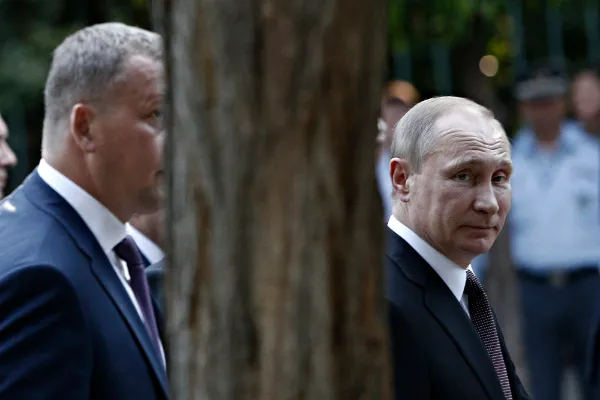
Putin’s latest move may deliver a stinging blow to the global food system, as the world edges closer to a fresh spike in food-price inflation unseen for decades. This looming crisis may prompt another wave of migrants heading to Europe and the collapse of multiple governments. Putin will be the one who takes advantage of the situation, since the red button was pushed by President Trump in late February.
Around a third of the world’s seaborne fertiliser trade passes through the Strait of Hormuz, a route that now faces an open‑ended closure as the Iran conflict rages. The narrow waterway is crucial not only for global oil and gas flows but also for the supply of ammonia and urea, the building blocks of modern nitrogen fertilisers. Without these inputs, crop yields could fall sharply, pushing food prices up to levels not seen since the pre‑industrial era.
In peacetime, Hormuz handles roughly 30 per cent of the world’s fertiliser commerce, including large volumes from Saudi Arabia, Qatar and the United Arab Emirates. The disruption has already bitten hard: since the start of the US‑led offensive in late February, the price of urea has surged by 40 per cent, climbing to about $670 per tonne. That is still far below the 2022 record of $1,000, but the outlook is grim.

Enter Vladimir Putin, who has once again found a way to lash out at what he calls “hostile” states. Together, Russia and Belarus account for about 40 per cent of global potash exports, roughly 23 per cent of ammonia and 14–16 per cent of urea. Yesterday Moscow announced a halt to several nitrogen‑fertiliser exports from March 21 to at least April 21, effectively pulling those volumes from world markets when farmers in the northern hemisphere are preparing for spring planting.
The consequences will be felt with a lag. Confronted with shortage and sky‑high prices, growers may reduce seed wheat, barley and maize planting or even leave fields fallow. Yields will fall, and those that do survive cultivation will often be of lower quality. Within a few months, supermarket shelves will reflect that reality in the form of higher, and more volatile, food prices.

The European Union is especially exposed. In 2025, some 22% of the bloc’s fertiliser imports came from Russia, with Poland, the Baltic states and Bulgaria among the heaviest buyers. Russian producers have long undercut European rivals with low prices, while German plants, heavily reliant on cheap Russian gas, have become uneconomical to run without it. It is no accident that sanctions on Russian fertilisers have been diluted or quietly lifted.
Farmers across western Europe now face a bleak calculus: if they somehow secure fertiliser at all, they will struggle to pass on the extra cost, unlike 2022, when rising grain prices shielded them from higher input bills. Many told Euronews they do not expect meaningful state support this time.

The knock‑on effects will be even more severe in Africa and parts of Asia. Countries including Nigeria, Ghana and Ethiopia, which rely heavily on Russian fertiliser imports, now face a sudden and dangerous shortfall. The risk of hunger, social unrest and mass migration rises sharply, especially where soils are already depleted and farming methods precarious.
According to a recent World Food Programme study, cited by the Centre for European Policy Analysis, some 45 million people may soon be on the brink of starvation: 28 million in Africa, 9 million in Asia and roughly 5 million in the Middle East. In this context, Russia may yet cast itself as the rescuer of the “global South,” supplying fertiliser to friendly states while Europe condemns it as a pariah over the war in Ukraine.
If the United States’ campaign in Iran drags on, the world could become heavily dependent on Russia’s vast reserves of raw materials and energy. For nitrogen‑based fertilisers, roughly 80% of production costs are tied to natural gas prices, and Russia dominates both. That gives Moscow the capacity to feed its own farms and those of favoured partners while the rest of the world scrapes for scraps.
Among those partners are heavyweight agricultural economies such as Brazil and India. Seen through that lens, Putin may transform himself from a condemned invader into a reluctant lifeline for much of the developing world, even as European capitals remain unswervingly hostile to his regime.
If you missed our previous articles concerning Trump’s Iran war:

 ZH
ZH IT
IT DE
DE


I am making a real GOOD MONEY (300$ to 400$ / hr )online from my laptop. Last month I GOT check of nearly 18,000$, this online work is simple and straightforward, don’t have to go OFFICE, Its home online job. At that point this work opportunity is for you.if you interested.simply give it a shot on the accompanying site….Simply go to the BELOW SITE and start your work…
.
This is what I do………………………. https://goo.su/8K4NZcU
Yes, yes … it is always our Dear Uncle Vladimir, who is the cause of the worlds’ woes, and never The Western Elite.
Who could have guessed?
Sarcasm doesn’t erase accountability @Mouton
You continuously blame this vague Western Elite concept for anything and everything, yet Russian military destruction feasted on its neighbors (plural) is both real and tangible.
Again – criticize the West – doesn’t absolve the person who actually pulled the trigger.
Putin is the living embodiment of a “Bond Villain”. He literally rubs his hands with glee at his latest plot to threaten the globe. This is yet another example of how no one should be dependent on any critical commodity imported from Russia. He cut off gas to Europe in 2021 in his lead up to the Ukraine invasion and how he wants to starve the world by cutting off fertilizer. How much more evil can you get. Send Szijjarto to Moscow to pledge his allegiance once more to “Dr. Evil”. Hungary has become the hand maiden of Satan.