
Russia’s war in Ukraine may be approaching a critical juncture. According to the latest satellite images analysed by OSINT experts – specialists in intelligence gathered from open sources – Moscow has almost completely run out of serviceable, stored tanks.
Big problems in Putin’s army?
This moment marks a significant milestone in the evolution of the conflict and could have serious long-term consequences for Russia’s military capabilities.
Before the war began, Russia possessed roughly 7,300 stored tanks. Today, that number has dwindled to around 2,500, and of these, only 92 have been classified as being in “decent” condition.
The rest fall into the “poor” or “worse” categories. Most of the remaining operational tanks were located at Base 904 in Crimea, one of the key logistics hubs for the Russian army – meaning these vehicles are likely already on their way to the front lines.
Russia almost out of working tanks?
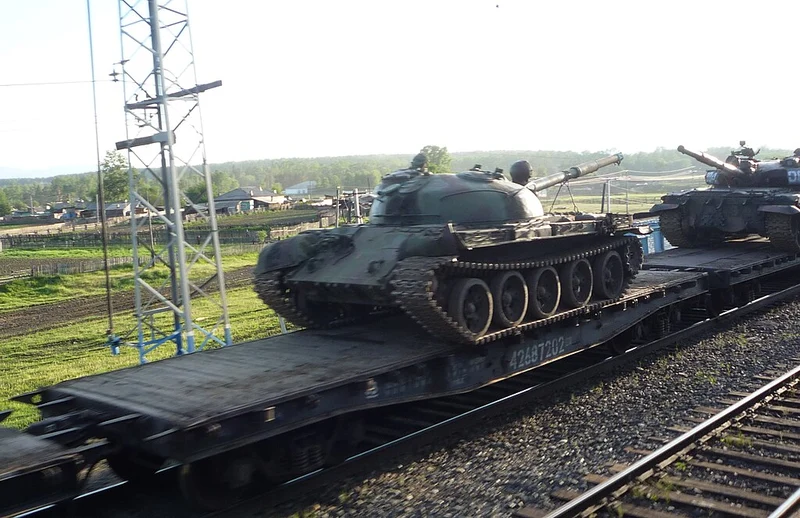
The most recent imagery shows that the storage bases are now almost empty, and the easily repairable examples of the more modern T-72B, T-80 and T-90 models have been exhausted.
As a result, Moscow has been forced to mobilise and modernise older T-72A variants. Interestingly, OSINT analysts predicted back in April 2024 that this situation would not occur until early 2026 – reality, it seems, has arrived much sooner than expected.
While this does not suggest an imminent collapse of the Russian army, the shortage of tanks will have a gradual but noticeable impact on the battlefield. The vehicles withdrawn from storage are first sent to maintenance or refurbishment plants before being deployed to the front.
According to the Oryx database, the Kremlin has already lost more than 4,100 tanks, meaning that the depletion of reserves is becoming an increasingly serious issue.
The factories cannot produce them fast enough
The current pace of production is also insufficient to offset the losses: Russian factories are turning out roughly 90–100 tanks per month, 90 per cent of which are refurbished vehicles.
Only a handful of new, modern T-90M models are being produced. However, the refurbishment of badly deteriorated tanks requires more time and manpower, which could easily slow down overall production.
This situation may force Moscow to rely increasingly on infantry assaults instead of armoured offensives. The shift is already visible on the ground: recent frontline reports mention fewer tank attacks, replaced by vast trench networks, drone-monitored “no man’s lands,” and infantry-led assaults stretching across many kilometres.



oh really? Why then Russia is advansing relentlesly in the battle front?? Russia is gaining territory day by day. Stop watching CNN kid
I’m in the U.S.
You?
I sometimes- not often, but sometimes-watch FOX, too, along with MSNBC, sometimes BBC, and admittedly only a couple times and with incomplete understanding Telemundo (Chicago).
Where would you recommend for neutral reporting on things about the war, starting with the casus belli and continuing into things like bombed maternity hospitals and other civilian deaths?
This is the same old tall tale as Von der Leyen’s who claimed that Russia took dishwashers and refrigerators! As a former armored soldier, I wonder where the famous Abrams tanks of the Ukrainian army are? They were going to be a game changer together with the Leopard 2 and Leopard 1 A5!What’s the deal with the Ukrainian F-16s and the French Mirage 2000? The first four Belgian Air Force F-35s will arrive in Florennes on Monday! Belgium ordered 34 and recently decided to order 11 more!Previous Prime Minister Alexander De Croo promised that Belgium would deliver 30 phased-out F-16s to Ukraine! At the end of August 2024, Belgium’s total debt amounted to €538.17 billion!In the first quarter of 2025, total debt was 106,8% of GDP! This makes Belgium the fourth-largest debt country in the EU! How nice it is that as a politician you can throw around money that was paid for by hard-working citizens! In political jargon, this is called helicopter money! We citizens call it squandering and mismanagement! After their mandate, politicians should not be held accountable for this! For example, they move to Tuscany in a beautiful villa with all the luxury and comfort! After their premiership, they then go to the European Parliament and fill their pockets! What they don’t quite understand is that citizens are developing an aversion to politics? Hypocrites…
Gosh, you make a good point, Ukraine never should have invaded Russia, just like Belgium never should have invaded Germany!
Russia’s summer offensve failed to gain much terrirtory and it incurred huge losses in troops and material. Ukraine has actually made some small gains in some areas. Outside of military production the Russian economy is in sharp contraction with many large factories shifting to four day per week production to avoid layoffs. Russia currently has the highest real interest rates in the world. Recent assessments are that Putin is growing desperate as Russia realizes that the longer the war goes on the more likely that it will lose as Europe gears up its’ own military production. Putin stated that military production is at maximum. They can’t achieve more. Putin therefore is resorting to larger strikes on civilians to demoralize the population and more hybrid attacks on the rest of Europe to divide EU and NATO member states.
https://www.iiss.org/online-analysis/online-analysis/2025/10/the-russiaukraine-war-has-entered-a-new-phase/
Putin relies on the Fidesz government to help spread division and disinformation within Europe with Orban promoting defeatism for a long time with statements that Ukraine has lost. You can see it with the types of comments that crop up in this blog site. Ask yourself, if Russia is so powerful and Ukraine so weak why is Russia unable to achieve victory and has gained so little while its’ economy slides into crisis? Time is no longer on Russia’s side but is on Europe’s side.
If anyone is that keen to get detailed information on the Ukraine war you can look up the daily information posted by the Institute For The Study Of War. It’s pretty dry stuff unless you are a military analyst. The information is quite detailed with front-line maps. I have one suggestion for our Hungary based readers. Change your internet browser search setting to English and then go a step further and change your region to a different region than Hungary – perhaps Germany or UK. Then do your searches on news on Hungary, Ukraine, Russia, Poland etc. You will be out of the Fidesz controlled information world and what you read will be completely different than what you have been getting.
Yeah, yeah, yeah…
Just like Putin was terminally ill back in 2021 and was supposed to drop dead any day. HAHAHAHAHAHAHAHA!!!!!!!!!!!!
The first victim of war is always the truth, as we all know or SHOULD know.
Russia was wrong and Putin is a d..k, but Ukraine is not a paragon of virtue. Zelensky and his gangsters have sold a lot of the aid (see Hugo Wils’ comment above) Ukraine has received and pocketed the proceeds. The whole thing is a giant washing machine.
Indeed, it wouldn’t surprise me if Russia was in on it all. After all, the front line hardly moving for two full years is a bit sus.
I don’t believe anyone anything anymore!
Russia is not running out of tanks or ammunition or troops. Any that believes otherwise is either a gullible person addicted to BBC, CNN, Daily Fail and other purveyors of wishful thinking or worse yet, the Fantasy’s of Frau Ursula Fond of Lying.