
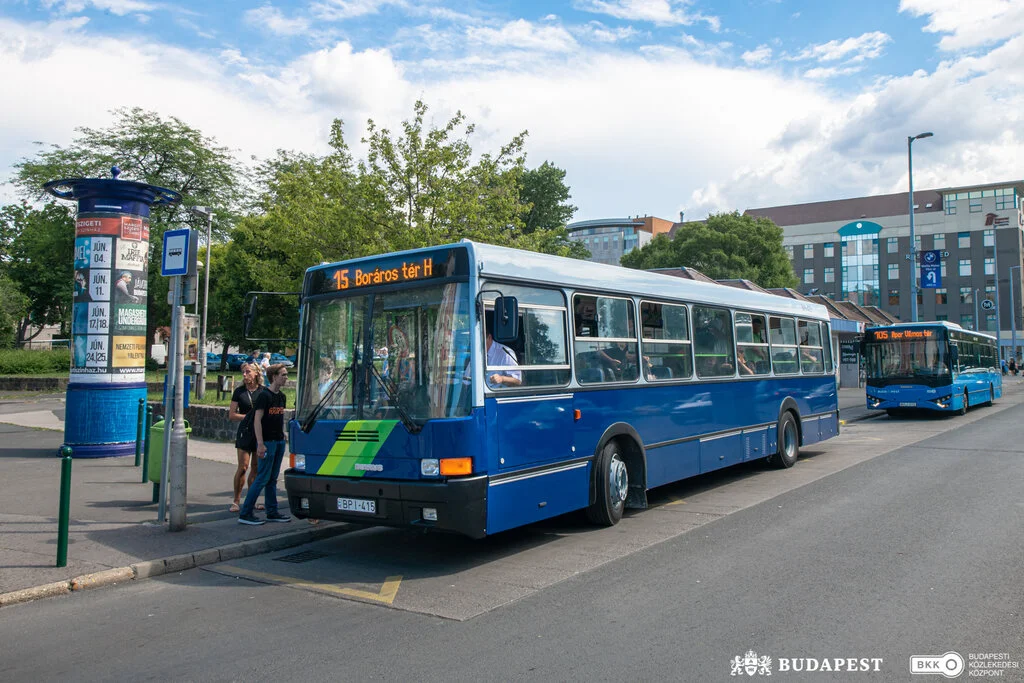
Passengers travelling on Budapest’s buses this summer may have to prepare for increasingly uncomfortable journeys, as many of the city’s ageing vehicles struggle to keep their air conditioning systems running during extreme heat.
According to Budapest transport operator BKV, a significant part of the fleet is equipped with cooling systems that automatically shut down when temperatures climb above 35°C. With Hungary facing another severe heatwave and authorities issuing a third-degree heat alert, the problem is becoming increasingly visible to commuters.
Old technology meets a new challenge
Speaking at a recent meeting of Budapest’s Climate Protection, Transport and Urban Development Committee, László Szedlmajer, BKV’s Deputy CEO for Bus and Trolleybus Operations, explained that the issue affects both old and relatively modern vehicles, reports VG.hu.
In buses more than 20 years old, air conditioning units are often no longer capable of operating efficiently. Many of these systems have reached the end of their service life and would require complete replacement rather than repair. However, upgrading a single vehicle could cost around HUF 10 million (approximately EUR 28,200), an investment BKV currently cannot afford.
The situation is not much better on newer buses. During extreme heat, pressure inside conventional air conditioning systems can rise to levels that trigger the vehicles’ built-in protection mechanisms, automatically switching the cooling off to prevent damage.
Szedlmajer noted that Budapest would ultimately need vehicles equipped with air conditioning systems designed for tropical or desert-like conditions if it wants reliable cooling during increasingly frequent heatwaves.
Nearly 200 buses are over two decades old
The challenge is magnified by the age of Budapest’s fleet. Around 190 of the city’s 862 buses are more than 20 years old, while several vehicles are more than 25 years old. BKV estimates that roughly 39% of its bus fleet is outdated.
Although around 300 new buses entered service in Budapest during the past year, most were acquired by Arriva, a private operator running several routes in the capital. BKV itself was only able to purchase 65 new buses, which feature more reliable cooling systems, writes Népszava.
Transport union leader Gábor Naszályi said cooling urban buses is particularly difficult because doors open frequently at stops, allowing cooled air to escape. Vehicles parked in direct sunlight can also become so overheated that air conditioning systems struggle to reduce temperatures during the journey.
In case you missed it: Budapest’s iconic green bikes are back: New MOL Bubi launches with e-bikes, bigger fleet and free trial rides
Cooling standards leave passengers dissatisfied
BKV conducts thousands of temperature checks during the summer season and says that between 60% and 80% of air conditioning systems are functioning. However, these inspections generally confirm only whether a unit is operating, not how effectively it cools the passenger compartment.
Under the city’s public service contract, buses manufactured after 2002 are considered compliant if interior temperatures are at least 4°C lower than outside temperatures when the mercury exceeds 29°C. In practice, that means a bus can legally reach 31°C inside on a 35°C day.
While technically meeting regulations, many passengers are unlikely to consider such temperatures comfortably cool, highlighting the growing gap between infrastructure designed for Europe’s past climate and the hotter summers now becoming the norm.
Stay up-to-date: Avoid costly mistakes — Budapest Airport taxi scams every tourist should know about




There are expatriate Hungarians who travel from where I am in Canada to Hungary in July and August. I think they are out of their minds. I won’t go any time between mid-June and the second week of September.
Two points:
1. Weren’t the new buses bought from Spain? Surely the Spanish know heat, if anyone does. If they sold us junk buses, then somebody screwed up and I’ll take a wild guess that it was the Communist government of Budapest.
2. Speaking of Communist governments, maybe–just maybe–if Budapest wasn’t allowing for almost everyone to use mass transit for “free,” B.K.K. wouldn’t be broke. You’re a kid? “Free.” You’re a student? “Free.” You’re a senior citizen? “Free.” You’re unemployed? “Free.” You’re disabled? “Free.” You’re got pink hair? “Free.” Seriously, the only people who have to pay for tickets are the long-suffering working folk and the hapless tourists who are bled dry from the moment they get on the 100E bus at the airport.
No Spanish buses, you’re confusing them with CAF trams which are indeed Spanish. The recently purchased buses are mainly from Mercedes, MAN and BYD. And there’s no suggestion that AC on new buses is anything other than effective. AC systems fail long before the engine and transmission are worn out. You only need a tiny leak in a perished hose or from a perished o-ring for the freon gas to escape and first the system becomes weak, then it cuts out altogether.
Steiner you can shut up because it was Fidesz that exercised control over BKV bus purchases. Do some research before you blog your usual shit. AI search:
The Hungarian national government exercises significant practical and regulatory control over bus purchases by the Budapest Transport Company (BKV). While the municipality of Budapest owns the transit operator, the national government heavily influences fleet procurement through funding, approvals, and regulatory actions. The central government uses the Public Procurement Arbitration Board as a political tool to monitor, block, or delay city-led vehicle purchases and international borrowing options. Direct acquisitions frequently depend on national subsidies. For instance, the central government has provided non-repayable grants (like the HUF 3.9 billion subsidy in the past) to enable BKV to purchase zero-emission electric buses.