In 1999, when Vladimir Putin was appointed prime minister, an elderly woman came forward claiming she was his real mother. According to her, the man who later became president had not been raised by his biological parents, who reportedly died of cancer, but by foster parents after she was forced to give him up at the age of ten. The woman, who lived to the age of 96 in Georgia, presented a story that, if true, would cast doubt on Putin’s official birthplace, parentage, and even his Russian citizenship. Experts say, however, that her story fills in the gaps of the president’s incomplete biography.
Gaps and oddities in the official biography
According to official records, Putin’s parents were Vladimir Spiridonovich Putin (1911–1999) and Maria Shelomova (1911–1998). He was born on 7 October 1952 in Saint Petersburg (then Leningrad). His paternal grandfather reportedly worked as a cook for both Lenin and later Stalin, connecting the family to the very core of 20th-century Soviet history.
However, there is a problem with the official narrative: there is almost no information about Putin’s life before 1960. Even more suspicious, according to journalist Krystyna Kurczab-Redlich, is that no one living in the apartment building where Putin supposedly grew up remembers seeing him as a child, or his mother pregnant at all. Given the times, such a pregnancy would have been highly unusual.
Maria Shelomova would have been 41 when Putin was born, and according to statistics cited by economist Zoltán Pogátsa, childbirth at that age was extremely rare in the Soviet Union. Moreover, Putin would have been her third child—his elder brothers, Albert and Oleg, both died in early childhood, one during the Nazi siege of Stalingrad and the other before it.
No one remembered the pregnancy, or the little Vladimir
In a close-knit apartment block, Maria’s late pregnancy and birth would have surely drawn attention, yet residents recalled no such event. According to Kurczab-Redlich, Putin first appeared in 1960 in the arms of Maria, who claimed he was her son and asked local children not to bully him.
The missing pieces in Putin’s biography seem to fit the story told by an elderly Georgian woman, Vera Nikolaevna Putina, who spoke out after his appointment as prime minister. Born in 1926, Vera claimed that she had given birth to the future president in 1950 after a relationship with a student named Platon Privalyov, who was already married at the time. When his wife found out, he was expelled, and Vera was left to raise her child alone.
She later returned to Tashkent to continue her electrical engineering studies, where she married a Georgian soldier named Giorgi Osepashvili. They had two children together but struggled financially. Her new husband reportedly abused the boy and blamed him for their poverty.
A bright child who suddenly disappeared
Locals in Metekhi, where Vera lived, remember “little Vova” as a bright, diligent pupil who loved fishing, wrestling, and the Russian language. One of his teachers told The Telegraph in 2008 that although he was the shortest boy in the class, he always wanted to win.
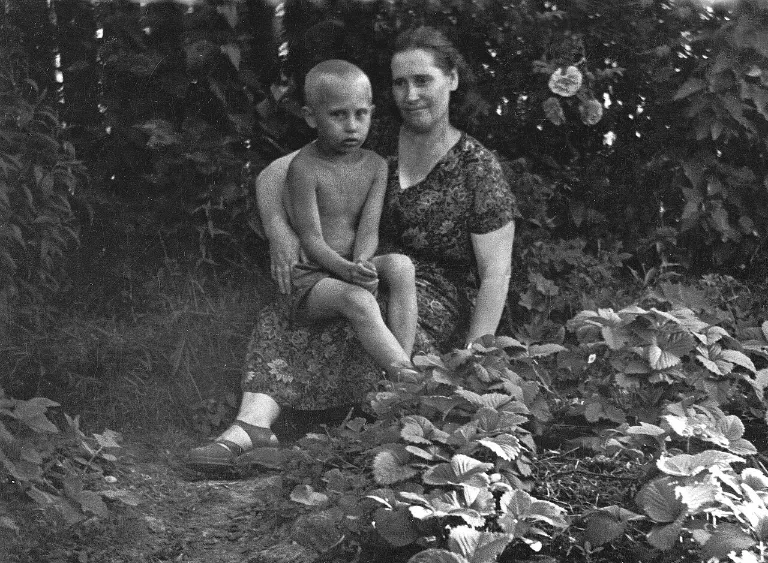
Marija Shelomova with little Putin in her arms in July 1958. At least according to the woman’s statement. However, according to Vera Putin, little Putin was still attending school in the small Georgian town that year and the following year, and only moved to St. Petersburg to live with the Shelomovas in 1960. Photo: Wikimedia Commons
However, when the abuse became unbearable, Vera sent him to her parents in Saint Petersburg around 1960, when he was ten. According to Kurczab-Redlich, she did not even hug him goodbye for fear her heart would break. She later explained that people in the village called the boy a “bastard,” and her new husband could not tolerate him. “If he had stayed in Metekhi, he would have become nobody, let alone president,” she reportedly said.
Investigating Putin’s origins has proven to be dangerous. After the 2000 presidential election, two journalists who delved into the story died under suspicious circumstances: Russian reporter Artyom Borovik died in a plane crash en route to Kyiv, while Italian journalist Antonio Russo was shot dead.
Kurczab-Redlich said the teachers from Metekhi were later warned to keep quiet about the boy, and Chechens allegedly even attempted to kidnap the supposed biological mother for a ransom of half a million dollars. Still, several people managed to visit the village, and a Dutch filmmaker even shot a documentary there.
According to Pogátsa, Vera repeatedly offered to take a DNA test after 1999, but Putin never agreed. She passed away in May 2023, aged 96, and was buried in Metekhi—meaning that comparison would still be possible today. Locals there still remember “little Vova,” the bright boy who one day simply vanished. Meanwhile, in Leningrad, memories of Putin only begin with his teenage years. Pogátsa also noted a curious coincidence: Putin’s childhood nickname in Leningrad referred to his waddling walk—something that, according to witnesses, also characterised Vera.



 ZH
ZH IT
IT DE
DE